
World Collapse: The Icarus Engine
Systems Dynamics of Industrial Overshoot

While the World3 Model from the Club of Rome is a remarkable development, it can be somewhat overwhelming and easy to get lost in. Here’s something a bit simpler that one might be able to grasp. Here’s an Insight Maker version of World3 by Scott Fortmann-Roe, which should make the point.
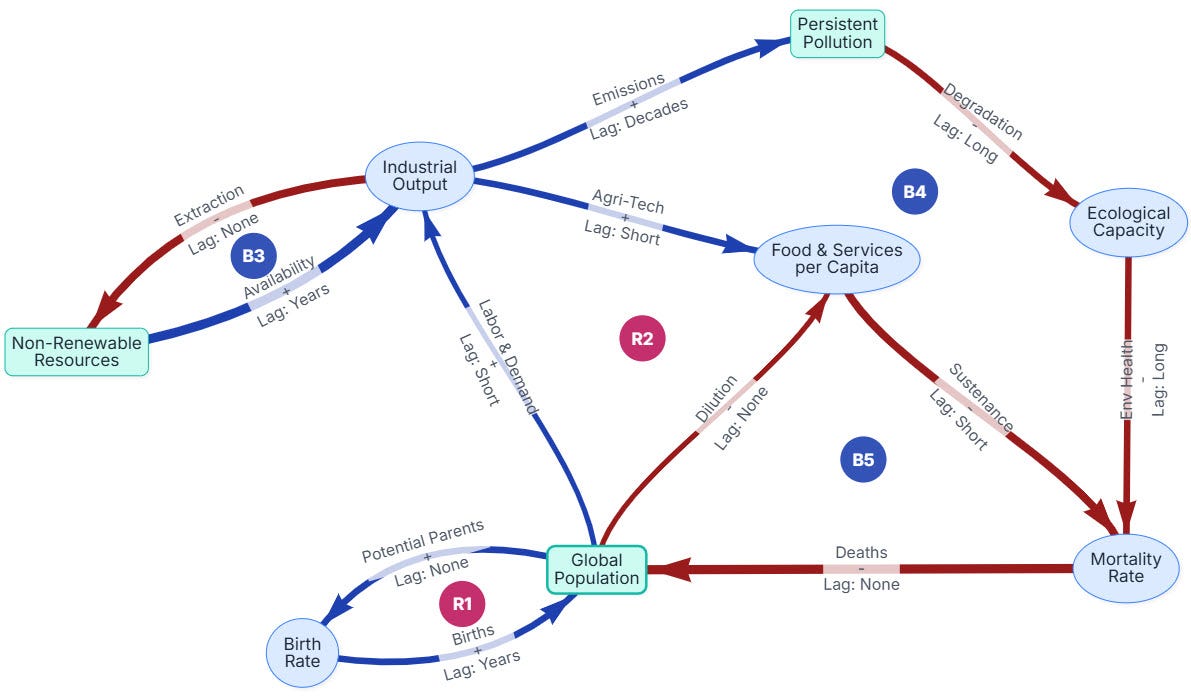
Download an HTML version of the model if you’d like to read all the nodes, edges, and loops.
Scenario Analysis: The Four Futures of the Industrial Loop
Based on the structure of the Industrial Acceleration Loop model—specifically the delays inherent in Ecological Collapse (B4) and the hard constraints of Resource Limits (B3)—here are the four most likely probabilistic futures.
These probabilities imply that without significant structural change (system redesign), the “default” behavior of the system leans heavily toward collapse rather than equilibrium.
Future 1: The Resource Cliff (Overshoot & Collapse)
Probability: 40%
This is the standard “Business as Usual” run where the system hits the supply-side wall.
The Narrative: The Industrial Acceleration (R2) loop continues to drive exponential growth in output and population. However, the system is essentially burning its furniture to keep the house warm. Because Non-Renewable Resources (n2) are finite, the Industrial Resource Limit (B3) is triggered abruptly.
Loop Dynamics:
R1 & R2 drive rapid upstream growth.
B3 acts as the primary braking mechanism.
B5 (Malthusian Check) follows quickly: As industry crashes due to lack of resources, agricultural inputs vanish, and the population is forced down by starvation.
The Outcome: A sharp peak in the mid-21st century followed by a rapid decline in industrial output and population. Pollution is not the primary killer; scarcity is.
Future 2: The Toxic Sink (Delayed Collapse)
Probability: 35%
This scenario assumes we successfully solve the resource problem (e.g., fusion energy, asteroid mining, extreme recycling) but fail to address the waste problem.
The Narrative: Technological advances weaken the Industrial Resource Limit (B3), effectively removing the supply constraint. This allows Industrial Acceleration (R2) to run longer and harder. However, because we haven’t curbed the waste outputs, Persistent Pollution (n4) accumulates to critical levels.
Loop Dynamics:
B3 is deactivated (or significantly delayed).
R2 continues to drive Industrial Output (n3) higher.
B4 (Ecological Collapse) becomes the dominant failure mode. Because the delay in e11 (Degradation) is “Long,” the system overshoots its safe pollution limit massively before mortality rises.
The Outcome: The population grows higher than in Future 1, but the crash is deeper and harder to recover from because the Ecological Capacity (n8) is permanently damaged.
Future 3: The Managed Plateau (Stabilization)
Probability: 20%
This requires a deliberate intervention to weaken the reinforcing growth loops before the balancing loops force a correction.
The Narrative: Through global policy and cultural shifts, society voluntarily limits R1 (Population Growth) and R2 (Industrial Acceleration). This is not a technological fix, but a “goal-seeking” adjustment where sufficiency replaces maximization.
Loop Dynamics:
R1 slows down (lower Birth Rate).
R2 decouples happiness/services from material industrial throughput.
B3 and B4 are approached asymptotically (smoothly) rather than exponentially (violently).
The Outcome: Industrial output and population level off at a standard that the Ecological Capacity (n8) can support indefinitely. The “Hard Landing” of B5 is avoided.
Future 4: The Techno-Decoupling (The Optimist’s Path)
Probability: 5%
This scenario assumes we can break the causal links in the physical reality of the model.
The Narrative: Radical invention allows for “dematerialization.” We achieve high Food & Services (n5) with near-zero Resources (n2) usage and near-zero Pollution (n4) generation.
Loop Dynamics:
The edge e4 (Extraction) is severed (Industry no longer needs non-renewables).
The edge e10 (Emissions) is severed (Industry no longer pollutes).
R1 and R2 become infinite growth loops, constrained only by physical space or heat dissipation.
The Outcome: Continuous exponential growth. This is statistically unlikely because it requires the negation of thermodynamic laws (entropy) represented by B3 and B4, rather than just their management.
First Principles, Core Wisdom & Leverage Points
Based on our discussion regarding the Industrial Acceleration Loop model, the reordering of its narrative arc, and the probabilistic scenario analysis, here is the synthesis using your requested framework.
First Principles
Finite Stocks are Non-Negotiable: The system is grounded in physical reality. Non-Renewable Resources (n2) and Ecological Capacity (n8) are finite stocks. You cannot draw from a finite source or fill a finite sink indefinitely without triggering a system state change (collapse).
Delays Distort Reality: The system contains critical delays, particularly in the feedback loop of pollution (e.g., e10 and e11). These delays uncouple the action (industrial output) from the consequence (mortality), creating a temporal gap where the system appears healthy while actually being in a state of terminal overshoot.
The Primacy of Exponential Growth: The two reinforcing loops (R1 Population and R2 Industrial Acceleration) are positive feedback engines. In the absence of immediate constraints, they will always grow exponentially, doubling at fixed intervals until they hit a wall.
Core Wisdom
The Aha! Paradox: The very mechanism we built to defeat the Malthusian trap—Industrial Acceleration (R2)—is the engine that ensures a more catastrophic collapse later. By artificially suppressing mortality (n6) without limiting fertility (n7), we essentially disabled the system’s “brakes” while accelerating the “engine,” ensuring that when we finally hit the wall (B3 or B4), we do so at maximum velocity.
The Efficiency Trap: By optimizing the system for maximum Industrial Output (n3) to support a growing population, we removed all slack. A system without slack is brittle; when the Resource Limit (B3) is hit, there is no buffer, causing the rapid transition from “Rise” to “Collapse” seen in Future 1 (The Resource Cliff).
Overshoot is Invisible: Because of the delays identified in First Principles, the point of no return is passed long before the negative consequences are felt. The system can be in “overshoot”—carrying more people than the planet can sustain—for decades before the Ecological Collapse (B4) loop closes.
Leverage Points
Goals (The Paradigm Shift): The highest leverage point lies in Future 3: The Managed Plateau. This requires shifting the system’s goal from Maximizing Output (n3) to Stabilizing Welfare (n5). If the goal of the system is “more stuff,” R2 will eventually destroy the system. If the goal is “sufficiency,” the loops can be balanced voluntarily.
Rules (Internalizing Externalities): We must artificially shorten the delay in B4 (Ecological Collapse). If the cost of pollution and degradation were felt immediately by the industrial actors (through tax, regulation, or pricing), the system would self-correct before hitting the physical limit.
Structure (Decoupling): We must structurally alter Edge e4 (Extraction). Moving from “Extraction” to “Regeneration” (circular economy) breaks the B3 (Resource Limit) loop. However, this is only a partial solution if R1 (Population) continues unchecked. Ultimately, the inflow to n1 (Global Population) must be balanced with the system’s carrying capacity by choice (Lower Birth Rate) rather than by force (Higher Mortality Rate).
I’ve often wondered if the focus changed from extraction to sufficiency, would we advance as a society? Would scientific advances upset the balance? Maybe not if making a profit from such advances were not possible. Guess I should try building a model to examine the idea. 😆
Gene - this feels like one of the keystone models. The level of detail / simplicity seems just right. It occurs to me that most presentations are to an individual stakeholder group and that while one might show the entire model, the main focus is on the loop that they might be able to influence. I have been focused on population since the early 1950s in my 2nd year of high school. Took a coure in demography in college as part of my major in Earth Sciences / Geography in trying to figure out how the world worked and chose city, regional, national and world planning as sequential interests. Is there a place that I can see the html for the entire World3 model? Would it work to show the entire model and then to focus on the more detailed look relevant to a specific stakeholder group one is supporting to understand their future scencio and future options?