
Broken Society: A Deeper Dive

Analysis of the “Broken Society” Causal Loop Diagram
This document provides a comprehensive systems analysis of the “Broken Society” model. The model illustrates the interconnected nature of social, political, and economic factors that contribute to either societal decline or stability.
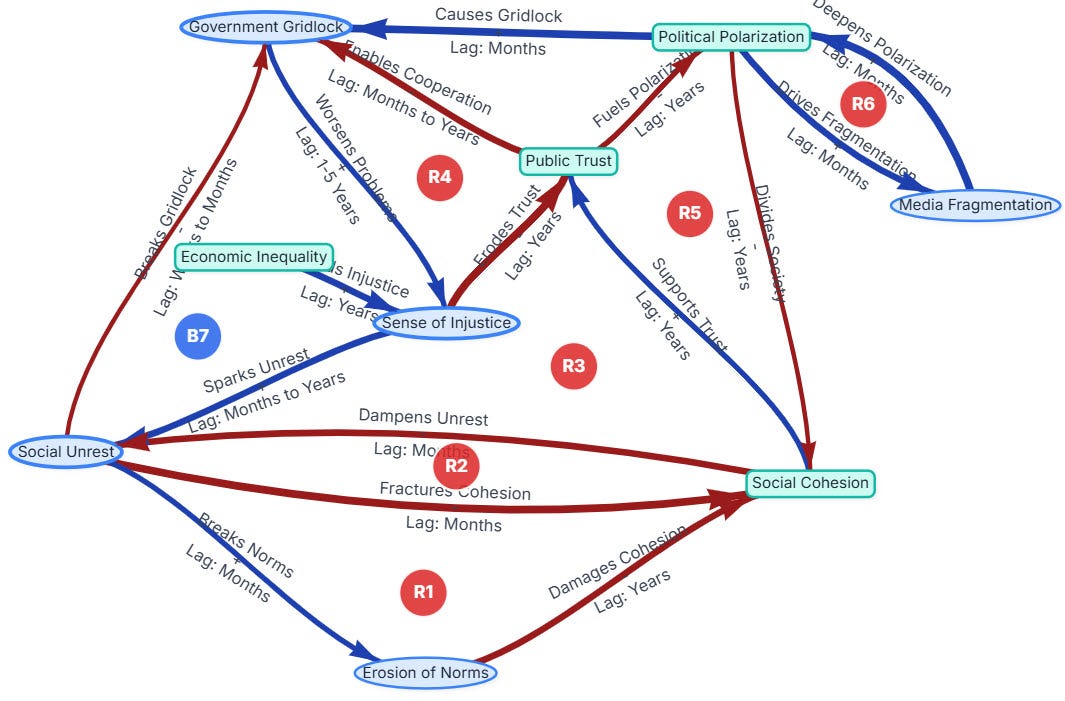
Model Explanation
The “Broken Society” model is a dynamic representation of how a society’s health can unravel. It posits that key societal stocks—Public Trust, Social Cohesion, Economic Inequality, and Political Polarization—do not exist in isolation. Instead, they are interconnected by a series of feedback loops. The model’s central thesis is that when negative reinforcing loops (vicious cycles) gain dominance, they can erode trust and cohesion at an accelerating rate, leading to systemic dysfunction. Conversely, balancing loops represent the system’s potential for self-correction and stabilization.
The primary drivers in the model are factors like Economic Inequality and Political Polarization, which create a Sense of Injustice and lead to behaviors like Social Unrest. The health of the system hinges on its ability to counteract these reinforcing spirals through mechanisms that rebuild trust and enable effective governance.
Source: Broken Society
Wisdom
The core wisdom of this model is that the functional integrity of a society is an emergent property, not a simple sum of its parts. Trust and cohesion are the invisible operating system of a healthy society. They are not merely outcomes but critical stocks that enable cooperation, problem-solving, and resilience. When these stocks are depleted, the system shifts from a state of stable self-regulation to one of self-reinforcing decay. The model teaches that focusing on isolated symptoms (like Social Unrest) without addressing the underlying feedback structures that erode trust is a losing battle. True stability comes from nurturing the loops that build and sustain trust and cohesion.
Donella Meadows’ Leverage Points
Applying Donella Meadows’ framework helps identify the most effective places to intervene in the system.
The Power to Transcend Paradigms (Highest Leverage): The single most powerful leverage point is to change the shared mindset or paradigm that governs the system. The model is currently driven by a paradigm of zero-sum conflict (partisan victory, short-term economic gain). Shifting this to a paradigm of shared destiny and collective well-being would change the goals of the actors within the system, fundamentally altering its behavior. It involves recognizing that
Social CohesionandPublic Trustare not byproducts but essential goals to be actively pursued.The Goals of the System: Directly related to the paradigm, changing the explicit goals of institutions would be a high-leverage intervention. For example, shifting the goal of media from capturing audience engagement (which
Media Fragmentationexcels at) to fostering shared understanding would weaken the vicious “Polarization Spiral” (R2).The Structure of Feedback Loops (Strengthening & Weakening): This is a powerful, tangible leverage point.
Weaken Reinforcing Loops: Interventions should focus on disrupting the vicious cycles. For instance, campaign finance reform could reduce the influence of wealth on politics, weakening the link between
Economic InequalityandPolitical Polarization. Independent media initiatives could break theMedia Fragmentation->Political Polarizationcycle (R2).Strengthen Balancing Loops: The “Corrective Action” loop (B1) is society’s emergency brake. Strengthening it means making governance more responsive to
Social Unrest, so that legitimate grievances are addressed before they escalate. This involves electoral reform, anti-corruption measures, and increasing civic engagement.
Delays: The model is fraught with delays. The negative impacts of
Government GridlockonSense of Injusticetake years to fully manifest. Public awareness campaigns can shorten these perception delays, making the consequences of inaction more immediately apparent and strengthening the pressure for corrective action.Parameters (Lower Leverage): These are numerical adjustments within the existing structure. Examples include changing tax rates to mitigate
Economic Inequality, adjusting the length of political terms, or regulating social media algorithms. While important, they are less powerful than changing the underlying loop structures or goals.
Knowledge
The model provides specific, actionable knowledge about the system’s structure:
Public Trust is the System’s Keystone: We know that
Public Trustis the most interconnected node. It is negatively impacted bySense of Injusticeand lowSocial Cohesion, and its depletion is a prerequisite for the acceleration of multiple vicious cycles, including the “Distrust Spiral” (R3) and the “Cohesion-Polarization Spiral” (R6).Polarization is an Accelerant: We know that
Political PolarizationandMedia Fragmentationcreate a fast-acting, tightly-coupled reinforcing loop (R2) that feeds itself. Once it gains momentum, it is exceptionally difficult to stop and acts as an engine for further decay.Gridlock is a Symptom and a Cause: The model shows that
Government Gridlockis both a result of low trust and polarization and a direct cause of the worseningSense of Injusticethat further erodes trust. It is a central transmission mechanism in the system’s failure.
Systems Archetypes
Two primary systems archetypes are visibly at play in this model:
Tragedy of the Commons: The “commons” is the shared, vital resource of Public Trust and Social Cohesion. Multiple actors or groups (e.g., political parties, media outlets, economic elites), pursuing their own short-term interests, engage in behaviors that fuel polarization and inequality. These actions individually benefit the actor but collectively deplete the commons of trust, leading to long-term systemic collapse (
Government Gridlock,Social Unrest) that ultimately harms everyone.Success to the Successful: This archetype is driven by
Economic Inequality. Those with initial economic advantages can leverage their resources to influence the political system and media narratives. This influence allows them to secure policies that further enhance their economic position, systematically draining resources and opportunities from less successful groups. This reinforces the initial inequality and fuels theSense of Injusticethat destabilizes the entire structure.
Primary Principles
Reinforcing Feedback: The model is dominated by multiple vicious reinforcing cycles (R2, R3, R4, R5, R6, R7) that create exponential decay. “The Polarization Spiral” and “The Distrust Spiral” are prime examples where division and cynicism feed on themselves.
Balancing Feedback: The “Corrective Action” loop (B1) is the primary balancing force, where social unrest can create enough pressure to force a response. However, its effectiveness is questionable.
Shifting Dominance: A key dynamic is the shifting dominance from a once-stable system (where balancing loops kept things in check) to a dysfunctional one where the reinforcing “death spirals” have become the primary drivers of system behavior.
Delays: Critical delays throughout the system (e.g., the time it takes for gridlock to increase injustice, or for injustice to erode trust) mean that by the time problems become obvious, the underlying causes are deeply entrenched and much harder to reverse.
Key Insights
Public Trust is the central pivot. Its decline is the clearest leading indicator of systemic breakdown. Efforts to address any other variable will likely fail if they do not, directly or indirectly, contribute to rebuilding trust.
The system contains multiple, interconnected “vicious cycles” that, once activated, can create a rapid and accelerating decline in societal function. The loops around polarization, trust, and cohesion are particularly potent.
The “natural” self-correcting mechanism, the “Corrective Action” loop (B1), may be too slow and require a dangerously high level of
Social Unrestto activate, making it an unreliable safeguard.The link between
Media FragmentationandPolitical Polarization(R2) acts as a powerful accelerant, making it a key strategic point for intervention.
Future Implications
Based on the current structure, the model suggests three potential futures:
Accelerated Collapse: If the reinforcing loops continue to dominate, the model predicts a future of increasing polarization, chronic government gridlock, falling public trust, and escalating social unrest, leading to a state of permanent crisis or the fracturing of the social contract.
Low-Level Stagnation: Interventions might be strong enough to slow the reinforcing loops but not reverse them. This would lead to a dysfunctional equilibrium characterized by low trust, high inequality, and persistent political gridlock, where the system fails to solve major problems but avoids outright collapse.
Renewal and Transformation: A conscious and sustained effort to intervene at high-leverage points—primarily by shifting the system’s paradigm and goals toward collective well-being and strengthening the loops that build trust (like R5)—could weaken the vicious cycles and turn them into virtuous ones, leading to a period of societal renewal.
Synthesis: Core Wisdom & Highest Leverage Point
Core Wisdom: The stability of a society is not determined by its economic output or political structure alone, but by the quality of its feedback loops. Trust is the currency of a functional society. When the mechanisms for building trust and cohesion fail, they are replaced by powerful, self-reinforcing engines of division and decay.
Highest Leverage Point: The highest point of leverage is not a specific policy but a paradigm shift. It requires transcending the governing mindset of zero-sum conflict—where one party’s gain is another’s loss—and elevating the shared goal of fostering social cohesion and public trust above all others. This means re-engineering institutions (media, political, economic) to be rewarded not for dividing people or concentrating wealth, but for bridging divides and creating shared prosperity. Intervening at this level of purpose is the only way to fundamentally alter the trajectory of all the interconnected loops and reverse the spiral of a broken society.
I have a concern when I read this diagram. I believe that the human nature problem throughout civilization as documented by Luke Kemp and his book the curse of Goliath is that the smart and strongest people accumulate the wealth and power for themselves and the more they have the more they want until the structure becomes brittle and the civilization collapses. If indeed incoming inequality is one of the most important variables, this diagram really misses that point. Research on those countries that have the best distribution of wealth are those that at one time were hit with some large catastrophe like a plague, famine or world war like Japan, Germany, generally north Europe, especially Scandinavia and it was also true in the United States after the Great Depression we had a period where we distributed the wealth better but now the rich are again In Control. The diagram misses this and therefore I think is misleading. It's the income inequality which causes most of the other factors diagram. For instance, the wealthy by the government.. the wealthy by the media. The wealthy destroy democratic institutions because when everybody votes, they would vote to distribute the money from the wealthy to the poor and the wealthy. Don't want the poor to vote because they call that socialism. I call a democracy. The wealthy, libertarian and Peter Thiel and others say the democracy and freedom cannot go together because in his mind, freedom is the freedom to do whatever you damn pleased without regulation by the government. So I think we need more Care in the way we set up our call loop diagrams. There is inherently a value system, and a hypothesis, even in the initial construction of cause a loop diagram and how it's put together. Here to four I've been rather blind to this foundational value system. In future, I would build a Cole loop diagram to understand how to build the desirable variable that we're focussing on. For instance, what are the factors that contribute to building a sound democracy which of of course relies on social cohesion and trust.
In an effort to get my emails to talk with each other outside my head This reminded me of this thoughful piece Perhaps healing a broken world https://richarddavidhames.substack.com/p/a-decolonised-world. WHat is your closest posting?