
Wicked Problems: A Deeper Dive

Comprehensive Analysis of the Wicked Problems Causal Loop Diagram
This document provides a detailed analysis of the Causal Loop Diagram (CLD) for “Wicked Problems,” examining its structure, dynamics, and the insights it offers for effective intervention.
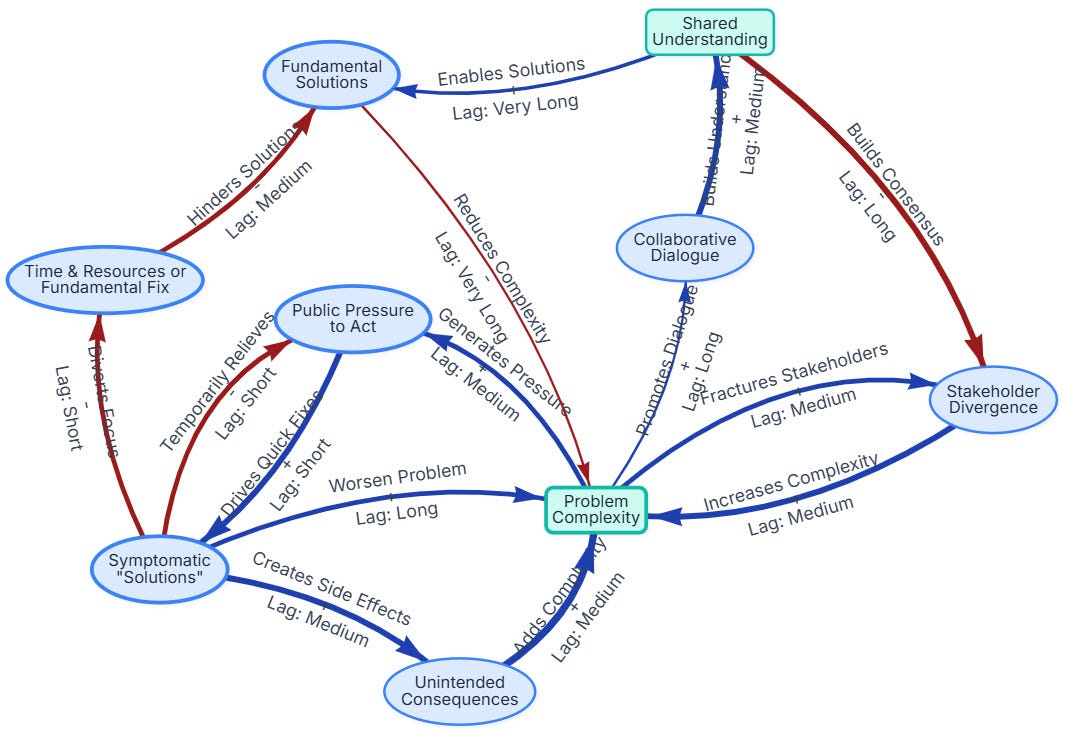
1. Model Explanation
The model illustrates why “wicked problems”—such as climate change, systemic poverty, or political polarization—are so persistent and resistant to solutions. It visualizes a system caught in a trap where the immediate and politically necessary responses to a problem’s symptoms actively undermine the long-term, fundamental solutions required to address its root causes.
The central dynamic revolves around the growth of Problem Complexity (a stock). As this complexity increases, it creates Public Pressure to Act. This pressure invariably leads to the implementation of fast-acting Symptomatic “Solutions”, which provide temporary relief. However, these quick fixes consume finite Time & Resources and often create Unintended Consequences, which ultimately feed back to make the initial Problem Complexity even worse. This structure creates a “Shifting the Burden” archetype, where the system becomes addicted to ineffective short-term fixes.
The only way out of this trap, as modeled, is through the slow and difficult process of Collaborative Dialogue, which builds Shared Understanding. This is the sole pathway that enables the development of Fundamental Solutions capable of reducing the underlying Problem Complexity over the long term.
Source: Wicked Problems (Archetypes Experimental)
2. Wisdom
The core wisdom of this model is that a system is perfectly structured to get the results it gets. Wicked problems persist not because of a lack of potential solutions, but because the system itself is structured to favor reactive, symptomatic interventions over proactive, fundamental ones. The constant pressure for immediate results creates an “addiction to the fix” that starves the real solutions of the resources and consensus they need to succeed.
True wisdom, therefore, lies not in finding a single “silver bullet” solution, but in changing the structure of the system itself. This means shifting the primary goal from appearing to solve the problem quickly to building the collective capacity to understand and address its complexity. The problem isn’t the problem; the way we are collectively organized to deal with the problem is the problem.
3. Donella Meadows’ Leverage Points
Analyzing the model through the lens of Donella Meadows’ “12 Leverage Points to Intervene in a System” reveals where efforts can be most effective.
9. The Length of Delays (Low-Medium Leverage): The model is filled with significant delays (e.g., the lag between implementing a fundamental solution and seeing a reduction in problem complexity). Shortening these feedback delays—for example, through better monitoring and faster reporting—can improve the system’s ability to learn, but it doesn’t change the underlying addictive structure.
6. The Structure of Information Flows (Medium Leverage): Intervening here involves creating new channels for information and ensuring all stakeholders have access to a shared pool of knowledge. This directly supports the Collaborative Dialogue node (n9). By improving who has access to information about the problem’s complexity and the failure of past symptomatic solutions, you can strengthen the push toward building Shared Understanding.
3. The Goal of the System (High Leverage): This is one of the most powerful leverage points in the model. The implicit goal of the system as modeled is to “reduce public pressure.” This goal is served perfectly by the “Symptomatic Fix” loop (B1). A transformative intervention would be to consciously and explicitly change the goal of the system to “increase shared understanding.” If the primary objective of task forces, funding, and political effort was to facilitate collaborative dialogue and sense-making, the system’s resources would naturally shift from symptomatic fixes (n4) to the activities that enable fundamental solutions (n9, n6, n7).
2. The Mindset or Paradigm Out of Which the System Arises (Highest Leverage): The highest leverage point is to transcend the paradigm that complex problems can be “solved” by a single entity with a top-down, engineered solution. This model shows the fallacy of that approach. The paradigm shift is to see intervention not as providing an answer, but as facilitating a process. It’s the shift from “we need a solution” to “we need a better way of seeing the problem together.” Embracing this paradigm of collaborative sense-making makes the goal of “increasing shared understanding” the only logical path forward.
4. Knowledge
Systems Archetypes: The dominant archetype is Shifting the Burden.
The Problem: Problem Complexity (n1).
The Symptomatic Solution (B1): Public Pressure (n2) leads to Symptomatic Solutions (n4), which temporarily relieve the pressure.
The Fundamental Solution (B3): Problem Complexity (n1) drives Collaborative Dialogue (n9), which builds Shared Understanding (n6), enabling Fundamental Solutions (n7) that finally reduce the complexity.
The “Side Effect” (R1, R3): The focus on the symptomatic solution creates unintended consequences (R1) and diverts resources from the fundamental solution (R3), making the original problem worse and strengthening the addiction to the quick fix.
Primary Principles:
The Easy Way Out Leads Back In: The symptomatic solution (B1) is faster and politically easier, but it always leads back to a worse problem state through reinforcing loops R1 and R3.
Behavior Grows Better Before it Grows Worse: Symptomatic solutions provide immediate relief (pressure goes down), making them appear successful, while the negative impacts (worsening complexity) are delayed and disconnected from the cause.
Cause and Effect are Not Closely Related in Time and Space: The very long delay between implementing a fundamental solution and seeing its effect makes it a politically and socially difficult path to follow. The system rewards the fast, ineffective action and punishes the slow, effective one.
5. Key Insights
The most common response to a wicked problem—addressing the loudest symptom—is almost always a trap that makes the problem worse in the long run.
The “problem” is often not a technical issue but a social one, rooted in the Stakeholder Divergence that prevents consensus and collective action.
Time and Resources are the critical finite resources. When spent on symptomatic fixes, they are unavailable for the fundamental solutions, creating a zero-sum dynamic.
Collaborative Dialogue is not a “soft” activity; in this model, it is the essential engine that drives the entire fundamental solution pathway. It is the most critical work to be done.
The model suggests that if systems continue to operate in their current paradigm, wicked problems will become exponentially more complex. The reinforcing loops (Problem-Response Trap, Stakeholder Fragmentation, Fixes That Fail) will dominate, leading to a state of perpetual crisis management where society lurches from one failed symptomatic solution to the next.
6. Future Implications
However, the model also illuminates a path forward. The future viability of addressing these challenges depends on our ability to elevate the importance of the balancing loops. This requires a societal investment in the processes and platforms that facilitate Collaborative Dialogue and build Shared Understanding. It implies a shift in leadership from providing answers to asking better questions and from making decisions to facilitating collective sense-making.
7. Synthesis: Core Wisdom & Highest Leverage Point
Core Wisdom: Wicked problems are not solved; they are navigated. The goal is not to find the “right” solution but to improve the system’s capacity to learn, adapt, and act wisely in the face of deep complexity and division. The most significant barrier is not the absence of a solution, but the absence of the shared perspective needed to implement one.
Highest Leverage Point: The single highest point of leverage is to change the goal of the intervention process itself. We must shift the goal from the deceptively simple “solve the problem” to the more profound and effective goal of “facilitate and resource the process of building shared understanding.” By making collaborative sense-making the primary objective, we weaken the “Shifting the Burden” trap and activate the slow, powerful balancing loops that offer the only sustainable path forward.