
US Tourism: A Deeper Dive

Analysis of the US Tourism Causal Loop Diagram
This document provides a detailed analysis of the Causal Loop Diagram (CLD) for the US Tourism system. It explores the model’s structure, identifies key feedback loops and archetypes, discusses leverage points for intervention, and synthesizes the core insights and wisdom derived from the model.
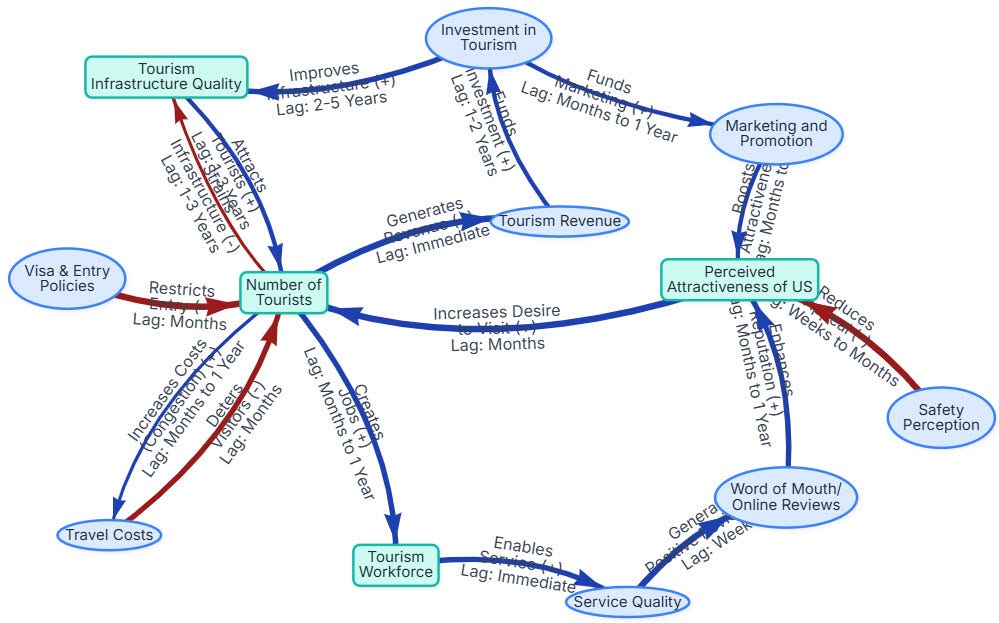
1. Model Explanation
The model centers around the primary stock, Number of Tourists, which represents the volume of tourism in the United States. The system’s behavior is driven by a series of interconnected feedback loops that either promote growth (reinforcing loops) or constrain it (balancing loops).
Reinforcing (R) Loops - The Engines of Growth:
R1 (The Growth Engine Loop): This core loop shows that more tourists generate more revenue, which funds investment in tourism infrastructure. Improved infrastructure then attracts even more tourists.
R2 (The Marketing Loop): This loop illustrates how tourism revenue also funds marketing and promotion, which enhances the perceived attractiveness of the US, thereby drawing in more visitors.
R3 (The Service Quality Loop): This loop demonstrates that a higher number of tourists creates jobs, expanding the tourism workforce. A larger, more experienced workforce can deliver higher service quality, leading to positive reviews and word-of-mouth, which boosts the nation’s attractiveness and attracts more tourists.
Balancing (B) Loops - The Limiting Factors:
B1 (The Crowding Loop): As the number of tourists grows, it increases demand for limited resources like flights and hotels, driving up travel costs. These higher costs eventually make the destination less affordable, deterring new visitors and limiting growth.
B2 (The Infrastructure Strain Loop): An excessive number of tourists can strain infrastructure (overcrowded airports, traffic, wear on attractions), reducing its quality. A decline in infrastructure quality makes the destination less appealing, which eventually reduces tourist numbers.
External factors like Visa & Entry Policies and Safety Perception act as direct influences on the system, capable of either enabling or restricting the flow of tourists.
Source: US Tourism (Archetypes Experimental)
2. Wisdom
The core wisdom of this model is that the success of a tourism system, if left unmanaged, sows the seeds of its own decline. Growth is a double-edged sword; the very factors that make a destination popular (accessibility, reputation) are strained by the growth they create. Sustainable success is not achieved by maximizing one variable (like Number of Tourists) but by balancing the reinforcing growth engines with the health of the system’s limiting factors, such as infrastructure, service quality, and affordability.
3. Donella Meadows’ Leverage Points
Analyzing the model through the lens of Donella Meadows’ 12 leverage points reveals where interventions could be most effective, from weakest to strongest.
12. Constants, parameters, numbers: (Weakest Leverage) Adjusting numerical values like the annual marketing budget (
v4) or the specific percentage of revenue reinvested (v2). While easy to change, these offer low leverage as they don’t alter the system’s behavior fundamentally.9. Length of delays: (Moderate Leverage) The delays between investment (
v2) and improved infrastructure (n2), or between poor service (v5) and a damaged reputation (v7/n3), are critical. Shortening the delay for infrastructure improvements or public relations responses could significantly enhance the system’s resilience.7. Strength of balancing feedback loops: (High Leverage) This is a powerful leverage point. The system’s long-term health depends on the strength of the “Crowding” (B1) and “Infrastructure Strain” (B2) loops. Interventions like dynamic pricing to manage peak demand (strengthening B1) or implementing tourist taxes to fund maintenance (strengthening B2) can prevent the system from overshooting its capacity.
6. Strength of reinforcing feedback loops: (High Leverage) Intervening here can either accelerate or decelerate the primary system behavior. In a phase of desired growth, policies could strengthen the “Growth Engine” (R1) through tax incentives for hotel construction. Conversely, if the system is overheating, one might slow this loop by, for example, placing zoning restrictions on new tourism developments.
5. Information flows: (High Leverage) The system’s behavior changes drastically depending on who has access to what information. Ensuring that policymakers and investors see clear, real-time data connecting the rising Number of Tourists (
n1) to the declining Tourism Infrastructure Quality (n2) and rising Travel Costs (v3) is crucial for triggering timely action in the balancing loops.4. The rules of the system: (Higher Leverage) This involves changing the fundamental rules that govern the system. Visa & Entry Policies (
v6) are a prime example. Making visas easier or harder to obtain directly changes the system’s structure and has a high-leverage impact on the flow of international tourists.3. The power to add, change, evolve, or self-organize system structure: (Higher Leverage) This could involve creating new institutions or feedback loops. For instance, establishing a national infrastructure fund specifically seeded by a tourism tax would create a new, powerful link between the problem (strain) and the solution (investment), enhancing the system’s ability to self-correct.
2. The goals of the system: (Highest Leverage) The most powerful leverage point. Is the goal simply to maximize the Number of Tourists and Tourism Revenue in the short term? Or is the goal to optimize for sustainable, high-quality tourism that provides long-term economic benefits while preserving infrastructure and visitor experience? Shifting the goal from pure quantity to balanced quality would fundamentally alter every decision made within the system.
4. Knowledge
The model codifies the following key relationships and facts about the US tourism system:
Tourism is driven by three main reinforcing engines: infrastructure investment, marketing, and service quality/reputation.
Growth is naturally limited by two primary factors: rising costs due to demand (crowding) and degradation of infrastructure from overuse.
Key stocks act as buffers:
Tourism Infrastructure Quality,Perceived Attractiveness, andTourism Workforceare assets that accumulate over time but can also be eroded.There are significant time delays between actions and consequences (e.g., investment takes years to translate into new infrastructure).
External policy decisions (Visa policies) and global perceptions (Safety) can have a powerful and immediate impact on the system.
5. Systems Archetypes
The primary archetype at play in this model is Limits to Growth.
Reinforcing Process: The reinforcing loops (R1, R2, R3) work together as the “engine of growth.” More tourists bring more revenue, which fuels investment, marketing, and job growth, leading to better infrastructure, a stronger reputation, and ultimately, even more tourists. This creates an initial period of accelerating growth.
Balancing Process: As the “Number of Tourists” grows, it activates the balancing “Crowding” loop (B1) and “Infrastructure Strain” loop (B2). Prices rise and quality falls.
The Limit: The “limit” or “carrying capacity” of the system is a combination of infrastructure capacity and tourist tolerance for high prices and crowding. As the reinforcing growth pushes the “Number of Tourists” higher, the balancing processes push back more strongly, causing growth to slow and eventually stagnate or reverse.
6. Primary Principles
Feedback Loops: The model is built on interconnected reinforcing (growth) and balancing (stabilizing) loops that drive the system’s dynamics.
Stocks and Flows: The model distinguishes between stocks (e.g.,
Number of Tourists,Infrastructure Quality) which accumulate over time, and flows (the rates of change influencing those stocks). This highlights that the system has memory and inertia.Delays: The model explicitly includes time delays, which are critical to understanding why problems like infrastructure strain can be difficult to manage. By the time the problem is obvious, the actions needed to fix it should have been taken years ago.
7. Key Insights
Proactive Investment is Crucial: Due to the long delay between investment and improved infrastructure, waiting until infrastructure is strained is too late. A proactive, forward-looking investment strategy is necessary to sustain growth.
Growth Can Kill Quality: The pursuit of ever-increasing tourist numbers without a parallel focus on service quality and workforce development will inevitably lead to a decline in visitor experience and damage the US tourism brand.
Perception is a Fragile Stock:
Perceived AttractivenessandSafety Perceptionare stocks that are built slowly through years of positive experiences and marketing but can be depleted rapidly by a single major negative event or policy change.Policy is a Powerful Lever: Non-tourism-related policies, such as visa regulations and international diplomacy, can have a more immediate and profound impact on tourism numbers than many industry-specific initiatives.
8. Future Implications
Based on the model, two primary future scenarios are possible:
Overshoot and Collapse: If policymakers focus solely on maximizing tourist numbers (driving the R-loops) while neglecting investment in infrastructure and workforce (ignoring the B-loops), the system will likely overshoot its carrying capacity. This would lead to a period of declining service quality, extreme crowding, and negative press, causing a sharp and potentially prolonged drop in tourism as the destination’s reputation is damaged.
Sustainable Oscillation: If policymakers successfully balance growth with capacity, the system can achieve a state of sustainable success. This would involve using information from the balancing loops (e.g., rising costs, user complaints) as signals to moderate growth policies and proactively invest in infrastructure and service quality, allowing the number of tourists to oscillate around a sustainable, high-quality equilibrium.
9. Synthesis: Core Wisdom & Highest Leverage Point
The core wisdom of the model is that unchecked tourism growth systematically destroys the very attractiveness that fuels it. Therefore, the highest point of leverage is not to find a better way to increase tourist numbers, but to transcend the goal of the system itself—shifting from a paradigm of maximizing quantity to one of optimizing for sustainable, high-quality visitor experiences that respect the system’s natural limits.