US Economy: Deconstructing Relationships
An Aha! Paradox

The Heart that Forgets to Count
There was a time when the village lived in a state of perpetual breathless contraction. Everyone carried a heavy, leather-bound ledger, and every time a neighbor offered a hand to mend a roof or share a bushel of grain, they would stop, open the book, and wait for the “payment” to be recorded before the work could begin. They believed the ledger was the source of their life—that if the numbers on the page ever dipped too low, the sun might fail to rise or the soil would turn to stone. They called this the Great Guarding. They were so busy protecting the “stored value” in their pockets that they didn’t notice the roads crumbling or the children growing thin. They were starving in a garden because they were waiting for the permission of the page. The air was thick with the friction of “No,” an extractive tension where every interaction felt like a withdrawal from a finite, dying tank.
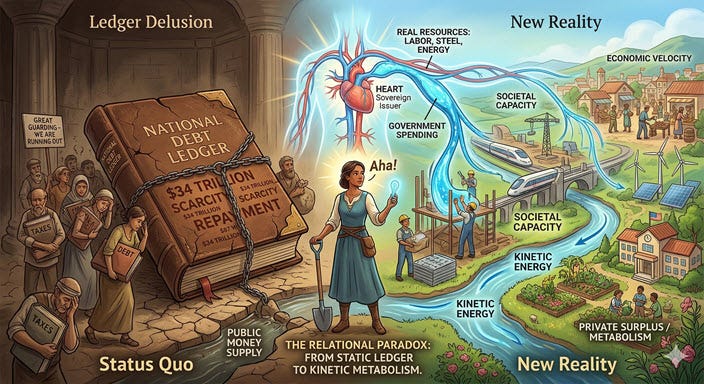
As the leader of this weary circle, the truth I must speak is brutal: we are not suffering from a lack of grain, but from a delusion of the ledger. We have treated the measurement of our love as if it were the limit of our capacity.
The shift began with a woman named Elara, who stood in the center of the dry square and simply started to build. When the elders shouted that there was no “budget” for a new well, she didn’t argue with their math; she simply pointed to the idle shovels and the strong arms standing around them. She realized that the “Debt” the village feared was nothing more than the record of every time the village had promised to take care of itself and hadn’t yet finished the job. She stopped asking, “Do we have the coins?” and started asking, “Do we have the stone?”
She began to move with a kinetic grace, treating the ledger not as a cage, but as a pulse. She understood that for the garden to bloom, the water must leave the well. To keep the water in the well to “save” it is to ensure the death of the garden. The “Aha!” moment rippled through the crowd like a physical heat: the money wasn’t the food; it was the invitation to eat. The friction that had exhausted them for generations—the constant checking of balances—evaporated. They moved from a Trial of Errors, where every mistake was a permanent loss on the page, to a Trial of Learning, where every movement was an investment in the village’s collective strength.
The visionaries among them saw the beauty of the invisible connections, realizing that wealth is not what you hold, but the speed at which you give. The pragmatists found peace in the reduced friction; things simply got done because the “permission” was now found in the presence of the resource rather than the presence of the token. They stopped trying to “manage” the forest and started acting like the mycelium, moving nutrients to where the soil was driest without waiting for a balance sheet to balance.
We stand now in a redefined reality. We have let go of the lie that felt like a comfort—the idea that scarcity protects us from ourselves. It is a heavy responsibility to realize that our only limit is our imagination and our willingness to work. Thank you for being the architects of this understanding, for braving the grief of losing your ledgers, and for finally allowing the heart of this community to beat without counting every drop.
Systemic Reflection & Stakeholder Notes
First Principles: The Law of Reciprocal Accounting
The narrative is anchored in the accounting identity that one agent’s deficit is another’s surplus. The “ledger” in the story represents the National Debt, which, when deconstructed, is revealed to be the private sector’s net financial assets. The foundational axiom is that a sovereign issuer cannot “run out” of the information it creates to coordinate labor.
Core Wisdom: The Paradox of Ownership
The systemic paradox explored is that by attempting to “own” or “save” the currency at the federal level, the government inadvertently “un-employs” the resources of the nation. The story mirrors the Fixes that Fail archetype, where the short-term “fix” of austerity leads to the long-term “failure” of collapsing infrastructure and social capital.
Leverage Points: The Goal of the System
The intervention occurs at the highest level of leverage: the Goal. By shifting the goal from “Fiscal Balance” (a parameter) to “Resource Mobilization” (a paradigm), the entire behavior of the system changes. The “Kinetic First Domino” is the rejection of the “How will you pay for it?” constraint in favor of the “Do the resources exist?” constraint.
Stakeholder Resonances
The Visionaries: They are moved by the “Mycelial” metaphor—the idea that money is a coordination signal, a shimmering web of trust that allows human potential to manifest.
The Pragmatists: They are moved by the “Circulatory” metaphor—the functional reality that “Debt” is simply the money currently in the system, and “Paying it off” would be a systemic heart attack.
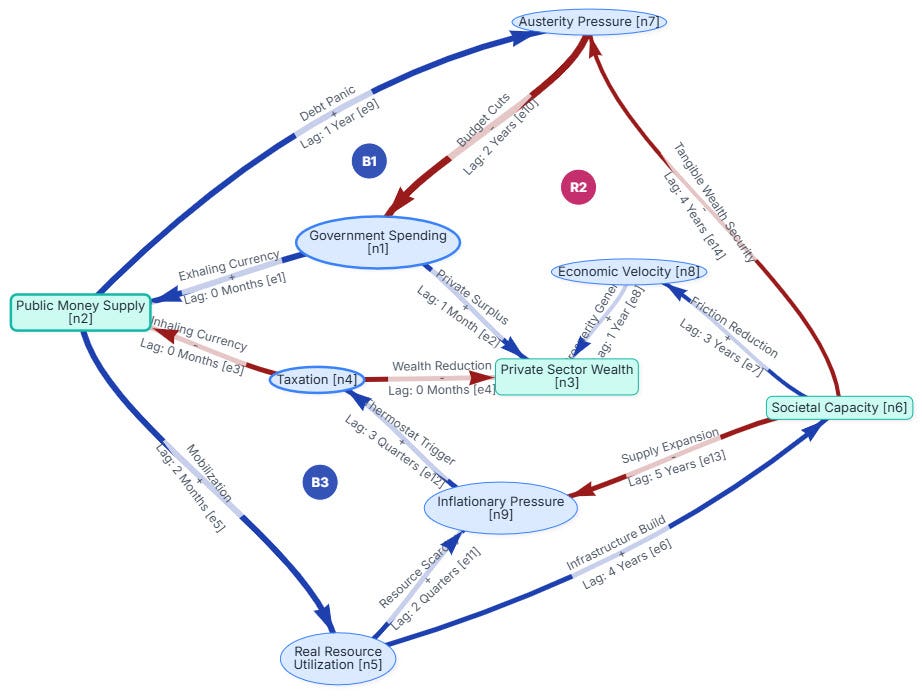
While the story provides the what, the following model provides the why of the situations. You can find additional information and download the model from the US Economy folder. There are two versions of the model in the folder. Learn to build these models at Free AI Tools.