Unraveling Wicked Problems
An Aha! Mystery - Deciphering the Mess

This post is not meant as an answer,
though more of a process for surfacing a deeper understanding.
The dialogue responsible for this post: https://gemini.google.com/share/837a5d4f510e
It has been said that the solution to a wicked problem creates another wicked problem, and Russell Ackoff referred to them as messes. Does this imply that the only really way to deal with the wicked problems is to address them all at once? I recall the diagram Fritjof Capra drew after beginning to read Plan B, which sort of linked everything together. So, where is the leverage point that addresses all the wicked problems at the same time?
The Seldon Shift
The Archive of the Second Epoch stood upon a wind-scoured promontory, a quiet monument of granite and glass looking out over the fracturing valley below. For generations, the valley had been governed by a singular, frantic ambition: the pursuit of the Great Accumulation. The elders spoke of it as an absolute law, a load-bearing delusion that insisted the valley must grow wider, its towers taller, and its extraction engines faster with every passing season. Yet, to those who looked closely, the energy of the movement was bleeding out into the dry soil. Effort had become entirely extractive; the communities labored night and day to build ever-more complex bureaucratic machinery to manage the symptoms of their own exhaustion, wasting their precious intellectual capital on short-term crises. The truth of the situation, undeniable to anyone who dared stand still, was that they were doing the wrong thing righter, speeding up their consumption to outrun the silent, delayed cracking of the valley’s bedrock.
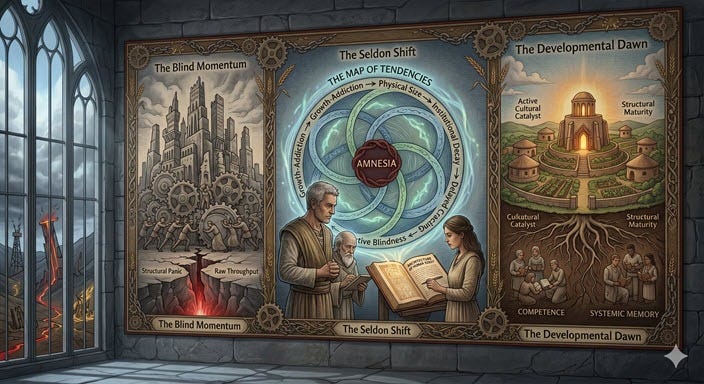
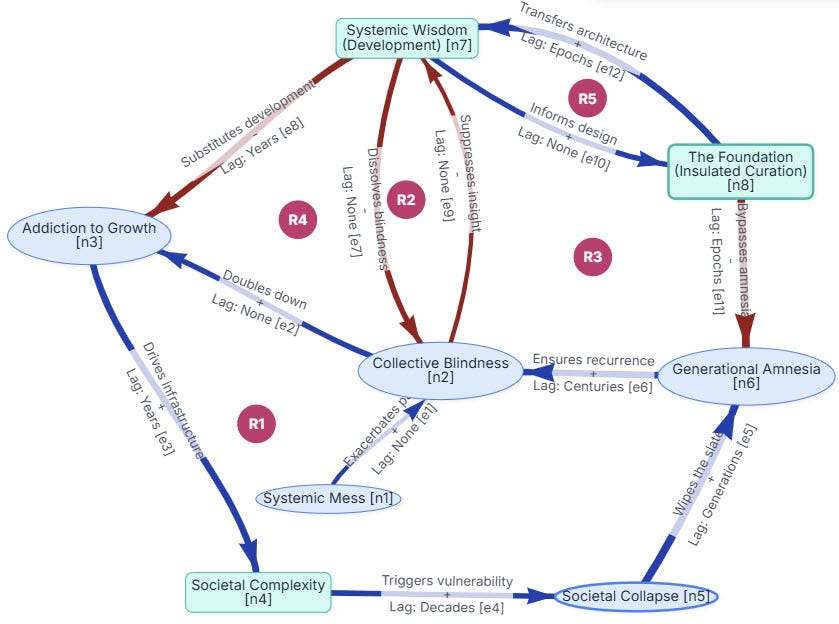
Elias had spent his youth running those engines, his hands calloused from tightening gears that always seemed to loosen by morning. He had lived in a constant state of structural panic, a functional blindness where the immediate pressure to produce overrode any capacity to comprehend the whole. One evening, as a towering aqueduct collapsed under the weight of its own unmaintained complexity, Elias walked away from the roaring construction sites. He climbed the high ridge to find the old weavers and scribes who had abandoned the growth-addiction decades prior. In the quiet sanctuary of the promontory, far removed from the institutional noise, he looked at a vast, interconnected tapestry they had woven over centuries. It did not depict a map of land, but a map of tendencies. As his eyes traced the continuous, circular paths where collective blindness fed the demand for physical size, which in turn triggered institutional decay, Elias felt a sudden, sharp clarity wash over him. The enemy wasn’t a corrupt leader or a failing engine; it was a predictable, recurring pattern of human amnesia. They were trapped in a macro-systemic overshoot, where the bill for their mistakes simply took centuries to arrive, ensuring that each new generation stepped into the same trap with a clean slate.
With this new understanding, the exhaustion that had weighed on Elias for years transformed into an active, disciplined hope. He realized that the true leverage point was not to fight the momentum of the falling towers below, but to build an indestructible vessel for the patterns themselves. He gathered a small circle of visionaries who saw the exquisite beauty of these invisible connections, and together they began translating the tapestry into a practical toolkit of systemic memory. They did not store gold or blueprints for faster engines; they curated the architecture of human folly and the grammar of wholeness. For the pragmatists who eventually fled the fracturing valley as the infrastructure began its inevitable, rapid simplification, this archive became a lifeline. It was not an abstract philosophy, but a highly functional toolkit that reduced the friction of their survival, showing them exactly how to organize their new, smaller communities around competence and development rather than raw throughput. When the old world finally fell quiet, the repository did not merely sit as a passive witness. It functioned as an active cultural catalyst, injecting systemic wisdom directly into the minds of the rebuilding generation, breaking the ancient wheel of amnesia and launching them onto a path of structural maturity before they could ever learn to be blind again.
The Story source file also contains First Principles, Core Wisdom, Systemic Paradoxes, Leverage Points, and Stakeholder Resonance.
The Story conveys what, the model shows why, and the transcript explains how. You can access the files associated with this post in the “Unraveling Wicked Problems” folder. To try the Aha! Mystery process, watch the Aha! Mystery Intro video, and download the components from the Prompts v1.3 folder.
Unique Perspectives on the Topic
You can download the models from the above folder.
The Amnesia of Empires