
Trade Wars: A Deeper Dive

Analysis of the Trade Wars Model
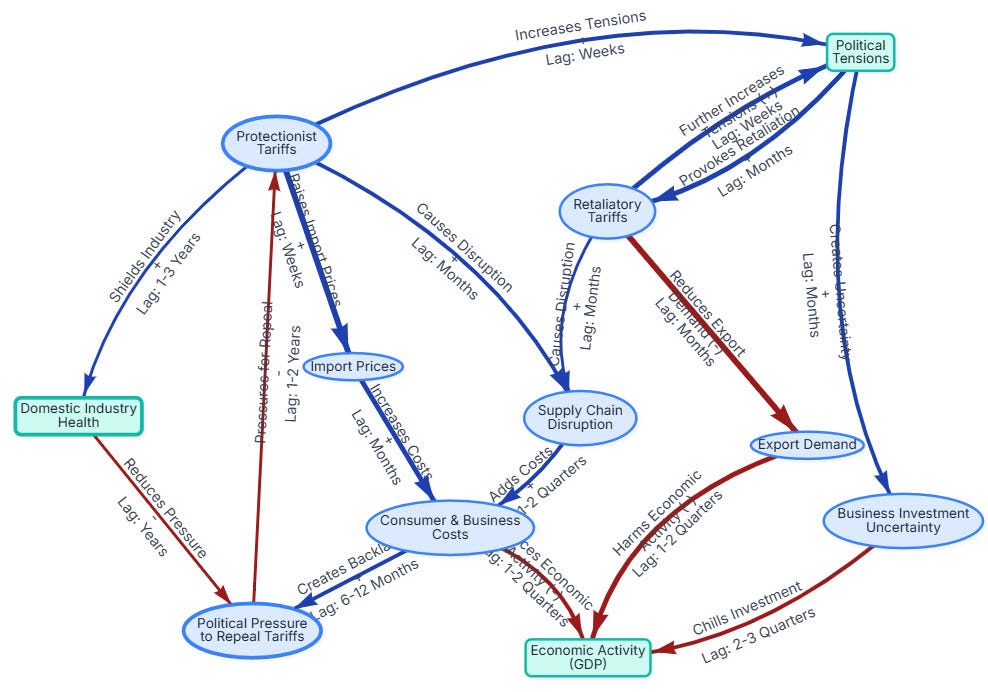
Model Explanation
This causal loop diagram models the complex dynamics of a trade war initiated by protectionist tariffs. It illustrates that a trade war is not a simple, linear event but a system of interconnected feedback loops with significant delays and unintended consequences.
The model’s central structure revolves around a fundamental conflict:
The Intended “Fix”: A nation imposes Protectionist Tariffs with the goal of improving the health of its Domestic Industry. This is represented by a balancing loop (B3: Protectionist Goal), where a healthier industry reduces the political pressure for continued protection.
The Unintended Consequences: This “fix” triggers a series of powerful reinforcing and balancing loops that ultimately undermine the initial goal and create wider economic and political damage. These include:
A reinforcing Escalation Spiral (R1) with other nations, leading to retaliatory tariffs and rising political tensions.
Two balancing “backlash” loops (B1 and B2) where tariffs increase Import Prices and create Supply Chain Disruptions. These raise costs for domestic consumers and businesses, generating political pressure to repeal the very tariffs that were meant to help.
A long-term, slow-moving reinforcing loop (R2: Economic Erosion) where these disruptions and the resulting uncertainty harm business investment, slow overall economic activity, and ultimately weaken the nation’s ability to withstand the conflict.
The model demonstrates how a policy designed to solve one problem (a struggling domestic industry) creates multiple new, and often larger, problems that feed back to worsen the original situation.
Source: Trade Wars (Archetypes Experimental)
Wisdom
The core wisdom of this model is that in a deeply interconnected global system, simple, unilateral “fixes” often act as poisons. The desire to protect one part of the system by building a wall around it (tariffs) ignores the complex flows of goods, capital, and trust that the system relies on. The model reveals that the true cost of a trade war is not measured in the price of specific goods, but in the degradation of the entire system’s health, stability, and future potential. It teaches that policies of isolation and aggression in an interconnected world inevitably lead to self-inflicted harm.
Leverage Points in Accordance with Donella Meadows
Identifying leverage points allows us to see where interventions in the system would be most effective. They are listed here from lowest to highest leverage.
#9. Length of Delays: A critical leverage point is the significant delay between the imposition of tariffs and the full realization of their negative consequences (Consumer & Business Costs, Economic Activity decline). The initial positive effects on the protected industry are often felt quickly, while the widespread negative effects are delayed and dispersed. Intervention: Shortening this delay through better public education and transparent, real-time economic impact reporting could increase political pressure to reverse course before the damage becomes entrenched.
#7. Strength of Negative Feedback Loops: The balancing loops B1 (Domestic Cost Backlash) and B2 (Supply Chain Cost Backlash) are the primary forces pushing back against the tariff policy. Intervention: Strengthening these loops by giving a louder voice to the businesses and consumer groups who bear the costs can increase the political pain of the policy, forcing a quicker re-evaluation.
#5. The Rules of the System: The current rules are the tariffs themselves. A higher-leverage intervention is changing the rules of engagement. Intervention: Instead of unilateral tariffs, engaging with established international trade bodies (like the WTO) or negotiating multilateral trade agreements changes the rules from adversarial to cooperative, disabling the “Escalation Spiral” entirely.
#3. The Goal of the System: The stated goal is “Protect Domestic Industry.” However, the system’s behavior reveals that this goal is in conflict with a larger, unstated goal of “Overall Economic Prosperity.” Intervention: The most powerful leverage point is to transcend the narrow goal and redefine it. Shifting the national conversation and policy objective from protecting one industry to enhancing overall economic competitiveness through investment in technology, education, and innovation would render the “fix” of tariffs obsolete.
#2. The Mindset or Paradigm: The highest leverage point is the paradigm out of which the system arises. The model operates from a paradigm of zero-sum, nationalistic competition (”Us vs. Them”). Intervention: The ultimate intervention is to change the paradigm to one of positive-sum, global cooperation. This involves recognizing that national economies are not isolated islands but deeply integrated nodes in a global network. A paradigm shift from “How do we beat them?” to “How do we create a system where everyone thrives?” would make the entire structure of a trade war unthinkable.
Knowledge
To validate, quantify, and deepen the understanding of this model, the following knowledge is essential:
Economic Data: Real-time and historical data on import/export volumes, tariff rates, consumer price indices (CPI), producer price indices (PPI), GDP growth, and foreign direct investment.
Supply Chain Analysis: Detailed maps and reports on key industrial supply chains to identify vulnerabilities and quantify the costs of disruption.
Political & Public Sentiment Data: Polling data on public support for tariffs, media analysis of political rhetoric, and lobbying records from various industries.
Historical Case Studies: In-depth analysis of past trade wars (e.g., Smoot-Hawley Tariff in the 1930s, the 2018 US-China trade war) to understand the timelines, magnitudes, and qualitative aspects of the feedback loops.
Systems Archetypes
Two primary systems archetypes govern the behavior of this model:
Fixes that Fail: This is the model’s central structure.
The Problem: A struggling Domestic Industry Health.
The “Fix”: Protectionist Tariffs are applied, which are intended to help the industry (Loop B3).
The Unintended Consequence: The tariffs raise costs for everyone else through Import Prices and Supply Chain Disruption. This creates powerful political backlash (Loops B1 and B2) and harms the broader economy, which eventually makes the original problem worse. The “fix” is not only temporary but actively destructive.
Escalation: This archetype is embodied by the reinforcing loop R1.
The Dynamic: One nation’s Protectionist Tariffs provoke Political Tensions, leading the other nation to impose Retaliatory Tariffs. This action is seen as a further provocation, increasing tensions and leading to more retaliation. Each actor’s response amplifies the action of the other, creating a runaway spiral of conflict that is difficult to stop and from which neither side can easily back down without losing face.
Primary Principles
This model serves as a powerful illustration of several key systems thinking principles:
Unintended Consequences: Actions in a complex system always have effects beyond the intended ones. The tariffs meant to help one industry end up harming many others.
Policy Resistance: The system naturally pushes back against the intervention. The “backlash” loops (B1, B2) are a classic form of policy resistance, where the system works to defeat the policy.
Shifting the Burden: The “fix” of tariffs shifts the burden of competition from the domestic industry onto the entire population of consumers and other businesses, who are forced to bear the higher costs.
Delays Matter: The political success of the “fix” is initially high because the pain is delayed. The time it takes for supply chains to break, prices to rise, and retaliation to take full effect allows the problem to become much worse before the balancing loops can correct it.
Key Insights
The initial “solution” is the primary cause of the system’s dysfunction.
The system itself generates pressure to both maintain the tariffs (from the protected industry) and repeal them (from everyone else), leading to political gridlock and prolonged economic pain.
The most visible part of the conflict (the back-and-forth tariffs) is a symptom of the underlying problem, not the problem itself. The real problem is the belief that such a conflict can be “won.”
Economic health is an emergent property of the entire system’s stability, not just the health of one of its parts. Protecting one part at the expense of the whole leads to a net loss for everyone.
Future Implications
If the reinforcing loops (R1: Escalation Spiral and R2: Economic Erosion) are allowed to dominate, the future implications are dire. The system points towards a future of:
Deepening Recession: Sustained disruption, high costs, and investment uncertainty will lead to significant job losses and a prolonged economic downturn, far beyond the initial protected industry.
Deglobalization: Trust, the invisible currency of international trade, will be destroyed. This will lead to a fracturing of the global economy into competing blocs, reducing efficiency, innovation, and cooperation on a global scale.
Political Instability: The economic pain and political division created by the trade war could lead to significant social and political instability, both domestically and internationally. The system is on a trajectory towards a tipping point where restoring the old cooperative order becomes incredibly difficult, if not impossible.
Synthesis: Core Wisdom & Highest Leverage Point
Core Wisdom: A trade war is a tragic system where the very act of trying to “win” by inflicting pain on another nation ensures that the deepest and most lasting wounds are self-inflicted.
Highest Leverage Point: The single most effective place to intervene is at the level of paradigm (Meadows’ #2). Shifting the guiding mindset from one of zero-sum nationalistic competition to one of positive-sum global economic cooperation is the only way to make the entire destructive system obsolete. This involves fundamentally changing the question from “How do we protect ourselves from them?” to “How do we build a more resilient and prosperous system for all?”