
Too Many Smart Gadgets vs. Running Out of Electricity
An Aha! Mystery Investigation

The Situation
The Hidden Trap: It is amazing that we have smartwatches, electric cars, and giant computer networks that can answer any question instantly. But all these digital brains use a massive amount of power. If we plug in millions of new gadgets faster than we can build safe energy plants, our electric grid gets overloaded, causing unexpected power outages where nobody has electricity.
The Goal: Balancing our love for high-tech gadgets with the actual amount of clean energy our power grids can safely produce.
The Paradox of the Dark Driveway
Look closely at the gleaming electric vehicle parked in a suburban garage at two o’clock in the afternoon, its dashboard blinking a red error message: “Charging Disabled by Municipal Grid Authority.” The car is useless, tethered to a dead outlet by government mandate. The widespread, superficial explanation for this localized paralysis is that modern society is simply too greedy. We are told by newscasters and utility spokespeople that our exponential appetite for smartwatches, digital networks, and electric cars has fundamentally outpaced the laws of physics. This is a load-bearing delusion, a classic case of shifting the burden onto the consumer to mask a deep, systemic failure. The reality is that there are no static objects in this garage, only processes and temporary bundles of energy flows. Our current environment is intentionally frozen in a state of deliberate gridlock. The legacy electrical grid operates on a one-way architecture designed decades ago to optimize upstream velocity—generating massive profits at central power plants—at the direct expense of downstream exhaustion and vulnerability.
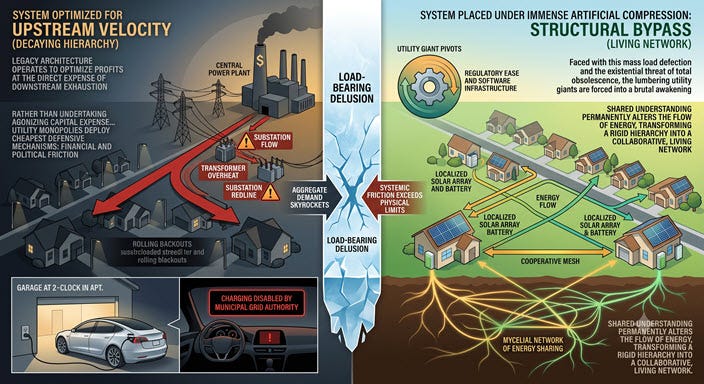
To understand how a driveway goes dark, we must trace the friction backward through the wires. The core paradox at play is that a system optimized solely for the cheapness of its initial creation generates an exponential debt of friction at the end of its lifecycle. As millions of digital interfaces and gadgets are acquired, aggregate power demand skyrockets. And? The legacy grid hits a hard, physical ceiling. Transformers overheat and substations redline. And? Rather than undertaking the agonizing capital expense of building modern, decentralized capacity, the utility monopolies deploy the cheapest defensive mechanisms available: financial and political friction. They implement punitive surge pricing. And when exorbitant utility bills fail to deter the daily habits of modern life, the grid physically buckles, plunging entire neighborhoods into rolling blackouts. And when sitting in the dark with dead screens drives voters to fury, the utilities open their checkbooks to lobby for regulatory capture. They secure local ordinances that enforce hard consumption limits, artificially throttling the energy use of the populace. You are looking at an architecture that is actively strangling its own host just to maintain the illusion of control.
But systems placed under immense, artificial compression do not stay frozen forever; the pressure eventually forces a structural bypass. This is not the work of an external, personalized enemy. The utility monopoly is simply acting out a predictable mechanism, trapped in a classic Limits to Growth archetype where its defensive behavior is the logical output of its obsolete design. When the state mandates scarcity, the isolated homeowner seeks an exit. Driven by steady, exogenous advances in affordability, a single neighborhood installs a localized solar array and a high-capacity battery. And? The financial pain of the legacy grid makes the investment immediately viable. And? The neighbor next door does the exact same thing, and they string their systems together. What begins as a desperate attempt to escape rolling blackouts rapidly mutates into a decentralized, peer-to-peer mycelial network of energy sharing.
This is where the invisible architecture of the future reveals itself. For the visionaries, there is profound beauty in making these hidden relational flows transparent, watching as passive consumers transform into an active, self-sustaining ecosystem. For the pragmatists, the appeal is the immediate utility of a new method that permanently reduces friction; every home that drops off the legacy load naturally relieves the stress on the old system while bypassing the central bottleneck entirely. Each new household added to the cooperative mesh acts as both a battery and a generator, intrinsically reinforcing the entire network’s capability. Faced with this mass load defection and the existential threat of total obsolescence, the lumbering utility giants are forced into a brutal awakening. They must cure their century-old marketing myopia and realize they are no longer in the business of mere power generation. To survive, they pivot, offering the regulatory ease and software infrastructure required to empower these micro-grids. Through this ongoing journey of trial and learning, shared understanding permanently alters the flow of energy, transforming a rigid, decaying hierarchy into a collaborative, living network.
Systemic Reflection & Stakeholder Notes
First Principles & Archetypal Mechanics
Limits to Growth & Structural Bypass: The legacy grid illustrates a terminal Limits to Growth archetype. Centralized generation hit a physical ceiling. Instead of innovating, the system attempted to artificially lower the growth limit through political chokeholds (daytime charging bans) and economic brakes (surge pricing).
Shifting the Burden: Utility monopolies utilized regulatory capture to shift the burden of structural decay onto the consumer. By blaming “gadget adoption” for outages, they masked the root cause: chronic underinvestment in grid modernization.
Mycelial Network Effects: The response to this friction triggered an exogenous, reinforcing feedback loop. Decentralized solar and battery tech reached a viability threshold, allowing nodes (homes) to defect from the main load. As the mesh expands, each new node increases total storage and generation, exhibiting positive compounding resilience.
Core Wisdom for Practitioners
Friction is a catalyst for defection. When a legacy system protects itself by making the user experience unbearably expensive or politically constrained, it inadvertently incentivizes the creation of its own replacement. The emergence of the decentralized micro-grid proves that users will not indefinitely tolerate artificial scarcity. If a centralized authority attempts to throttle modern behavior, the market will utilize decentralized technology to route around the blockage entirely.
Leverage Points & Strategic Pivot
Curing Marketing Myopia: The ultimate leverage point in this system is the cognitive pivot of the utility monopolies. By clinging to the identity of “centralized power generators,” they face extinction. By redefining themselves as “cooperative network enablers,” they secure their future.
Infrastructure Support over Resistance: Rather than lobbying to crush peer-to-peer networks, legacy institutions must provide the software, grid-ties, and financial integration to accelerate them. Co-opting the decentralized mesh allows the utility to monetize the infrastructure of the bypass, turning an existential threat into an evolutionary partnership.
Investigation & Relationships & Perspectives
What is presented here is not intended as a solution, but as food for thought regarding the interdependence of relationships and their implications.