
The Question vs. The Answer
An Aha! Paradox

The Gravity of the Given
The room always smelled of old paper and the specific, metallic scent of filtered air—a climate-controlled tomb for things we were certain we already knew. We sat in a circle of heavy mahogany chairs, each of us clutching a leather-bound “Book of Answers” as if it were a shield. We called ourselves the Keepers, but the truth was simpler: we were exhausted. We spent our days hauling these heavy volumes from one fire to the next, dropping “Solutions” onto problems that seemed to only grow hungrier the more we “fed” them. My arms ached with the weight of being right. I looked at the person next to me, a woman whose title was “Director of Certainty,” and saw the same gray fatigue in her eyes. We weren’t working; we were merely participating in a high-stakes exchange of static objects. We treated our knowledge like a battery that was constantly running dry, leaving us in a frantic race to find the next charging station, the next expert, the next final word. The friction was everywhere—in the way we waited for permission to speak, in the way our ideas died the moment they were transcribed into a static report. We were living in a landscape of nouns, and we were suffocating.

One afternoon, a leak sprung in the ceiling of the Archive. A single, rhythmic drop of water began to fall onto the “Master Volume of Outcomes.” I watched, paralyzed, as the ink began to bleed. The “Final Result” blurred into a blue smudge. In that moment of minor catastrophe, I didn’t feel panic; I felt a strange, osmotic pull. I reached out and touched the wet page, not to save it, but to feel the movement. The water wasn’t an object; it was a process of finding the path of least resistance. It didn’t care about the shelf or the title. It was simply flowing. I looked at the circle of exhausted Keepers and realized that our “Answers” were just dams we had built to stop the terrifying, beautiful flow of not-knowing. We were treating our relationships like boxes on a chart, but the energy—the real vitality—was in the space between the boxes. It was the “Gapping.” It was the “Inquiring.”
I stood up and did something unforgivable: I dropped my book. The sound was like a gunshot in the hushed room. I didn’t offer a new manual or a better strategy. I simply asked, “What happens to the light in this room if we stop trying to trap it in a jar?” The silence that followed wasn’t the heavy silence of a dead end; it was the vibrating silence of a beginning. We began to speak, not as Nouns with Titles, but as Verbs in Motion. We stopped “Managing Employees” and started “Nurturing Growth.” We stopped “Solving Problems” and started “Listening to the System’s Hunger.” The “Aha!” didn’t come from a new piece of data; it came from the collective grief of letting go of our safety nets. We wept for the “Rightness” we were losing, and in that mourning, the “Relational Latency” evaporated. We weren’t waiting for the Answer anymore; we were the Question, unfolding in real-time. Friction didn’t disappear, but it changed from the heat of a brake pad to the warmth of a seed pushing through soil. We became architects not of a structure, but of a current. And for the first time in years, the air in the room tasted like oxygen. Thank you for choosing to be the crack in the ceiling through which the water finally falls.
Systemic Reflection & Stakeholder Notes
First Principles & Foundational Axioms
The narrative is governed by the Law of Entropy (static answers decay) and Requisite Variety. The system’s structure rests on the axiom that “The quality of the output is a function of the quality of the relationship,” not the volume of the information.
Core Wisdom & Systemic Paradoxes
The Paradox of Certainty: The more we cling to a “proven” answer, the less capable we are of responding to the reality of the present.
The Paradox of Restoration: To restore the vitality of the organization, we had to “destroy” the artifacts (the books) that gave the members their sense of identity.
Leverage Points
The Goal (High Leverage): Shifting the system’s purpose from “Storing Knowledge” to “Facilitating Inquiry.”
The Mindset (Highest Leverage): Moving from a “Noun-based” reality (The Archive) to a “Verb-based” reality (The Flow).
Stakeholder Resonances
The Visionaries: Will resonate with the “bleeding ink” and the shift from “light in a jar” to “becoming the current.” It validates their intuition that the invisible connections are what matter.
The Pragmatists: Will see the “reduction of friction” and the “exhaustion of hauling heavy volumes” as a direct argument for efficiency. The “Stop Rule” (dropping the book) provides a concrete kinetic first domino to reduce waste.
The “Back-Test” on Relational Latency
The story identifies that “Relational Latency” was caused by the “Master Volume”—a stand-in for non-requisite management layers or static SOPs that prevent real-time “Trial & Learning.” By removing the “Noun” (The Book), the “Time-Span of Discretion” is immediately returned to the individuals in the circle.
While the story provides the what, the following model provides the why of the situation. You can find additional information and download the model from The Question vs. The Answer folder. Learn to build these models at Free AI Tools.
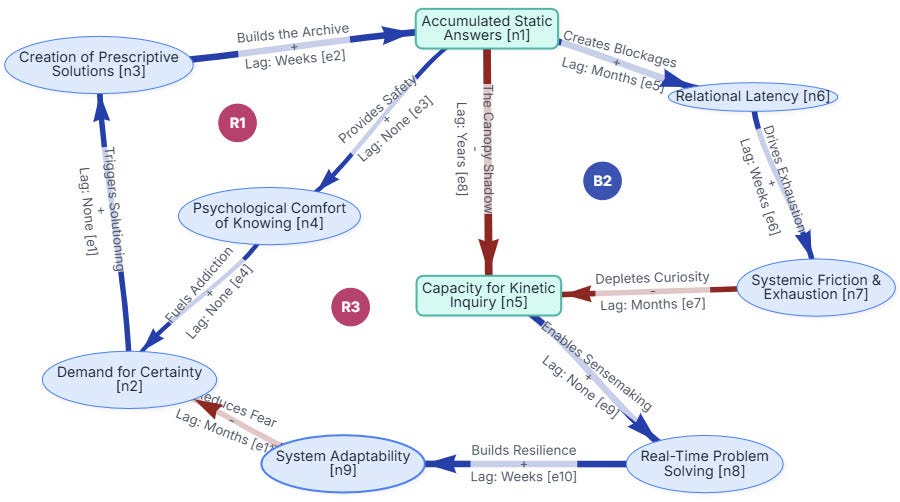
We stopped “Solving Problems” and started “Listening to the System’s Hunger.”
My bias: I'm a management consultant. When I read your stories, I detect a bias against managing. I understand that you are likely using the popular connotations of managing, as, in people's experience, many of their interactions with managers have been negative because so few managers are trained and reinforced in managing well. See the definition of "manage" https://dictionary.cambridge.org/us/dictionary/english/manage Yet you go on to describe your preferred types of relationships exacting those that Requisite Organization describes that good managers do. Good managers add value to the work of those employeed to accomplish an objective. I'd be more comfortable with a guideline in your stories which recognized and valued appropriate hierarchies with their effective managerial leadership practices. These seem rare in your stories. My brother was a college professor with tenure. He rejected being managed in any way with a vengeance. Many of my management consultant colleagues and I no longer want to work in the organizations we consult to. While I and many others do not want to work in organizations, we respect their value and help to make them more effective. Granted that many organizations in late stage extreme capitalism driven primarily by greed and exploitation are not good for our species survival. The question, can we improve them without improving the total system?