
The Polycrisis
An Aha! Paradox

The Metabolism of the Great Return
We have spent decades building a cathedral of glass and calling it a fortress. We stood in the center of a bustling marketplace, surrounded by the hum of “The Economy,” the “The Infrastructure,” and “The Supply Chain,” treating these labels as if they were solid granite foundations rather than the fragile, high-velocity interactions they truly are. We spoke of “managing” the planet as if it were a dormant machine in a basement, something we could oil and tune to keep the lights on forever. But the air has grown heavy with a heat that logic cannot explain away, and the friction of our “solutions”—each one a frantic patch on a bursting pipe—has only increased the pressure. We are exhausted from the effort of holding up a ceiling that was never meant to be static, wasting our life-force on the extractive delusion that we can take from the whole without becoming the void we leave behind. To lead now is to admit the brutal, beautiful truth: we are not the mechanics of a broken world; we are the cells of a feverish one.
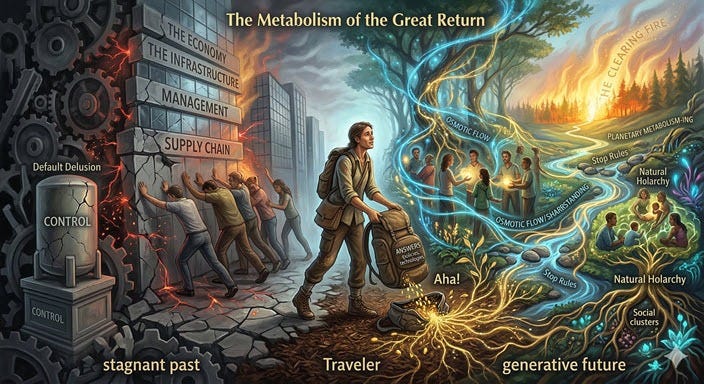
Imagine a wanderer who spent a lifetime trying to map a forest by counting only the fallen logs, ignoring the invisible mycelial pulse beneath the soil and the way the canopy breathes in unison with the sun. This traveler carried a heavy pack filled with “answers”—technologies and policies designed to stop the leaves from falling or the seasons from turning. He was perishing from the weight of his own certainty. But one evening, as the horizon glowed with a fire that was not a disaster but a clearing, he dropped the pack. In that silence, he didn’t find a new “thing” to fix; he found a new way to belong. He realized the forest wasn’t a collection of trees to be managed, but a process of “foresting” to be joined. The weight lifted not because the fire went out, but because he stopped trying to outrun the metabolism of the earth. He saw that the crises weren’t separate enemies at the gate, but the interconnected nerves of a single body finally waking up to its own limits. He moved from the desperation of “fixing” to the grace of “integrating,” shifting his feet from the brittle pavement of control to the soft, resilient mulch of participation.
We are all that traveler, standing at the edge of the clearing. The pragmatists among us will see that when we stop treating our neighbors and our landscapes as resources to be mined, the friction that burns our days away begins to cool. The visionaries will see the shimmering threads of a world where “Value” is no longer a noun we hoard, but a verb we circulate. We have been trapped in a cycle where every “fix” only made the system more brittle, a predictable dance of limits where our growth became our gravity. But today, we stop trying to “solve” the planet back to a yesterday that never really worked. We acknowledge the grief of losing the myth of control, and in that mourning, we find the kinetic energy to actually move. Thank you for being the ones brave enough to stop being architects of a cage and start being the pulse of a living return. We are finally learning that the only way to survive the storm is to remember that we are the weather.
Systemic Reflection & Stakeholder Notes
First Principles (The Physics):
The narrative is grounded in the Second Law of Thermodynamics. The “Status Quo” is defined as a high-entropy state where energy is wasted on maintaining “static” delusions. The shift is toward Planetary Metabolism, recognizing that energy cannot be created or destroyed, only transformed through relationship.
Core Wisdom (Systemic Paradoxes):
The Paradox of Control: The more we attempt to “fix” the Polycrisis as a series of objects, the more we destabilize the interweaving whole.
The Paradox of Ownership: The “Standard of Living” (a noun) is revealed as a “Standard of Participating” (a verb). Ownership creates friction; participation creates flow.
Leverage Points:
The story intervenes at the level of the Goal/Mindset. By shifting the goal from “Managing a Crisis” to “Participating in an Integration,” it changes the entire feedback structure of the system from extractive to generative.
Stakeholder Resonance:
For the Visionaries: It provides the “Aha!” of seeing the world as a Holarchy (the mycelial pulse), where the economy is nested within society, which is nested within the biosphere.
For the Pragmatists: It frames the shift as a reduction in Relational Latency. By stopping “non-requisite” control measures, we reduce the “friction that burns our days away,” making the reality of life more manageable.
The Shadow (Grief):
The story explicitly requires the audience to “drop the pack”—to grieve the Myth of Control and the comfort of the “Standard of Living” as a static right.
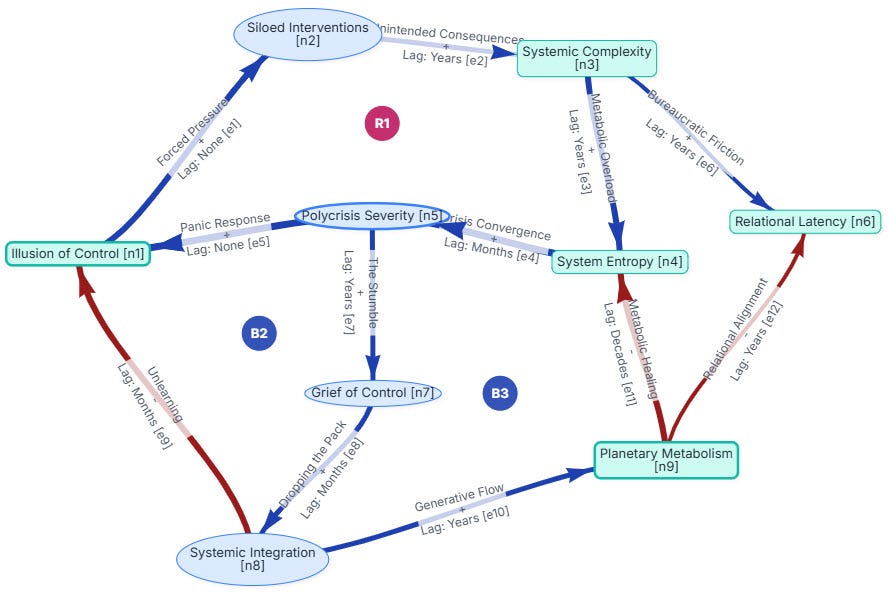
While the story provides the what, the following model provides the why of the situation. You can find additional information and download the model from The Polycrisis folder. Learn to build these models at Free AI Tools.
Gene, I think that you will really enjoy my latest story, as it has a very similar theme to your work.
https://plotweaver.substack.com/p/at-municipal-value-chapter-4-the?utm_campaign=post-expanded-share&utm_medium=web
Yes, Ken Wilbur's nested natural hierarchies. We live in late stage exploitive capitalism destroying the planetary ecology that sustains us. And the core problem seems to be the extreme gap in income. There are enough billionaires who organize to continue the extraction that they overwhelm the efforts of some of more charitable billionaires. It seems to take a famine, plague or war or some other catastrophe for a society to reorganize as Japan, Germany, Scandanavia and much of north Europe has to distribute wealth more evenly for a much higher quality of life - working toward sustaining life and the planet. Let's look ever more closely at the flow of money.