
The Political Outrage Engine
An Aha! Mystery - Deciphering the Mess

Situation
It seems that the US Congress is amazingly dysfunctional. They spend all of their time arguing with each other over everything. Charles Hampden-Turner claims the best solutions happen when we figure out how to integrate perceived dilemmas. So how do we integrate the democratic and republican parties so we end up with a US Congress that acts in the best interest of the country?
The Case of the Outrage Engine
A crumbling municipal water pipe sits unreplaced beneath a main street intersection, quietly cracking while lawmakers a thousand miles away shout at each other on television screens. The accepted, everyday explanation for this local decay is that the political system in Washington is hopelessly broken and entirely dysfunctional. This widespread belief is a load-bearing delusion, masking the reality that the political system is not broken at all, but rather shifts the burden of fundamental leadership onto the short-term symptomatic relief provided by outrage and base loyalty. To understand this, we must accept that there are no static political parties or permanent gridlocks, but only fluid processes, energy flows, and temporary bundles of relationships. The current congressional environment is intentionally frozen in a state of deliberate gridlock to optimize the upstream velocity of campaign survival and media engagement at the direct expense of downstream exhaustion and failing infrastructure.
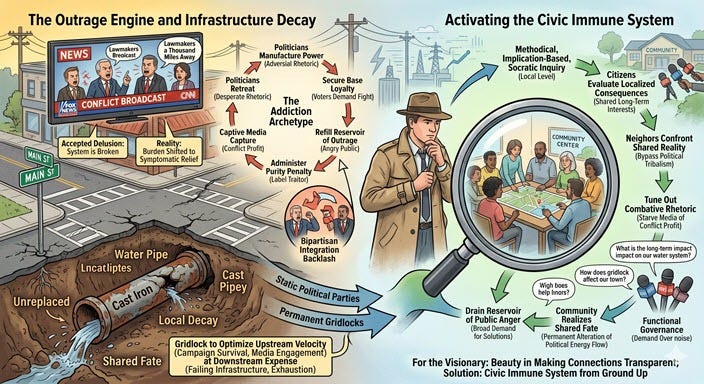
We begin our investigation by looking at the core paradox of modern political assembly, where optimizing a system solely for the cheapness of its initial creation generates an exponential debt of friction at the end of its lifecycle. Politicians manufacture power cheaply by deploying adversarial, combative language to attack the opposing party, which immediately secures intense loyalty from their most extreme voters and justifies their continued existence in office. And how does this affect the broader environment? The resulting base loyalty rewards the politician, incentivizing them to deploy even more combative rhetoric in a vicious identity trap. And where does this rhetoric travel? It is eagerly captured by news agencies and social media platforms, whose financial gain and engagement metrics grow directly in proportion to the level of conflict they can broadcast. And what is the output of this media profit? As the platforms maximize their profits through sensationalism, they continuously refill the general electorate’s reservoir of outrage, fear, and polarization. And what happens to this public anger? The angry, polarized public creates a strict environment where voters actively demand that their representatives fight rather than govern, administering a severe purity penalty to any politician seeking compromise. And what occurs if a brave lawmaker actually tries to merge conflicting dilemmas into a workable, long-term national solution? This bipartisan integration instantly triggers a backlash, labeling the politician a traitor to their own party extremes, rapidly draining their base loyalty, and forcing them to desperately retreat back to aggressive rhetoric to prove their allegiance.
This inescapable pattern acts as an addiction archetype, a predictable mechanism that actively hunts down moderation and ensures any small integrative step instantly triggers the purity penalty again in a bipartisan death spiral. For the visionary who wishes to see these invisible connections made transparent, the beauty lies in realizing that the outrage engine relies entirely on our participation to function. For the pragmatist searching for a new architecture, the solution is not to fight the system head-on, but to activate a civic immune system from the ground up. By utilizing methodical, implication-based, Columbo-style Socratic inquiry at the local community level, citizens are forced to evaluate the localized, long-term consequences of their political gridlock. When neighbors confront the reality of their shared interests, they bypass political tribalism and begin to tune out the combative rhetoric. This collective rejection starves the media of its conflict-driven profit, slowly drains the reservoir of public anger, and ultimately forges an unavoidable broad public demand for tangible solutions over partisan bickering. Through continuous trial and learning, communities realize their shared fate and permanently alter the flow of political energy, replacing the noise of division with a quiet, powerful demand for functional governance.
Systemic Reflection & Stakeholder Notes
First Principles: The legislative branch is trapped in a Stratum VII societal deadlock, functioning as a highly profitable outrage engine rather than a governing body.
Core Wisdom: Combative rhetoric secures base loyalty and drives media engagement, but it completely destroys the interpersonal trust required for bipartisan integration. Any attempt to merge conflicting dilemmas into long-term national solutions triggers a backlash from party extremes.
Leverage Points: The system’s addiction to conflict can be broken by activating a civic immune system. By applying Socratic inquiry to spark shared understanding, communities can build consensus, reject adversarial noise, and generate a broad public demand that shifts the ultimate political incentives toward real solutions.
Unique Perspectives on the Political Outrage Engine
Several prominent researchers and authors have published groundbreaking work that directly maps onto the dynamics of the Congressional dysfunction we have been investigating. Here are the key thinkers and their unique perspectives:
Lilliana Mason on “Affective Polarization”: In her book Uncivil Agreement, Mason argues that American political division is no longer based primarily on rational policy disagreements, but rather operates as a deeply tribal identity clash.
She explains that voters behave like sports fans rooting for a “home team,” leading to a powerful, mutual dislike of the opposing side.
This aligns perfectly with the dynamic where politicians are deeply incentivized to use combative rhetoric because it secures intense loyalty from their political base.
This tribalism fuels the continuous flow of adversarial, combative language utilized by politicians to attack the opposing party.
Frances Lee on the “Perpetual Campaign”: In Insecure Majorities, political scientist Frances Lee offers a unique structural explanation for legislative gridlock.
She posits that modern dysfunction is driven by the historically prolonged period of competitive balance between the two parties that began in the 1980s.
Because control of Congress is constantly up for grabs, politicians are trapped in a “perpetual campaign” where their chief strategy is to aggressively distinguish themselves from the opposition through strident “teamsmanship.”
This confirms why politicians remain locked in a perpetual cycle of “Us vs. Them” conflict and prioritize political theater over the country’s long-term best interest.
It also explains the severity of the purity penalty, which acts as a severe punishment mechanism for any attempt at compromise or integration.
Algorithm Researchers on the “Economics of Outrage”: Studies on the attention economy, including a landmark MIT analysis of social media, have proven that digital algorithms are designed to prioritize incendiary content over accuracy.
Because of human “negativity bias,” false and outrage-inducing narratives spread 70 percent faster and reach vastly more people than factual reporting.
This directly validates the reality of media profit, where the accumulation of financial gain and engagement metrics grows directly in proportion to the level of conflict they can broadcast.
This algorithmic machinery ensures that media amplification continuously boils public anger, which then enforces a severe “purity penalty” on collaborating lawmakers.
James Fishkin on “Deliberative Democracy”: Offering a proven counter-mechanism, Stanford’s James Fishkin pioneered the concept of “Deliberative Polling.”
His research brings randomly selected, representative citizens together for balanced, moderated small-group discussions with experts.
Fishkin found that when citizens participate in methodical use of implication-based questions at the community level, they consistently shed their polarized views and build consensus.
His work provides real-world evidence that local, ground-up Socratic inquiry can shift voter focus toward the long-term consequences of gridlock.
This intervention ultimately starves the conflict engine of its attention-based fuel and generates an undeniable demand for functional governance.
These experts reveal that our mapped architecture is not just a theoretical model, but a reflection of verifiable psychological, economic, and structural forces.
Better than the alternatives. I'll take inflation over what the US has now. It's not a democracy but a sociopathic corporation. Bernie had the people behind him and would have won if the elites had not quashed him. He's still one of the few sane ones in the Senate. Roosevelt could do it because he was of the elites and he had two crises that rallied the voters - the depression and Nazi Germany. It was a short window of good times - 1938-1980 - my time resident of the US. the best times ever and now Canada is in best times ever... with Carney and the taming of the billionaires. We've controlled campaign contributions here.
Pinpointing a critical systemic vulnerability in the "Aha!" model.
By treating the solution as a localized, ground-up civic immune response, the analysis attempts to use 4th Order (Conceptual/Organizational) methods to resolve what is fundamentally a 5th Order (Universal/Societal) structural deadlock.
When you shift the lens to the legislative and legal frameworks that shape market incentives, the nature of the variables changes entirely.
The Scale and Scalability Mismatch
The remedy proposed in the article—expert-facilitated, local Socratic inquiry—is essentially a series of isolated, resource-intensive interventions. As you noted, in an era of hollowed-out local journalism and highly consolidated media networks, expecting decentralized community action to scale fast enough to counter a multi-billion-dollar algorithmic engine is a romantic, but cold-appraisal flawed strategy.
To use an ecological analogy, it is like trying to filter a poisoned river bucket by bucket at the riverbank, rather than shutting off the toxic dump at the upstream chemical plant.
Mapping the Real Stratum VII / 5th Order Dilemma
When we elevate the discussion to the legal and market architectures, the variables become the rules of the game that dictate how capital, data, and speech interact across the entire society.
The Article’s Intervention (4th Order / Stratum IV-V)
* Core variable - Human behaviour, localized consensus, civic willpower.
* Mechanism - Starving the media engine by changing consumer demand from the bottom up.
* Friction - High cost, lack of scalability, erosion of local communication infrastructure.
The Structural Reality (5th Order / Stratum VII)
* Core Variable - Legal frameworks, anti-trust laws, market incentive structures
* Mechanism - Rewriting the statutory definitions of liability, data ownership, and media monopoly from the top down.
* Friction: Deeply entrenched, highly capitalized power blocks fighting to maintain their dominance.
The True Stratum VII Paradox
If the true level of resolution must be legislative, the 5th Order dilemma reveals itself as a massive, self-referential paradox:
* The Market Frame: The current market rules reward outrage because outrage drives engagement, engagement drives data collection, and data collection drives profit.
* The Legislative Capture: The politicians who possess the constitutional authority to change these market rules (e.g., reforming Section 230, enforcing strict anti-trust laws on media conglomerates, or subsidizing public-interest journalism) are the exact individuals whose careers are funded and sustained by the current outrage engine.
* The Purity Penalty: Any legislator who attempts to introduce comprehensive, bipartisan market reform instantly triggers the "purity penalty" from the media machinery, threatening their political survival.
Therefore, the dilemma is not just that the market is broken; it is that the machine designed to fix the market (the legislature) is powered by the broken market's fuel. This is the definition of a Stratum VII civilizational knot. Resolving it requires a 5th Order intervention that alters the legal boundaries of the market itself—such as fundamental campaign finance transformation, breaking up media monopolies, or establishing a new legal architecture for data sovereignty—rather than relying on communities to opt out of a game where the dice are already loaded.
And the dilemma continues as these reforms also will be resisted by the same vested power interests controlling the legislative process.