
The Localized Supply Chain Squeeze
An Aha! Mystery - Deciphering the Mess

Situation
The Current Event: An eco-friendly apparel manufacturer seeks to scale its production fourfold by partnering with localized, worker-owned co-op textile mills in rural regions. However, the co-ops cannot absorb the sudden volume spikes or the rigid delivery timelines demanded by large-scale retail distributors, leading to stockouts.
The “Aha!” Angle: This represents a fixes that fail paradox where scaling the business outpaces the developmental capacity of the ethical supply ecosystem. By forcing a non-linear scale mandate onto linear, regenerative local systems, the CEO inadvertently triggers an unintended consequence: the co-ops overextend, burn out their workforce, and face operational collapse. The surface-level goal of expanding positive local impact ends up destabilizing the very communities the B-Corp was founded to support.
The Question: What is the structural trade-off between maximizing top-line market penetration and maintaining a supply chain bounded by regenerative human limits?
The Paradox of the Empty Loom
The crime scene is a single, discarded wooden bobbin resting on an empty stool in a rural textile cooperative. Above it, a metal spike overflows with hundreds of unfulfilled retail order slips. The executive team in the distant B-Corp boardroom looks at this empty seat and diagnoses a simple recruitment problem. They believe the local workforce simply lacks resilience, demanding that human resources hire replacements faster to keep up with soaring corporate sales. But this is a load-bearing delusion, a classic shifting of the burden that treats a symptom while masking a far more dangerous reality. There are no isolated recruitment failures here; there are only temporary bundles of relationships and energy flows currently buckling under impossible pressure. The corporate office has intentionally frozen this supply chain into a state of deliberate gridlock, optimizing for the dizzying velocity of upstream retail intake at the direct expense of downstream human exhaustion.
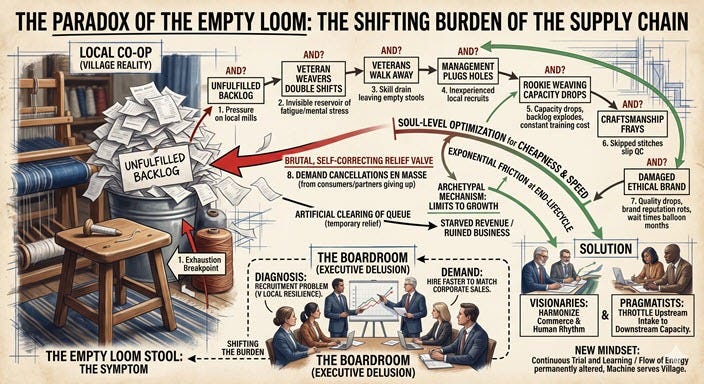
This creates a profound structural contradiction, as optimizing a system solely for the cheapness and speed of its initial creation generates an exponential debt of friction at the end of its lifecycle. Let us trace the perimeter of this failure. The massive volume of macro-level retail demand drops instantly onto the local co-op. And? The production capacity of these village mills is organically bounded by the speed of human hands, meaning the backlog of unfulfilled orders immediately begins to pile up. And? To compensate for the swelling queue, veteran weavers are pressured to pull double shifts, steadily filling an invisible reservoir of physical and mental fatigue. And? This exhaustion eventually reaches a breaking point, forcing the most skilled artisans to walk away and leaving behind empty stools. And? Management scrambles to plug the holes with inexperienced local recruits. And? These well-meaning rookies weave at a fraction of the speed of the veterans they replaced. And? Overall workshop capacity drops, causing the backlog to explode even faster and bleeding the company dry through constant training costs. But the investigative thread pulls further. As the reservoir of fatigue deepens, exhausted veterans and panicked rookies begin to make mistakes. And? The once-pristine craftsmanship of the eco-apparel begins to fray, with skipped stitches slipping past quality control. And? These flaws inevitably reach the consumer, deeply damaging the ethical, high-quality brand reputation that fueled the massive demand in the first place. And? While the brand’s reputation rots from the inside, the towering backlog causes customer wait times to balloon from days into agonizing months. And? The system finally triggers its own brutal, self-correcting relief valve as consumers and retail partners simply give up and cancel their orders en masse. These cancellations artificially clear the queue and relieve the immediate pressure on the factory floor, but they do so at the terrible cost of starved revenue and a ruined business.
The culprit here is not a villainous executive or an unmotivated workforce, but the archetypal mechanism of limits to growth acting as a predictable, cold force. The system behaved exactly as it was designed to, enforcing its own natural boundaries when the exogenous shock of corporate demand was pushed beyond the physical limits of the local ecosystem. For the visionaries, there is a profound beauty in making these invisible connections transparent, revealing that true ethical scaling requires harmonizing the speed of commerce with the rhythm of human craft. For the pragmatists, the immediate utility lies in designing a new architecture that throttles upstream intake to match actual downstream capacity, attacking the root cause rather than treating the symptoms of turnover and plummeting quality. Ultimately, survival in this ecosystem demands a mindset of continuous trial and learning, where a shared understanding of these boundaries permanently alters the flow of energy, ensuring that the machine serves the village rather than consuming it.
Systemic Reflection & Stakeholder Notes
First Principles
*The Illusion of Infinite Scale: Demand can scale exponentially on a spreadsheet, but physical production capacity is bounded by the organic limits of human time, skill, and endurance.
Energy Flow and Friction: A system cannot absorb more kinetic energy than its structures can process. Forcing exogenous volume into a bounded local ecosystem does not increase output; it merely converts the excess energy into systemic friction (fatigue, errors, and turnover).
Delay and Information Lag: The delay between a worker’s rising exhaustion and the ultimate drop in consumer demand creates a dangerous blind spot. By the time the financial consequences of burnout are visible, the institutional skill of the workforce has already been destroyed.
Core Wisdom
The Burnout Spiral (Reinforcing Loop): Attempting to clear an overwhelming backlog by overworking staff directly degrades the capacity needed to clear that very backlog. Pushing veterans to quit and replacing them with slower rookies is a mathematical guarantee of operational collapse.
The Quality Compromise (Balancing Loop): When speed is prioritized over sustainability, the invisible decay of the brand begins. Worker fatigue guarantees rushed work, which destroys the ethical reputation of the product and naturally kills future demand.
The Attrition Relief Valve (Balancing Loop): Systems will always find a way to relieve unsustainable pressure. If management does not actively manage the backlog by pausing intake, the market will manage it for them through massive order cancellations.
Leverage Points
Throttle the Intake (Pragmatic): The highest leverage point is decoupling retail demand from the localized co-ops. Implement strict waitlists or capped batch releases. By deliberately throttling the intake of orders, the backlog is kept manageable, protecting the local workers from the pressure of impossible quotas.
Protect Institutional Capacity (Visionary): Shift the operational focus from aggressive hiring to aggressive retention. Recognize that a rested, experienced veteran weaver is exponentially more valuable than a high-turnover revolving door of trainees. Protect the organic limits of the regenerative system at all costs.
Unique Perspectives
Based on the system map and literature seed you provided—which explores the collision between macro-level retail demand and the bounded, organic limits of localized co-ops—there are several notable thinkers and researchers who have published unique perspectives on this exact intersection.
Here are the key thought leaders who have explored this dynamic, and their unique perspectives mapped directly to your system:
1. Nelson Repenning & John Sterman
Who they are: Prominent System Dynamics researchers at MIT Sloan, famous for their work on operational physics and organizational behavior.
Their Unique Perspective: The Capability Trap
Repenning and Sterman’s research perfectly explains your **”Act I: The Burnout Spiral” (Loop R1)**. Their unique perspective is that when faced with a backlog (**n1**), management always has two choices: “Work Harder” (pushing the current workforce) or “Work Smarter” (investing in capability/capacity).
Because the retail demand is urgent, companies almost always default to “Working Harder.”
This creates a vicious cycle: pushing workers creates fatigue, which leads to turnover.
The unique insight here is that throughput actually drops when you push people harder because the time required to train new, slower hires drains the very resources needed to fulfill orders. Sterman and Repenning mathematically proved that aggressive growth targets in constrained human systems inevitably destroy the system’s baseline production capacity.
2. Kate Fletcher
Who she is: A pioneer of the “Slow Fashion” movement and Professor of Sustainability, Design, and Fashion.
Her Unique Perspective: The Rhythms of Production vs. The Tyranny of Volume
Fletcher’s work directly addresses the structural conflict between aggressive retail distributors and ethical ecosystems (your “Original Premise”). Her unique perspective is that sustainability in apparel is not just about using eco-friendly materials; it is fundamentally about the speed and volume of throughput.
She argues that large-scale retail operates on “machine time” (relentless, non-linear growth), while ethical, localized co-ops operate on “nature/human time” (bounded, organic rhythms).
Fletcher points out that attempting to force human-scale cooperatives to match corporate order backlogs (Overwhelms) inherently strips the “ethics” out of ethical fashion. The rush to scale inevitably degrades the craftsmanship (Product Quality), which validates The Quality Compromise.
3. E.F. Schumacher
Who he was: An economic thinker and statistician, best known for his foundational book *Small Is Beautiful: Economics as if People Mattered*.
His Unique Perspective: Human-Scale Diseconomies of Scale
While traditional economics praises “economies of scale,” Schumacher championed the concept that pushing localized, human-centric enterprises into massive scale creates diseconomies of scale.
His perspective was that once an organization outgrows the “human scale” of a village or co-op, it loses its social cohesion.
In your model, as the B-Corp attempts to scale its production fourfold, it triggers a collapse. Schumacher would argue this happens because the B-Corp treats the weavers as interchangeable parts of a machine rather than a biological community. The loss of skilled veterans and the resulting erosion of Brand Reputation perfectly illustrate his theory that pushing beyond localized limits destroys the core value of the enterprise.
4. Christopher Marquis
Who he is: Professor at Cambridge Judge Business School and author of *Better Business: How the B Corp Movement Is Remaking Capitalism*.
His Unique Perspective: The Ethical Scaling Paradox
Marquis studies the exact scenario described in your literature seed: what happens when purpose-driven brands (like B-Corps) attempt to scale through traditional, aggressive capitalist distribution channels.
His unique perspective highlights the “stakeholder vs. shareholder mismatch.” When an eco-friendly brand promises large retail distributors massive volume, they are prioritizing financial growth over the well-being of the localized workers.
Marquis notes that this often leads to “mission drift.” As seen in your Act III: The Customer Attrition Relief Valve, the system brutally corrects itself. The company loses its ethical standing and suffers massive financial losses from wait times and order cancellations. Marquis argues that true B-Corps must learn to implement deliberate boundaries on their growth to protect their supply chains.
5. Juliet Schor
Who she is: Economist and Sociologist at Boston College, author of *Plenitude* and *The Overworked American*.
Her Unique Perspective: Time Poverty as an Ecological Degradation
Schor’s unique lens focuses on how aggressive business scaling impacts time and human energy.
She views Worker Fatigue not just as an HR issue, but as a depletion of a natural resource.
Her perspective suggests that large retail models extract “time and health” from localized workers just as aggressively as fossil fuel companies extract oil. When the Co-op workers are forced into exhaustion to meet the Retail Demand, the supply chain isn’t just bottlenecked—it is actively strip-mining the local community’s human capital.
Summary of the work
If you are building out narratives or research based on your JSON system map, leveraging Sterman will give you the hard operational mechanics of why the backlog grows when workers quit; Fletcher will give you the industry-specific context of fast vs. slow fashion rhythms; and Marquis will ground the business narrative in the modern reality of B-Corps trying—and failing—to satisfy both local ethics and global retail scale.