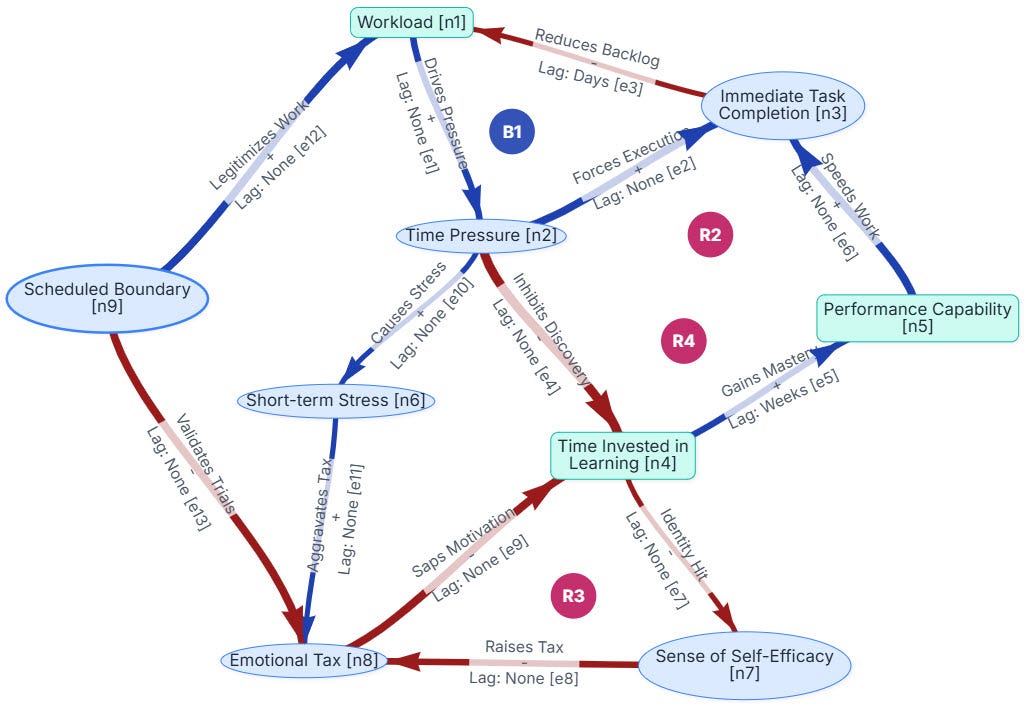
The Learning Dilemma: Why Not Improve?
An Aha! Mystery - Deciphering the Mess

I find it rather amazing that every time I do one of these, I seem to end up somewhere other than where I expected. It’s delightful.
I was curious as to what the Aha! Mystery prompt would reveal for the following.
Why is it that people don't readily engage in learning new things that would improve their performance, making them more effective, and what might we do to improve the situation?
The dialogue, if you care to read it: https://gemini.google.com/share/0256b1c01fec
Unique Perspectives on The Learning Dilemma
The Weight of the Known
The air in the office had become thick with the smell of scorched adrenaline and cold coffee, a stagnant atmosphere where the only thing growing was the mountain on everyone’s desk. We lived within a load-bearing delusion: the belief that if we simply ran faster, the treadmill would eventually let us off. We were experts at the quick fix, patching cracks with sheer willpower while the foundation of our collective effectiveness quietly eroded beneath us. Every hour was an extraction, a withdrawal from a diminishing reservoir of human spirit, leaving us with energy leaks that hissed through the hallways in the form of weary sighs and defensive silence. As the leader, I had to stand before the team and speak the undeniable truth: we were not actually working; we were merely surviving the consequences of not learning. We had become prisoners of our own competence, so afraid of the clumsy vulnerability of being a beginner that we had anchored ourselves to a sinking ship of “the way we’ve always done it.”

Then came the morning of the first “Unavailable Hour.” It was a quiet rebellion, a quest not for more time, but for a different kind of space. I watched Sarah, our most dedicated marathoner on the hamster wheel, stare at her locked calendar with a mixture of terror and hope. This was the first critical move—a declaration that the time for discovery was now as billable and legitimate as the time for production. At first, the silence was heavy with the identity toll; the friction of trying a new path made everyone feel slower, heavier, and less sure of themselves. But as we held the boundary, the energy began to shift from extractive to generative. We stopped fighting the mountain and started mapping the gravity that held it in place. The frustration of the “beginner’s dip” was no longer a personal failure to be hidden, but a shared signal of growth. We were no longer just clearing a backlog; we were architecting a new understanding of how we related to our tools and to each other. The “Aha!” didn’t come as a lightning bolt, but as a gentle lifting of the fog, as the gears of our collective engine finally shifted from a grinding reverse into a smooth, purposeful forward motion. We discovered that the safety to be “bad” at something new was the only way to ever be truly good at anything again. To the dreamers among us, it looked like the invisible threads of our potential finally tightening into a sturdy web. To the pragmatists, it felt like the sudden, blessed reduction of a friction they had forgotten they were fighting. We emerged from the trial not just more effective, but more human, realizing that the greatest work we could ever do was the work of understanding the system we inhabit. Thank you for daring to be clumsy, for trusting the silence of the scheduled hour, and for proving that when we protect the space to learn, the mountain eventually learns to move for us.
The Story source file also contains First Principles, Core Wisdom, Systemic Paradoxes, Leverage Points, and Stakeholder Resonance.
The Story conveys what, the model shows why, and the transcript explains how. You can access the files associated with this post in the “The Learning Dilemma” folder. To try the Aha! Mystery process, send systemswiki@gmail.com an email, and I’ll send you the prompts.
The Stagnation Trap