
The Iterative Lens

The workshop was never silent, though to an outside observer, it might have seemed still. Elias sat before the glass-top table, watching the light from the morning sun refract through a series of prisms he’d arranged to track the day’s progression. To most, a prism was an object—a heavy, triangular “thing” of polished silica. To Elias, it was a pause in the light’s journey, a specific relationship between density and speed that resulted in a burst of color.
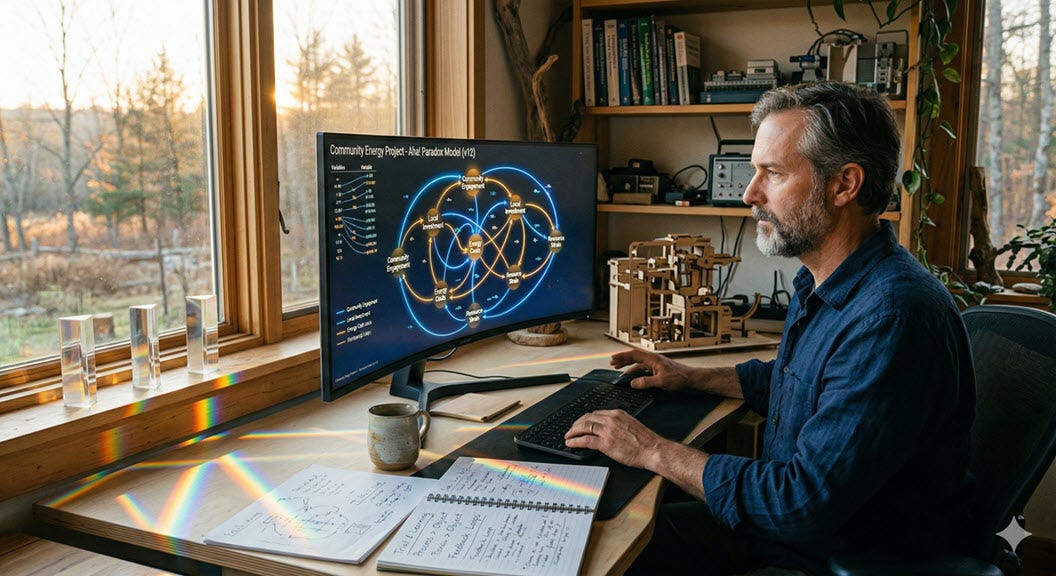
He was currently mapping a new Causal Loop Diagram (CLD) for a community energy project. On the digital display, the nodes were pulsing. He watched the reinforcing loop of Community Engagement driving Local Investment, which in turn lowered Energy Costs. But he was looking for the “Aha! Paradox”—that elusive point where the very success of the system might create a balancing loop of Resource Depletion he hadn’t yet accounted for.
“Trial and learning,” he murmured, his fingers dancing across the interface. He adjusted a variable, watching the simulated energy flows shift from a jagged red to a smooth, oscillating blue. He didn’t see the previous ten failed simulations as errors. They were the necessary friction required to smooth the lens of his understanding. Each one had been a discrete event, a snapshot in time, but collectively they were an evolving process of discovery.
As the simulation stabilized, Elias leaned back. He thought about how people described their lives as a series of milestones—birthdays, graduations, jobs. Discrete events. But sitting here, watching the light move 15 degrees across his desk, he knew better. There was no “gap” between 8:00 AM and 8:01 AM. There was only the continuous rotation of the Earth, the steady flow of electrons through his processor, and the rhythmic rise and fall of his own breath.
We affix labels to the world as a matter of convenience, he realized. We call this a “table” and that a “chair” so we don’t have to navigate a chaotic sea of atoms every time we want to sit down. But the reality was the relationship between them. The table supported the weight; the chair offered the rest. Without the interaction, the objects lost their definition.
Suddenly, the paradox clicked. The “Aha!” wasn’t a destination he had reached; it was the moment his internal model finally synchronized with the external flow of the system. He saw the link: the energy wasn’t just being consumed; it was being transformed into social capital, which acted as a buffer against the resource strain.
He didn’t save the file as “Final Version.” He labeled it “Iteration 12.” After all, the sun was still moving, the dust was still dancing in the light, and the process was far from over. He stood up, ready for the next trial, his mind already beginning to flow into the next loop of learning.
Your phrase "the moment his internal model finally synchronized with the external flow of the system" calls to mind the work of Count Korzybski and SI Hayakawa: the map is not the territory, it it more like a key in a lock, which opens the door to acting in the world. Two other valuable life lessons present in your story: 1) the iterative learning process looks like repeated failure if we focus solely on judging outcomes and fail to take up what is there for us in each try. 2) "state of the art" does not mean wonderful, only the best we can do today.