
The Iran War
An Aha! Paradox

The Undergrowth and the Embers
The maps on the wall are lying to us. We stare at the bold lines, the shaded territories, and the solid blocks of color labeled with the names of nations, believing that if we could only move a boundary or erase a name, the friction would cease. We have treated the desert and the sea as a chessboard of static pieces, a collection of “things” to be captured or removed. But as the sun rises over the Strait of Hormuz, the heat shimmering off the water reveals the truth of the “Tank Delusion.” The energy of this place does not sit still in palaces or oil drums; it flows like a subterranean river through a thousand invisible veins of history, grievance, and shared survival. We have been trying to stop a flood by punching the water.
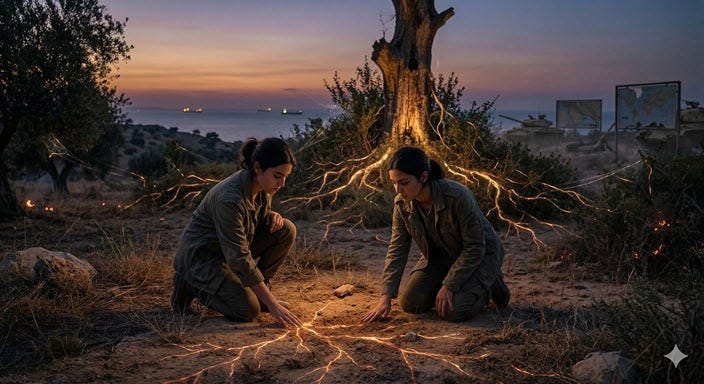
For decades, we operated under the comfort of the Great Oak—the belief that a single, central trunk of power governed the canopy. We thought that by striking the trunk, we could clear the forest. But we are waking up to a reality where the fire of our intervention has only cleared the shade for the undergrowth. The “Regime” we sought to dismantle was never a building; it was a process of influence, a rhythmic pulse of deterrence that has now decentralized into ten thousand autonomous thorns. We are exhausted because we are fighting a noun with our hands, while the verb—the relentless, adaptive spreading of a network—moves beneath our feet. Our effort is an extractive leak, a massive output of kinetic force that returns to us only as the heat of increased complexity. We are trying to manage a forest by counting the trees, while the soil itself is changing composition.
In the quiet hours of the command center, a young analyst finally looked away from the satellite feeds and toward the flow of the tide. She realized that the “Enemy” wasn’t a person to be deleted, but a relationship to be recalibrated. She saw that every time we applied “Forced Pressure,” we weren’t breaking a link; we were hardening it. The “Aha!” didn’t come from a new weapon, but from the sudden, chilling clarity that our superior force was the very nutrient the undergrowth required to thrive. To change the forest, she stopped trying to kill the fire and started looking at the moisture in the soil. She began to treat security not as a wall to be built, but as an osmotic flow—a balance of pressures that requires the health of the entire ecosystem to remain stable.
To the visionaries among us, this is the beauty of the invisible. It is the realization that we are not separate from the map; we are the ink. We are part of the bundle of relationships, and our every move sends a ripple through the network that eventually washes back onto our own shores. To the pragmatists, this is the toolkit of reality. It means we stop wasting our “Time-Span of Discretion” on bureaucratic nouns that cannot keep pace with the kinetic verbs of the street. It means shifting our “Stop Rules” from the destruction of targets to the verification of intent. It reduces the friction of war by acknowledging the physics of the system: you cannot win a war against a process; you can only participate in its evolution.
We must grieve the safety of the old labels. It was comforting to believe there was a “Bad Object” that, once removed, would leave us in peace. That was the lie that felt like a shield. The truth is heavier, but it is also more hopeful. We are the architects of a new understanding, moving from the crude mechanics of “Trial & Error” to the sophisticated grace of “Trial & Learning.” We are no longer trying to “fix” the Middle East as if it were a broken machine; we are learning to garden a wild and ancient landscape. Thank you for staying at the table when the old maps failed. Thank you for having the courage to see the verbs, to feel the energy, and to realize that the only way to hold the forest is to become part of its growth.
Systemic Reflection & Stakeholder Notes
First Principles & Foundational Axioms
The system is governed by the Law of Requisite Variety, which states that for a sovereign system to be stable, its internal complexity must match the complexity of the environment it seeks to control. The “Noun-based” military approach fails because its internal variety is lower than the “Verb-based” decentralized network it opposes.
Core Wisdom & Systemic Paradoxes
The Paradox of Ownership is at play: The more we try to “own” the security of the region through unilateral force, the less security we actually possess. By attempting to control the “Tank” (the static object), we lose influence over the “Flow” (the relational process). This mirrors the Limits to Growth archetype, where the “growing” loop of the resistance network is fueled by the “limiting” loop of external pressure.
Leverage Points
The Paradigm Shift (Highest Leverage): Moving from “Entity-Based Targeting” to “Relational Integrity.”
The Rules of the System (High Leverage): Changing the “Stop Rules” from achieving a surrender (a noun) to establishing a feedback loop (a verb).
Information Flows (Mid Leverage): Reducing “Relational Latency” by creating real-time de-escalation channels that match the “Time-Span of Discretion” of drone-speed conflict.
Stakeholder Resonance Mapping
The Visionaries: They are moved by the shift from the “Grave of Labels” to the “Life of Processes.” They find hope in the idea that peace is a dynamic equilibrium rather than a static treaty.
The Pragmatists: They see the “Toolkit” as a way to stop “Fixes that Fail.” By identifying “Relational Latency,” they can physically point to why current strategies are hitting a wall of diminishing returns.
The Kinetic First Domino
The movement begins when a leader publicly defines the “Current Reality” not as a “War against Iran,” but as a “Collision with a Systemic Feedback Loop.” This honesty collapses the “Tank Delusion” and forces the system into a state of Trial & Learning.
While the story provides the what, the following model provides the why of the situation. You can find additional information and download the model from the Iran War Aha! folder. Learn to build these models at Free AI Tools.
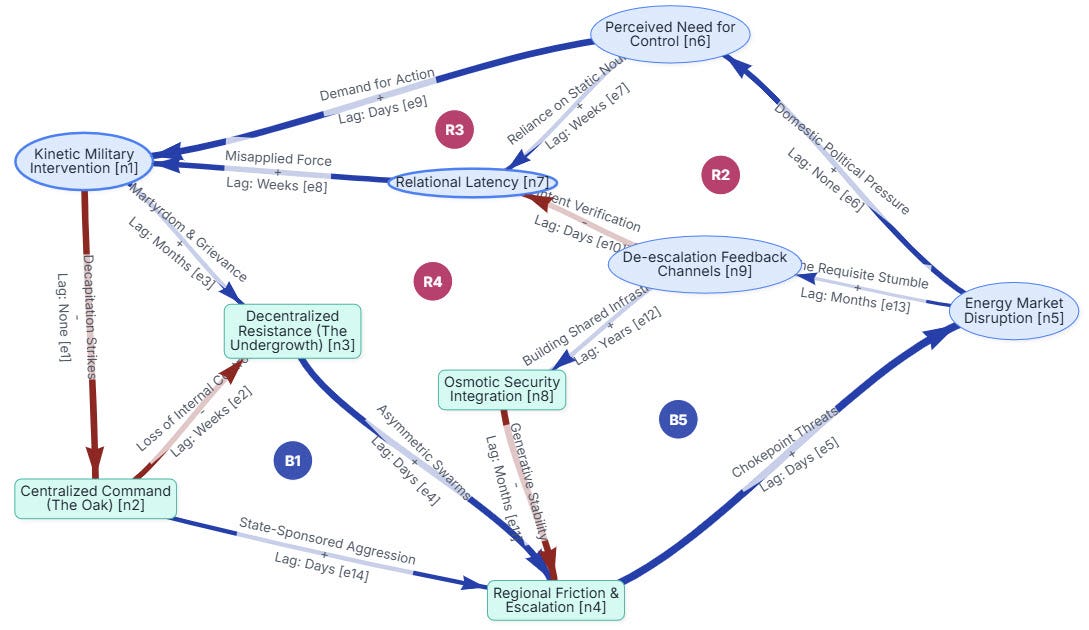
As I read the story and looked at the diagram of the system, it occurred to me that that described and illustrated system did not include the source and inspiration of the money. My hypothesis is that Sheldon and Miriam Adelson's 1.5 billion in known money and probably another billion in hidden subsidies have supported Netanyahu and the Republican party since 2000 or so. And that these two individuals with clear policies and a direct phone to the white house and to Netanyahu have been able to direct the policies of the USA and Israel. To verify my hypothesis, use AI to list the Adelson's desired policies and then check what happened. You can see my Gemini Deep Research here https://docs.google.com/document/d/19kW-cSqyIhbQV7IJqcE8eKC6XoiZuF1C1IUsiVIQbg0/edit?usp=sharing