
The Homecoming Paradigm: Reshaping Economic Resilience
An Aha! Paradox

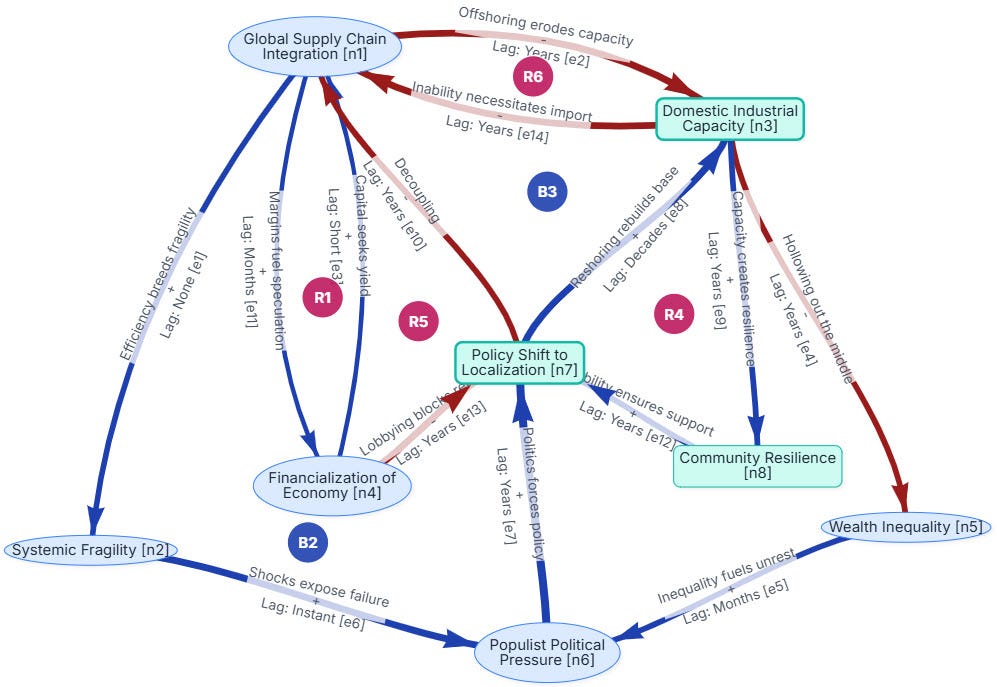
With many thanks to Rana Foroohar for Homecoming: The Path to Prosperity in a Post-Global World
The Hands of Ironwood
A Story of Economic Rebirth
Plot Archetype: Rebirth
Core Dynamic: Breaking the “Capability Trap” (R6) and establishing “Community Resilience” (n8).
The Winter of Efficiency
The silence in Ironwood was not the quiet of peace; it was the quiet of a stopped heart.
Henry stood before the chain-link fence of the old stamping plant, his breath clouding in the freezing January air. For thirty years, this plant had been the lungs of the town, breathing in steel and breathing out chassis parts. Now, it was a hollow shell, gutted ten years ago when the Private Equity firm from New York decided that Ironwood’s “Domestic Capacity” (n3) was an inefficient line item.
They had moved the machinery to a province in Guangdong. They promised cheaper cars, cheaper phones, and a “frictionless” economy. And for a while, the “Neoliberal Flywheel” (R1) spun beautifully. The shelves at the local big-box store were full of cheap goods, even if the pockets of the people buying them were increasingly empty (n5).
But tonight, the efficiency had frozen over.
A polar vortex had descended, shattering records and snapping the main regulator valve on the county’s district heating system. In the old days, the plant maintenance crew would have machined a replacement in three hours.
“I checked the tracking number again,” said Maya, Henry’s granddaughter. She held up her phone, the blue light illuminating her worried face. “The replacement valve is stuck in a container ship off the coast of Los Angeles. They say the port is backed up. Four weeks, maybe five.”
Henry looked at her. “The town will freeze in four days, Maya.”
“I know, Grandpa. But there’s no inventory. No slack. Just-in-Time delivery means it’s not here.”
This was the “Systemic Fragility” (n2) they had been warned about. The system was lean, optimized, and perfect—until it encountered reality. The shock (e6) had hit, and the town was naked.
The Capability Trap
They sat in Henry’s garage, wrapped in blankets. The garage was a museum of the old world—cluttered with tools, scraps of copper, and the smell of grease.
“We have to make it,” Henry said.
Maya shook her head. “Make a high-pressure regulator valve? Grandpa, we don’t have the specs. We don’t have the CNC machines. That stuff is gone.”
“I have a lathe,” Henry said, pointing to the corner. “I have a Bridgeport mill from 1978.”
“And I have a 3D scanner on my iPad,” Maya whispered, a thought forming.
They went to work. But this was where the “Capability Trap” (R6) revealed its teeth. Henry’s hands, once steady as stone, shook with age. He reached for a caliper and realized he had forgotten the specific tolerance for the flange. The knowledge—the “tacit capacity”—had atrophied.
“I can’t remember the thread pitch,” Henry cursed, throwing a wrench onto the bench. “We let it go, Maya. We forgot how to do this because it was cheaper to let someone else do it.”
The first attempt failed. The metal shattered.
The second attempt failed. The seal leaked.
The “Davos Defense” (R5) whispered in their ears: It’s too hard. It’s too expensive. Just wait for the ship. Just wait for the experts.
The Spark of Resilience
But the cold was a powerful motivator. Neighbors started showing up. Not to complain, but to help. Jim, a laid-off logistician, scoured the scrapyards for the right grade of steel. Sarah, a software engineer working remotely for a Silicon Valley firm, helped Maya program a workaround for the milling path.
The “Populist Pressure” (n6) that usually vented itself in angry online forums was suddenly transmuted into “Community Resilience” (n8). They weren’t waiting for a policy shift from Washington. They were enacting the Homecoming right there in the freezing garage.
On the third night, the lathe sang. It wasn’t the high-pitched whine of a modern robot; it was the low, rhythmic grumble of Henry’s manual machining. Maya fed him the measurements; Henry turned the wheels. Old hands guiding new data.
When they bolted the valve into the district main, it didn’t look like the shiny, mass-produced part from overseas. It was rough. It was heavy. It was “inefficient.”
But when they opened the intake, the valve held. The pressure climbed. The heat returned to Ironwood.
The Aftermath
The container ship arrived six weeks later. By then, Ironwood didn’t need it.
The crisis had shifted something deep in the town’s psyche. The “Policy Shift” (n7) started locally. The town council voted to subsidize a new fabrication maker-space in the empty shell of the old plant. They weren’t trying to compete on price with the global supply chain. They were paying a premium for the privilege of never being helpless again.
Henry stood by the fence again, spring thawing the ground. The plant was still mostly empty, but he could hear the hum of a single machine inside. It was the sound of a heartbeat restarting.
They had paid a high price for efficiency, but they had found their way home.
Stakeholder Modifications
Here is how to adapt this story to resonate with specific audiences involved in the system:
1. For The Policymaker / Legislator
The Hook: Focus on National Security and Stability (Loop B2).
The Narrative Shift: Frame the freezing town not just as a tragedy, but as a national security vulnerability. If a storm can shut down a town because of a missing valve, what could a foreign adversary do?
The Moral: “Mr./Ms. Senator, Henry represents the voters you are losing. Maya represents the future you need to secure. The CHIPS Act isn’t about economics; it’s about the sovereignty of our infrastructure. We aren’t subsidizing a factory; we are buying insurance against chaos.”
2. For The Corporate Leader (CEO / CFO)
The Hook: Focus on Risk Management vs. Efficiency (Loop R1 vs. R4).
The Narrative Shift: Retell the story from the perspective of the utility company that owns the heating grid. Calculate the cost of the lawsuit from the frozen town versus the cost of warehousing spare parts locally.
The Moral: “We saved $40 on the valve by sourcing it from overseas, but we lost $40 million in reputational damage and emergency repairs. The story of Ironwood proves that ‘redundancy’ is actually ‘reliability.’ Resilience is a competitive advantage.”
3. For The Labor Union / Community Organizer
The Hook: Focus on Dignity and Inequality (Node n5 and Loop R6).
The Narrative Shift: Emphasize the shame Henry felt when he couldn’t remember how to work, and the pride restored when they fixed it. Focus on the collaboration between the old blue-collar skills and the new white-collar tech (Maya).
The Moral: “They told us our labor was too expensive. They told us we were obsolete. But when the world broke, the algorithms couldn’t fix it. We did. The Homecoming is about reclaiming the dignity of our hands. We need to demand investment in skills, not just handouts.”
The Aha! Paradox
1. The Anchor (The Delusion)
The Cult of Frictionless Efficiency. The load-bearing delusion holding the current system together is the belief that redundancy is waste. We have accepted a “flat world” dogma where the only metric that matters is the lowest immediate unit cost. We assume that borders are obsolete, that logistics will always be fluid, and that the “Just-in-Time” delivery of goods is a permanent triumph of engineering rather than a temporary stroke of luck. We believe the economy is a machine to be optimized, not an ecosystem to be sustained.
2. The Default (The Status Quo)
The Race to the Bottom. Driven by the “Neoliberal Flywheel” (Loop R1), the standard path is to aggressively strip-mine the supply chain for “fat.” CFOs and consultants systematically eliminate inventory buffers, consolidate suppliers to single sources in distant regions, and offshore labor to whichever coordinate offers the cheapest wage this quarter. This creates a “lean” balance sheet that looks beautiful in a quarterly report but structurally fragile in reality. It is a system designed to maximize profit in a perfect world, but destined to collapse in a real one.
3. The Bottleneck (The Constraint)
The “100-Mile” Embargo. To break this thinking, we impose a brutal constraint: You are forbidden from importing any critical input for your primary product from outside a 100-mile radius. The Insight: Suddenly, “lowest unit cost” becomes irrelevant. The only metric that matters is existence. You realize that your “efficient” global supply chain wasn’t an asset; it was a liability that outsourced your survival to strangers. You see that “local capacity” (Node n3) isn’t a sentimental nostalgia; it is the only true security you have.
4. The Collision (The Isomorph)
Biological Homeostasis (The Human Body). If we force the Global Economy to collide with Human Biology, we see the error instantly. If a Private Equity firm managed the human body, they would call having two kidneys “inefficient redundant capacity” and sell one. They would view 20% body fat as “idle inventory” and starve you to 0% to reduce weight. They would view sleep as “unproductive downtime” and eliminate it. The Synthesis: The body is “inefficient” by design because it is optimized for survival, not quarterly returns. It carries “waste” (fat, spare organs, antibodies) because that waste is actually insurance. The “Homecoming” model is simply the economy remembering it is a biological entity that needs an immune system (domestic capacity), not a machine that needs to run hot until it breaks.
5. The Reversal (The Truth)
Efficiency is Fragility. The core assumption is flipped: “Waste” is not waste; it is Slack. The “inefficiency” of a local factory (higher wages, higher costs) is actually the premium you pay for the insurance policy of resilience. The “friction” of borders and tariffs is not a bug; it is a necessary membrane that protects the cell from infection. The truth is that optimization is the enemy of longevity. To survive, you must be slightly inefficient.
6. The Kinetic Result (The Action)
The Aha! Insight: The economy is not a spreadsheet; it is a root system. You cannot sever the roots (local capacity) to save money on water and expect the tree (the nation) to stand when the wind blows.
The First Domino: The “One-Component” Audit. Do not try to reshore everything today. Look at your Bill of Materials (BOM) or personal life requirements. Identify one critical component that currently relies on a single offshore source. Immediately contract a local/regional supplier for 20% of that volume, willingly paying the higher price. That 20% “loss” is the price of your independence.
Summary Analysis
First Principles
Law of Requisite Variety: Only variety (complexity/redundancy) can absorb variety (shocks). A simplified, efficient system cannot survive a complex, chaotic environment.
Tragedy of the Commons (Inverted): Private efficiency creates public fragility. When every company optimizes for itself, the collective system becomes brittle.
Core Wisdom
“Resilience is expensive, but it is the only thing that is not optional.”
“You can buy efficiency, but you have to build capacity.”
Leverage Points
The “Capability Trap” (Loop R6): This is the most dangerous loop. Breaking it requires accepting the initial pain of “re-learning” how to make things. The leverage point is subsidizing the learning curve, not just the final product.
The “Davos Defense” (Loop R5): The blockage is political, not economic. The leverage point is narrative control—reframing “protectionism” (a negative word) as “security” or “stewardship” (positive words) to bypass the lobbying defense.