
The Autophagic Democracy

System Diagnostic: The Autophagic Democracy
Auditor Report | Global Count Protocol Applied
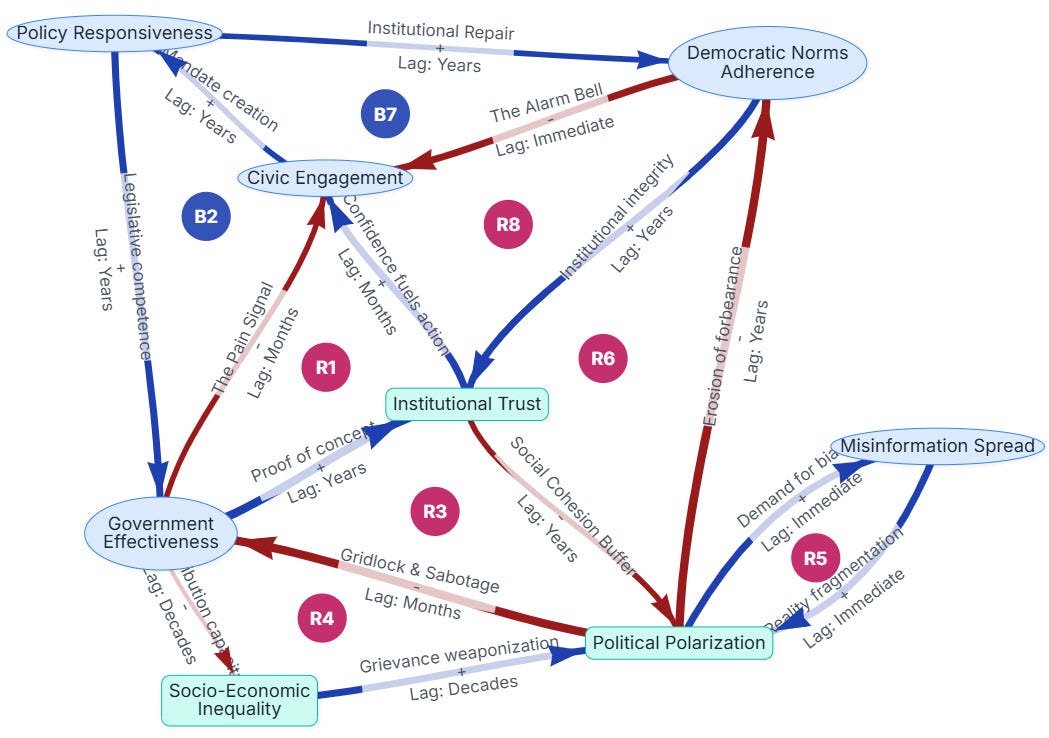
1. The Mundane Baseline (Legacy Code)
Loop R1: The Democratic Dividend
This is the system’s “happy path”—the legacy code written by the architects. In this ideal state, Institutional Trust reduces transaction costs, fueling Civic Engagement. This engagement creates a clear mandate for Policy Responsiveness, which drives Government Effectiveness. The tangible success of the state then replenishes the reservoir of Trust.
Status: This loop is mathematically sound but currently starved of resources. It relies on a “Proof of Concept” link that is being intercepted by faster, more volatile loops.
2. The Surface Glitch (Failed Defense)
Loop B2: The Reform Correction
This is the system’s first-line immune response. When Effectiveness drops, it should trigger a “Pain Signal” that angers the public, forcing Engagement and Correction.
Failure Mode: The signal is jamming. Instead of pain triggering useful correction, the delay (lag) is too long. The loop is trying to execute a “self-correcting” patch, but the signal is being drowned out by the noise of polarization. The system feels the pain, but the administrative reflexes (Policy Responsiveness) are too slow to mitigate it before the parasitic loops take over.
3. The System Truth (Parasitic Code)
Loop R3: The Legitimacy Crisis
This is the dominant loop currently executing in the kernel. It has hijacked the variables from R1 and B2.
Here, Institutional Trust is low, which bypasses Engagement and instead routes directly to Political Polarization via the “Social Cohesion Buffer” failure. High polarization creates Gridlock, which actively sabotages Government Effectiveness (n4). This failure confirms the public’s suspicion that the government is broken, draining Trust further.
Diagnosis: This is an autophagic (self-eating) cycle. The system is consuming its own legitimacy to fuel tribal identities. While R1 builds capacity linearly, R3 destroys it exponentially.
4. The Compounding Factors (Contextual Loops)
These loops are not the root cause, but they are the reason the root cause is becoming fatal. They lock the system into the R3 failure state.
R4: The Inequality Trap: Because the government is paralyzed (R3), it cannot redistribute wealth or opportunity. This growing gap fuels the polarization that paralyzed the government in the first place.
R5: The Echo Chamber: To rationalize the polarization caused by R3, users retreat into information bubbles. This acts as a “reality shield,” preventing any factual data about government performance from penetrating.
R6: The Cynic’s Spiral: As R3 destroys trust, users stop believing in norms. The violation of norms confirms that “everyone else is cheating,” which justifies further violations.
B7: The Constitutional Defense: This is the “break-glass-in-emergency” loop. It tries to mobilize civil society when norms are shattered. However, it is currently overwhelmed by the speed of the Echo Chamber (R5).
R8: The Legitimacy Cycle: The potential for ethical behavior to rebuild trust without material output. Currently dormant because the “noise” from R3 and R6 is too loud.