
Tesla: A Deeper Dive

Model Explanation and Future Implications
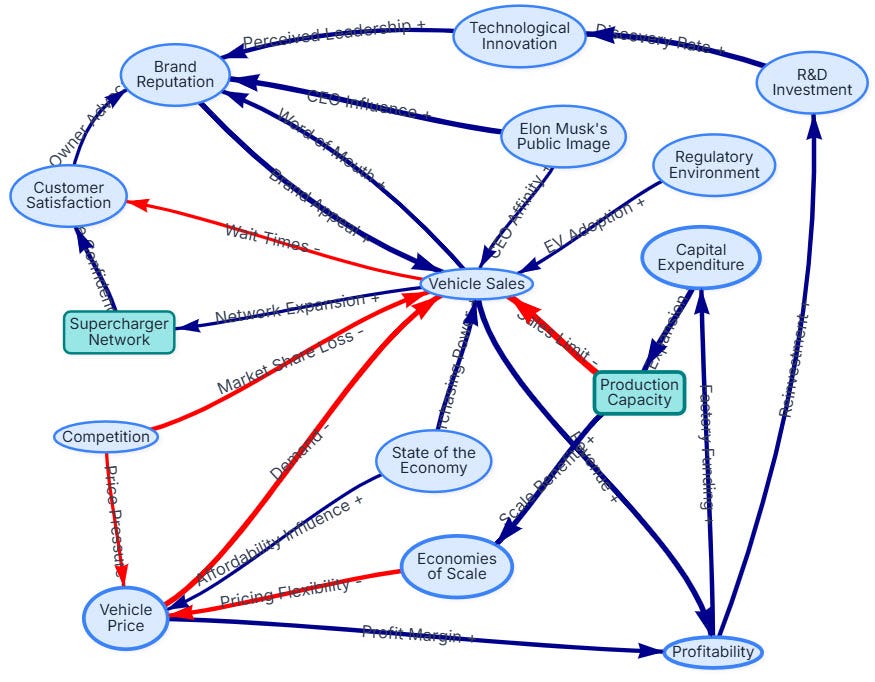
Source: Tesla
Model Explanation:
This causal loop diagram models Tesla not as a static company, but as a dynamic, living system. It's a web of interconnected feedback loops where each element influences others over time. The system's behavior is driven by two main types of loops:
Reinforcing (R) Loops (The Engines): These are the engines of growth. Loops like R1 (The Flywheel of Reputation), R2 (Innovation Fuels the Brand), and R4 (Scaling to Dominate) create virtuous cycles. For example, more sales enhance brand reputation, which drives more sales. This exponential behavior is responsible for Tesla's rapid rise.
Balancing (B) Loops (The Brakes): These are the constraints and pressures that slow down growth. B3 (Wait Time Dissatisfaction) is an internal brake where success (high sales) leads to a problem (long waits) that pushes back against further growth. External factors like Competition, the State of the Economy, and the volatile Elon Musk's Public Image also act as powerful brakes on the system.
Future Implications:
The future of Tesla, as implied by this model, is not a single guaranteed path but a dynamic tug-of-war between its reinforcing and balancing forces. Three primary scenarios emerge:
Sustained, Transformed Growth: If the company can successfully weaken its balancing loops (e.g., by solving production bottlenecks and professionalizing its brand image separate from its CEO), the powerful reinforcing loops of innovation and scale could continue to drive growth. The future would see Tesla maturing from a personality-driven disruptor into a resilient industrial leader.
Stagnation and Normalization: If the negative pressures from the balancing loops (especially
Competitionand a volatilePublic Image) become equal in force to the reinforcing loops, the company's growth will plateau. It will cease to be an exponential disruptor and become just another major automaker, forced to compete on traditional metrics like price and efficiency, losing its innovative edge.Tragic Decline: This scenario occurs if a key reinforcing loop is broken. Specifically, if the CEO's
Public Imagecontinues to decline, it could permanently tarnish theBrand Reputation. This would cripple the R1 "Flywheel of Reputation," the company's primary growth engine. Without this engine, the company becomes vulnerable, and the system could enter a reinforcing downward spiral where falling sales reduce profitability, leading to cuts in R&D and a loss of the very technological edge the company was built on.
2. Primary Insights of the Model
The Growth Engine is Intangible: The model reveals that Tesla's core strength isn't just manufacturing; it's the powerful reinforcing loops between Brand Reputation (R1) and Technological Innovation (R2). The company's value is deeply tied to these intangible assets.
Success Creates Its Own Bottlenecks: The "Limits to Growth" archetype is clearly visible. Rapid growth in sales naturally creates limiting factors like production capacity constraints and long customer wait times, which can damage the brand and slow the very growth that caused them.
Extreme "Key-Person" Vulnerability: The model starkly illustrates that the
Elon Musk's Public Imagenode is a uniquely powerful and volatile variable. It acts as a system-wide lever that can either supercharge or cripple the brand, independent of the company's actual performance or product quality. This represents the single greatest systemic risk.Macroeconomic Susceptibility: Despite its identity as a tech company, the
State of the Economynode shows that Tesla is fundamentally a manufacturer of a high-cost, discretionary consumer product. It is therefore highly susceptible to economic downturns, which can suppress sales and put pressure on pricing, affecting the entire system.
3. Primary Archetypes Driving the Model
Limits to Growth: This is the dominant archetype of the entire model. The "growth engines" are the reinforcing loops (R1, R2, R4) that drive sales, innovation, and production. The "limiting condition" is a collection of pressures: internal constraints like
Production Capacity, and external forces likeCompetition, theState of the Economy, and the unpredictable variable ofElon Musk's Public Image. The central story is the struggle of the growth engines against these rising pressures.Success to the Successful: This archetype is visible within the competitive landscape. The R1 "Flywheel of Reputation" allows Tesla to attract the best talent, generate hype, and capture market share, which in turn generates profits that can be reinvested to further widen its lead. Its success starves competitors of the oxygen (market share, talent, attention) they need to thrive.
Eroding Goals (A Potential Risk): While not fully formed, the structure for this archetype exists as a future threat. If negative pressure on
Vehicle Price(fromCompetitionor a badEconomy) andBrand Reputation(fromPublic Image) becomes too great, there could be a temptation to weaken theR&D Investmentloop to cut costs. This would "erode" the core goal of technological leadership in favor of short-term market share, leading to a long-term decline in competitiveness and brand value.
4. Leverage Points (Donella Meadows Hierarchy)
Identifying leverage points allows for finding the most effective places to intervene in the system.
9. Length of Delays: A moderate leverage point. Reducing the delay between
Capital Expenditureand increasedProduction Capacity(i.e., building factories faster) would weaken the "Limits to Growth" pressure and allow sales to keep pace with demand.6. Strength of Feedback Loops: A high leverage point.
Strengthening Reinforcing Loops: Pouring resources into R&D to accelerate the
Innovationloop (R2) would strengthen Tesla's core competitive advantage.Weakening Balancing Loops: A concerted effort to improve
Customer Satisfactionthrough better service would weaken the negative impact of long wait times (B3).
4. The Power to Add, Change, Evolve, or Self-Organize System Structure: A very high leverage point. The system is currently structured with an extreme dependency on the CEO. A structural change, such as elevating a strong COO or President to be the public face of the company for operational and brand matters, would introduce a new stabilizing element, making the system more resilient and less dependent on a single, volatile node.
2. The Mindset or Paradigm out of which the System Arises: This is the highest leverage point.
Current Paradigm: "Tesla's success is a product of a singular, unpredictable genius." This paradigm makes the company and its stakeholders accept the extreme volatility associated with its leader.
Leveraged Paradigm Shift: Changing the paradigm to "Tesla's success is a product of its mission to accelerate the world's transition to sustainable energy, executed by a resilient and innovative organization." This shift in mindset is the most profound intervention. It involves consciously and publicly separating the identity of the company from the identity of the CEO. It means the board, investors, and employees begin to see the company's enduring value in its mission, people, and technology, rather than just in its founder. Transcending the "hero-CEO" model is the most powerful lever to ensure the long-term health and stability of the entire system.
I'm not sure Tesla can be modeled in a vacuum without Optimus, batteries/Tesla Solar, SpaecX, the Boring company, Skylink, and eventually nueralink. Not sure how X fits. But all of these are components of building out life on Mars. You might need a mega-model for that!