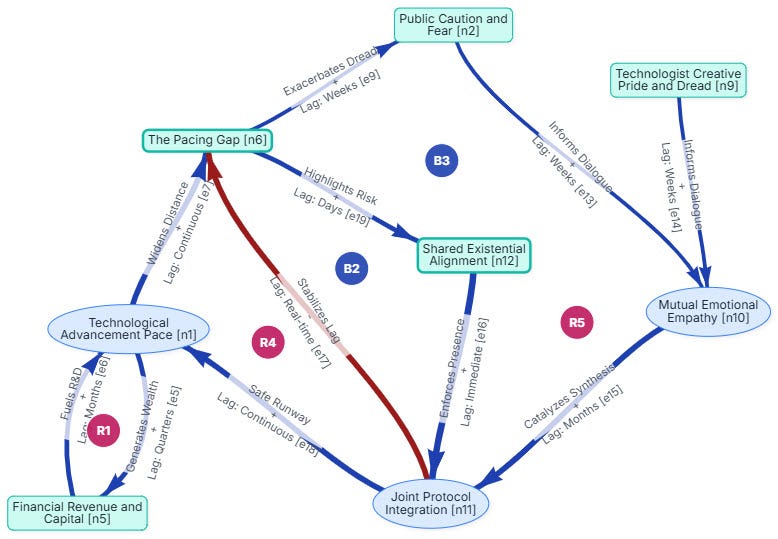
Technological Acceleration vs Regulation
An Aha! Mystery - Deciphering the Mess

The “Nuclear-Powered AI” De-Regulation Push
The Current Event: To fuel the staggering energy demands of 1-gigawatt hyperscale data centers, tech conglomerates are rapidly buying up power from nuclear facilities, prompting intense legislative debates over fast-tracking environmental and safety permits.
The “Aha!” Angle: It looks like a win-win: clean energy solving a massive tech-infrastructure constraint. However, bypasses in regulatory oversight risk creating systemic vulnerabilities. A single operational oversight could trigger a massive public backlash, resulting in sudden, heavy-handed regulations that freeze data center growth globally.
The Question: How do we map the tension between exponential technological acceleration and the linear, protective boundaries of regulatory safety?
The Architecture of the Unseen Runway
The air inside the room was heavy with the exhaustion of an endless, invisible war. For years, the brilliant minds who pushed the boundaries of human capability had operated under a quiet, exhausting delusion: that speed was an unalloyed victory, and that any attempt to slow down to accommodate human anxiety was a form of creative death. On the other side of the chasm, the public sat paralyzed by a creeping, load-bearing terror, watching a technological engine accelerate into the fog while holding onto the fragile, desperate belief that a static piece of legislation or an emergency shutdown switch could protect them. Millions of dollars and lifetimes of human intellect were being poured directly into this friction—an extractive cycle of action, fear, defensive workaround, and bureaucratic gridlock. It was a massive energy leak, a systemic tragedy where the watcher and the creator stood back-to-back, burning their best energies just to keep from being swallowed by the dark. The undeniable truth of the situation was painfully simple: the distance between our ability to innovate and our ability to comprehend had become an existential chasm, and trying to bridge it with walls was only causing the ground beneath both sides to crumble.
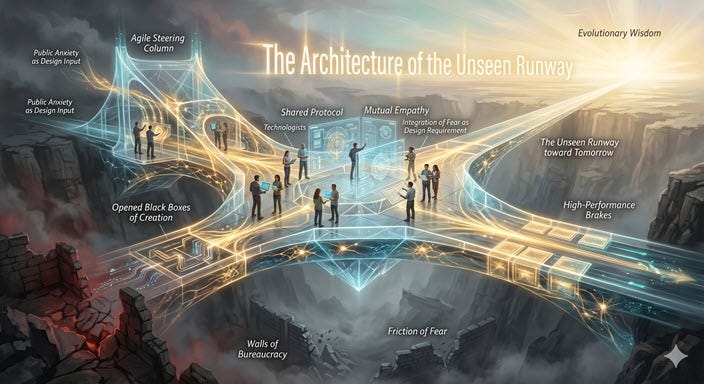
The breakthrough did not come from an algorithm or a new piece of legislation, but from a single, quiet realization that reshaped the entire geometry of the struggle. It began when a weary architect of these new systems sat across from an equally exhausted representative of a vulnerable public, stripped away the defensive corporate taglines and the political armor, and asked a raw, human question: Do we both want to be alive tomorrow? In that sudden, blinding moment of alignment, the adversarial landscape vanished. The realization rippled through the room like a sudden clearing of the fog—an absolute “Aha!” that reshaped their exhaustion into an active, shared quest. They realized that human fear wasn’t a bureaucratic roadblock to be bypassed, and creative pride wasn’t an engine to be caged. They were two halves of the same living organism. The first critical move was to stop building walls and instead establish a shared sandbox—a joint protocol built not on compromise, but on mutual integration. Technologists opened the black boxes of their creation to map out societal vulnerabilities, while the public articulated its fear not as a demand for a shutdown, but as a design requirement for safety.
They looked at the massive gap between them and no longer saw an external enemy to be defeated, but rather a predictable, organic threshold—a classic limit where unchecked growth threatens its own soil. They recognized that if the engine kept accelerating without expanding the human capacity to guide it, the system would inevitably collapse under the weight of its own volatility. But by feeding public anxiety directly into an engine of mutual empathy, the nature of the gap shifted. The pragmatists in the room sat up, suddenly seeing how an agile, real-time steering column reduced the daily friction of compliance, making the chaotic landscape intensely manageable. The visionaries looked deeper, marveling at the beauty of the invisible connection that had been forged: the protocol was no longer a cage designed to slow the vehicle down, but an incredible set of high-performance brakes designed specifically so that the vehicle could safely go faster than ever before. Security became the very fuel for speed. As the new architecture settled into place, a deep, resonant quiet filled the space. The trial and learning of the long journey had left scars, but it had also left a profound evolutionary wisdom. Thank you to those who stayed in the room when the tension rose, who refused the cheap comfort of compromise, and who had the courage to sit in the friction until it transformed into a safe, open runway toward tomorrow.
The Story source file also contains First Principles, Core Wisdom, Systemic Paradoxes, Leverage Points, and Stakeholder Resonance.
The Story conveys what, the model shows why, and the transcript explains how. You can access the files associated with this post in the “Tech Acceleration and Regulation” folder. To try the Aha! Mystery process, send systemswiki@gmail.com an email, and I’ll send you the prompts.
The dialogue, if you care to read it: https://gemini.google.com/share/00d4aff22195
Unique Perspectives on the Topic
The Friction of Innovation v1
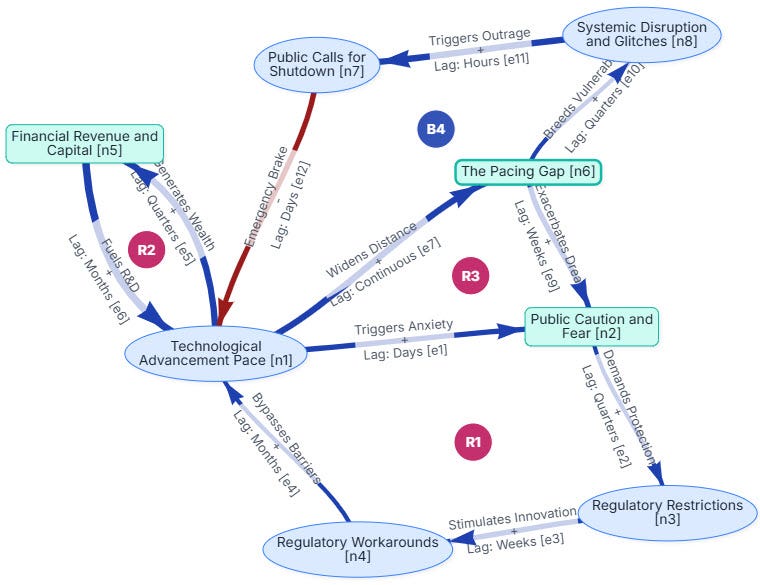
The Friction of Innovation v2