
Technological Acceleration vs Public Trust
An Aha! Mystery - Deciphering the Mess

The “Deepfake Physician” Crisis & The Erosion of Institutional Trust
The Current Event: The American Medical Association (AMA) just rolled out a major policy framework to protect doctors’ identities from unauthorized AI deepfakes used to sell unproven medical treatments.
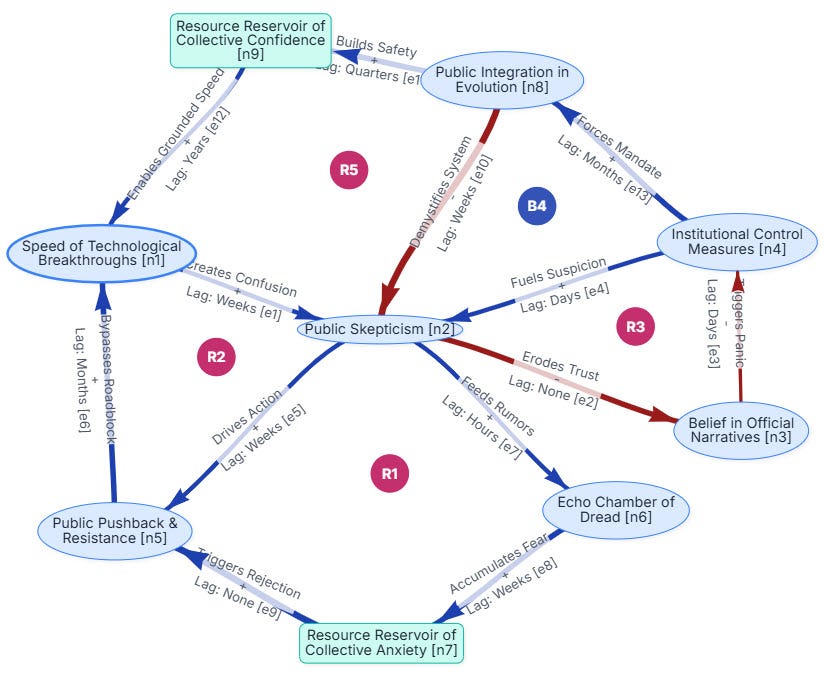
The “Aha!” Angle: On the surface, this looks like a straightforward security or legal issue. But systemically, it’s a fascinating Feedback Trap. As trust in traditional medical institutions weakens, people look for alternative solutions. Scammers use AI to exploit that search, which leads to harmful health outcomes, which further degrades trust in the entire medical system.
The Question: How do we map the relationship between technological acceleration and the psychological fragility of public trust?
The Architecture of the Open Door
The air in the city crackled with a relentless, frantic hum. For years, the builders in the glass towers had operated under a single, load-bearing delusion: that velocity was the only true metric of progress. They pushed their shimmering, complex inventions into the streets at breakneck speed, convinced they were delivering the future. But down in the squares, the people did not see miracles; they saw a storm they could not comprehend. This was the undeniable truth of the situation—progress had become a force of profound alienation. Energy was bleeding out everywhere in this extractive, defensive dance. The people huddled together, pooling their doubts into a deep, heavy reservoir of collective anxiety, whispering in echo chambers that amplified their dread. Meanwhile, the builders, frustrated by the public’s sudden, visceral rejection of their gifts, wasted immense effort trying to force acceptance. They built high fences of regulation, dispatched armies of messengers to dictate the official narrative, and tried to control the panic from the top down. Yet, every attempt to manage the friction only poured gasoline on the fire of suspicion. The harder the builders pushed to outrun the resistance, the taller the invisible wall between them grew. It was a tragic limit to their growth, a self-feeding trap made entirely of their own blind ambition.
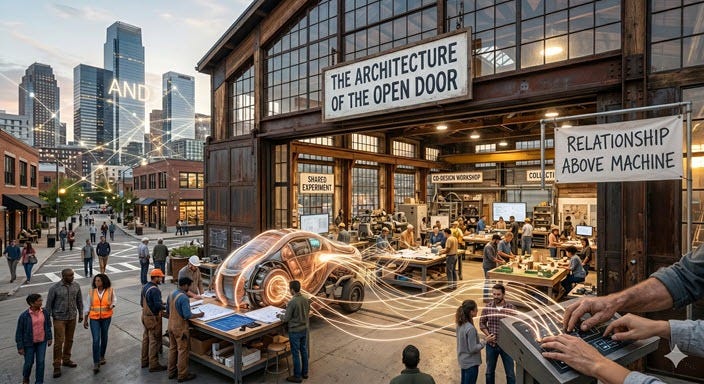
Exhaustion finally settled over both the towers and the town. The builders were drained from fighting the very people they claimed to serve, and the people were weary from living in a permanent state of defensive crouch. It was in this heavy, stagnant quiet that a new kind of architecture was proposed—one that saw not enemies, but the invisible, fractured connections crying out for repair. The realization struck like a sudden dawn: they did not have to choose between the speed of the future and the psychological safety of the present. They needed to embrace the “And.” The critical move was radical in its vulnerability. The builders were asked to lay down their megaphones and, instead, unlock the heavy iron doors of their workshops. They invited the townspeople inside, not as consumers to be managed, but as partners in a grand, ongoing experiment of trial and learning. They built open sandboxes where the community could touch the gears, question the blueprints, and co-design the mechanics of tomorrow.
In these shared spaces, the magic of realigned energy took hold. For those who looked to the horizon, the beauty of the invisible connections became vibrantly clear—the technology was no longer an alien artifact, but a living, breathing reflection of their shared humanity and collective agency. For the pragmatists on the workshop floor, the relief was palpable; the agonizing friction of protests and desperate PR campaigns vanished, making the daily reality of building and living infinitely more manageable and grounded. The dread drained away, replaced drop by drop with a deep, sustaining reservoir of collective confidence. Yet, a quiet, sacred understanding remained at the heart of this new world: this newfound trust was not merely a green light to carelessly accelerate again. If they ever mistook this hard-won partnership as an excuse to return to their old, blind velocity, the trap of suspicion would spring shut once more. And so, they moved forward together, valuing the relationship above the machine. Thank you to the builders who learned to listen, and to the brave citizens who found the courage to step inside the workshop, for proving that the greatest breakthroughs are never just built—they are shared.
The Story source file also contains First Principles, Core Wisdom, Systemic Paradoxes, Leverage Points, and Stakeholder Resonance.
The Story conveys what, the model shows why, and the transcript explains how. You can access the files associated with this post in the “Tech Speed and Trust Frability” folder. To try the Aha! Mystery process, send systemswiki@gmail.com an email, and I’ll send you the prompts.
Technological Acceleration vs Public Trust
If you wander through the dialogue a bit, you’ll find this exchange quite different than all previous ones, and possibly the best one yet. The initial prompt was:
The dialogue, if you care to read it: https://gemini.google.com/share/f81baa68b83e
Oh. By the way. Great graphic.
Gene, I can understand yours. pride in this story. It articulately described an important part of the system I wonder if you approach could embody the complexity of the larger system that would need to follow the money, that acknowledges that we are in late stage capitalism in which owners seldom cooperate with the public, where secrecy and bloody competition with other builders is in full force, where the US is in existential survival competition with emerging China, and according to recent research showing that the billionaires controlling these companies are mentally ill in that their brains measured by MRI no longer feel empathy for other human beings. Your story might work in a one world governance with a progressive democracy. Otherwise to me it's a lovely fantasy.