
Team-Based Organization: A Deeper Dive

Comprehensive Analysis of the Team-Based Organization Model
This document provides a detailed analysis of the Causal Loop Diagram (CLD) model for a “Team-Based Organization.” It breaks down the model’s core concepts, underlying principles, and strategic implications for any leader or team member.
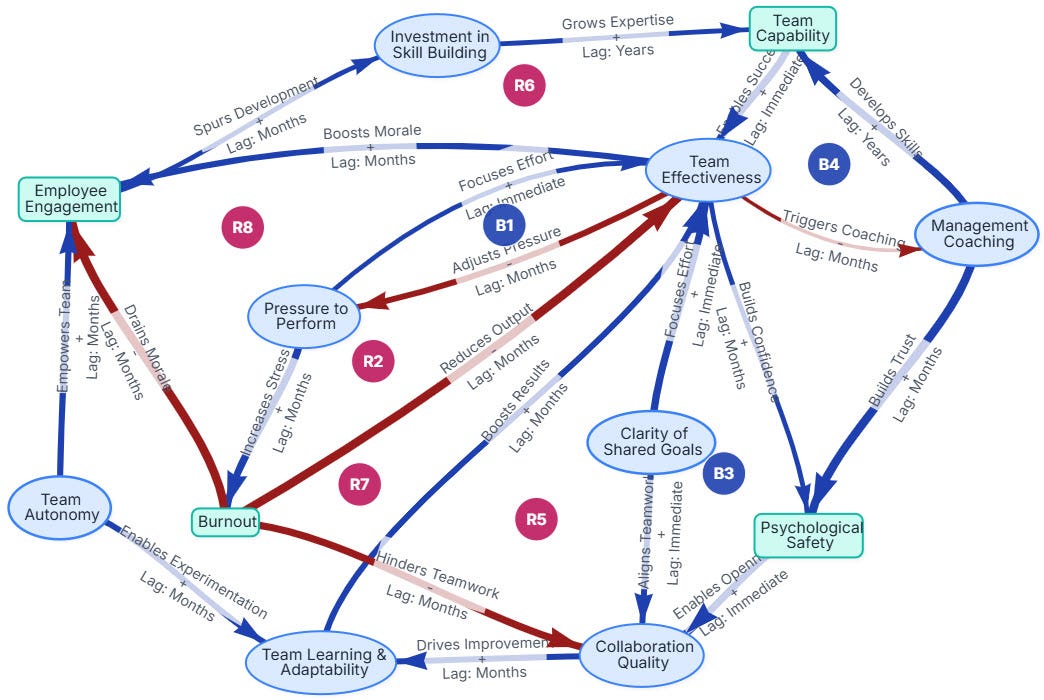
1. Model Explanation
At its core, this model describes the central tension in management: the choice between two different responses to a single problem.
The Problem:
Team Effectiveness(n4) drops.Path 1: The Symptomatic Fix: This is the fast, intuitive, and common reaction. Leadership, feeling the
Pressure to Perform(n8), applies that pressure to the team. This creates the balancing loopB1: The Pressure Fix, which can temporarily increase focus (e20) and bring effectiveness back up.Path 2: The Fundamental Solutions: This is the slow, deliberate, and difficult response. Leadership, seeing the drop in effectiveness, instead engages in
Management Coaching(n11). This coaching activates two powerful, long-term balancing loops:B3: The Fundamental Solution (Safety): Coaching buildsPsychological Safety(n1), which improvesCollaboration(n2) andLearning(n3), sustainably rebuilding effectiveness.B4: The Fundamental Solution (Capability): Coaching buildsTeam Capability(n5), which directly enables the team to be more effective (e5).
The Conflict: The model’s central dynamic is the conflict between these two paths. The “symptomatic fix” (Path 1) has a disastrous side effect: it activates the vicious reinforcing loop
R2: The Burnout Spiral, which destroys effectiveness (e12). It also ignites other spirals likeR7andR8, which actively attack the foundations of the fundamental solutions (collaboration and engagement).
The model tells the story of a “Shifting the Burden” archetype, where the easy, short-term fix (B1) not only fails in the long run but also makes it harder for the long-term, fundamental solutions (B3, B4) to ever succeed.
Source: Team-Based Organization (Archetypes Experimental)
2. Wisdom
The wisdom of this model is that how you solve a problem is more important than that you solve it.
The pursuit of a quick, visible “fix” for effectiveness is a trap. It mistakes a symptom (Effectiveness) for the root cause. True effectiveness is not a lever to be pulled; it is an emergent property that arises naturally from a healthy system.
The model teaches that a leader’s job is not to manage effectiveness but to cultivate the conditions from which effectiveness springs: Psychological Safety (n1) and Team Capability (n5). The “Pressure Fix” (B1) is the act of a director; the “Coaching Solution” (B3/B4) is the act of a gardener. The director gets a forced, temporary result and a barren field. The gardener gets a sustainable, resilient harvest, season after season.
3. Donella Meadows’ Leverage Points
This model provides clear examples of Donella Meadows’ 12 leverage points for intervening in a system.
Low Leverage (Parameters): Trying to “optimize” the amount of
Pressure to Perform(n8). This is just tinkering with the strength of the symptomatic fix.Moderate Leverage (Delays): The key to success is surviving the delay of the fundamental solutions. The links from
Management Coaching(n11) toSafety(n1) andCapability(n5) take time (months or years). A leader’s intervention is to create the organizational patience to wait for these loops to work, rather than panicking and reverting toB1.High Leverage (Information Flows): The model itself is this leverage point. By making the “Shifting the Burden” structure visible to everyone, a manager can no longer apply the
B1fix out of ignorance. The team can now ask, “Are we applying a short-term fix at the cost of long-term burnout?”High Leverage (Rules of the System): The implicit rule is “Fix low effectiveness quickly.” This forces managers to use
B1. A high-leverage intervention would be to change the rules. Imagine if managers were bonused not on their team’s short-term output, but on the quarterly growth of their team’sPsychological SafetyandTeam Capabilityscores. This one change would starve theB1andR2loops and pour energy intoB3andB4.Highest Leverage (The Paradigm): The highest leverage point is to change the entire paradigm.
Old Paradigm: “My team is a resource to be directed. My job is to apply pressure to get results.”
New Paradigm: “My team is a system to be cultivated. My job is to build safety and capability, and results will be the outcome.”
4. Knowledge
This model provides specific, factual knowledge about team dynamics:
Pressure is a Toxin:
Pressure to Perform(n8) has one weak, short-term positive link (e20) and three powerful, long-term negative links (e9, e13, e12) that create reinforcing spirals. It is, by definition, a bad intervention.Burnout is a Stock:
Burnout(n9) is not an “on/off” switch; it’s an accumulation of stress. This explains why a team can seem fine until it suddenly collapses—the stock was already full. It also means recovery is slow; the stock must be drained.Coaching is the Catalyst:
Management Coaching(n11) is the primary driver for both fundamental solutions. It is the key intervention that unlocks the system’s virtuous potential.Effectiveness is an Output, Not an Input: The model clearly shows
Team Effectiveness(n4) as a variable that is acted upon by other, more fundamental stocks likeSafety(n1) andCapability(n5).
5. Systems Archetypes
The model is built on two primary archetypes that are in conflict:
Shifting the Burden (arch1): This is the main story.
The Problem: Low
Team Effectiveness(n4).Symptomatic Solution: The
B1: Pressure Fixloop. It’s fast and provides immediate relief.Fundamental Solutions: The
B3: Safety SolutionandB4: Capability Solution. They are slow and their results are delayed.The “Fix”: Relying on
B1creates a “side effect” (R2: The Burnout Spiral) that not only makes the original problem worse but also actively weakens the system’s ability to ever use the fundamental solutions (by destroyingCollaborationviaR7andEngagementviaR8).
Virtuous and Vicious Cycles (arch2): The model is a battlefield between competing reinforcing loops.
Vicious Cycles:
R2(The Burnout Spiral),R7(Collaboration Burnout), andR8(Engagement Burnout). These are “death spirals” that feed on themselves and drain the system’s core stocks.Virtuous Cycles:
R5(The Safety-Learning Engine) andR6(The Capability-Engagement Engine). These are the growth engines that build the team’s health, resilience, and long-term effectiveness.
The core conflict of the model is that the B1 fix activates all the vicious cycles, while the B3/B4 fixes activate all the virtuous cycles.
6. Primary Principles
Symptomatic solutions are insidious. They are a mortgage on the future, creating a dependency that weakens the system’s own ability to solve problems.
Fundamental solutions build resilience. They are an investment. They are slower, but they strengthen the system and create the capacity for self-correction and growth.
You cannot have both pressure and safety. The model shows them as products of opposing management strategies. One path (
B1/R2) creates burnout; the other (B3/R5) creates safety.What you measure determines the outcome. Measuring only short-term
Effectivenesswill create a system that optimizes for theB1fix. Measuring the health of the stocks (Safety,Capability,Engagement,Burnout) will force a shift to the fundamental solutions.
7. First Principles
If we reduce the model to its most basic, irreducible truths:
A team’s sustainable output (
Effectiveness) is a direct function of itsCapability(what it can do) and itsCollaboration(how it does it together).Collaborationis not a given; it is a behavior that requires a stock ofPsychological Safetyto exist.Capabilityis not fixed; it is a stock that erodes if not actively rebuilt throughInvestment in Skill Building.Humans are not machines. Applying
Pressureconsumes a finite stock ofEngagementand creates a toxic stock ofBurnout.In any system with long and short delays, the short-term solution will always be more tempting, and it will often undermine the long-term one.
8. Key Insights
The “Choice”: The most powerful moment in the model is the choice a manager makes when
Effectiveness(n4) drops. Do they follow the path toPressure(n8) or the path toCoaching(n11)? This model proves this is the single most important decision a leader can make, as it determines which loops (virtuous or vicious) will come to dominate the team.Burnout’s Triple Attack: The
R2loop is devastating because it creates three other loops. Burnout doesn’t just make people tired (e12); it makes them silent (e11, attackingR5) and detached (e10, attackingR6). It is a systemic cancer that attacks the two engines of a healthy team.The Two Engines of Growth: A team needs both
R5andR6. A team that is allSafetybut noCapabilityis a “happy family” that can’t deliver. A team that is allCapabilitybut noSafetyis a group of “toxic rockstars” who can’t collaborate. A high-performing team must have both engines running.
9. Future Implications
This model presents two mutually exclusive futures:
The “Tragedy” Path (B1/R2 Dominance): If the organization continues to reward the
B1fix, it will create a “doom loop.” The best, most engaged employees will burn out first and leave. The team will stabilize at a new, low level of effectiveness, composed of cynical, disengaged members.Psychological SafetyandCapabilitywill be low, and the organization will be defined by high turnover and constant fire-fighting.The “Rebirth” Path (B3/B4 Dominance): If the organization makes the difficult choice to invest in
Management Coaching(n11), it will be slower to see results. Effectiveness may even dip as the team takes time to learn. But as theR5andR6engines engage, the team’s capacity will grow exponentially. This organization becomes a “talent factory,” a place where people are safe, engaged, and highly skilled. Its effectiveness becomes resilient and sustainable.
10. Synthesis: Core Wisdom & Highest Leverage Point
Core Wisdom:
The core wisdom of this model is that sustainable effectiveness is not the result of pressure, but the emergent property of a system designed for safety and capability. The “easy” solution of applying pressure is a trap that creates a dependency and destroys the system’s capacity to thrive.
Highest Leverage Point:
The highest leverage point is to change the paradigm and the goals of management.
The intervention is not to tell managers to “stop applying pressure”—that’s a low-leverage rule. The intervention is to change the manager’s job.
From: “Your job is to maximize short-term
Effectiveness.” (This forcesB1)To: “Your job is to maximize the long-term
Psychological SafetyandTeam Capabilityof your people.” (This forcesB3andB4)
The highest leverage point is to shift the goal of management from directing resources to cultivating potential.
Gene, I like this cld. To tailor it for my use, I'd want to change its "invest in employee learning" to install a Requisite Operating System including new structure, processes, and employee development. I'm not sure how to do that.