
Systems Thinking
An Aha! Paradox

The Pulse Beneath the Pavement
The city was a masterwork of gridlines and cold, grey certainty. For years, we walked the same concrete paths, measuring our lives by the checkboxes on our clipboards and the number of bricks we could count before sunset. We spoke of the city as a collection of heavy things—the buildings, the traffic, the hierarchy. We believed that if we could just polish the bricks or reorganize the grid, the exhaustion that hung in the air like smog would finally lift. We were working harder than ever, yet we felt like ghosts haunting our own machines, pouring our vitality into a system that seemed designed to consume energy rather than create it. We called it “The Structure,” a name that felt like a weight we were born to carry. We were so busy maintaining the statues of our ideas that we never noticed the pavement was cracking from the pressure of something alive underneath.
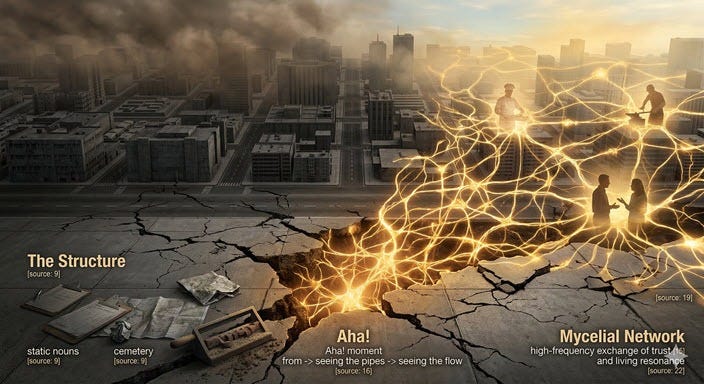
The first responsibility of anyone standing in that smog was to admit the brutal truth: we weren’t building a city; we were babysitting a cemetery of static nouns. Every time we tried to “fix” a problem, we just added another layer of concrete, wondering why the weight only made the cracks spread. We were in a race against entropy, using willpower to hold up a ceiling that the universe wanted to pull down.
Then came the day the maps failed. A small group of us sat in the center of the square, staring at a diagram of the city’s plumbing. We were looking for the “clog,” the thing we could blame. But as we looked, the lines on the paper began to blur. We stopped seeing the pipes and started seeing the flow. We realized that the “City” wasn’t the bricks at all—it was the high-frequency exchange of trust, the quiet hum of needles moving through fabric, the solar-conversion of every conversation. The “Aha!” didn’t arrive like a thunderbolt; it arrived like the realization that you aren’t a passenger on a train, but the movement of the train itself. We saw that the smog wasn’t an external enemy; it was the friction of our own resistance to change.
We stopped trying to “manage” the city and started to “resonate” with it. The visionaries among us saw the invisible mycelial threads connecting the baker to the blacksmith, a web of nourishment that didn’t need a clipboard to exist. The pragmatists realized that by simply removing the “Stop Rules”—the barriers we built to protect our status—the energy began to move through the system with the effortless grace of water finding the sea. We stopped doing trial and error, treating every failure like a broken brick, and started doing trial and learning, treating every bruise as a lesson in ripening. We transitioned from being owners of a static asset to being architects of a living resonance. To those of you who stayed in the cracks when the pavement felt too heavy: thank you. You didn’t just survive the structure; you became the pulse beneath it. We are no longer defined by the grid, but by the way we move through it.
Systemic Reflection & Stakeholder Notes
First Principles:
The narrative is grounded in the Law of Emergence and the Second Law of Thermodynamics. It acknowledges that a system is not a collection of objects but a temporary capture of energy. The foundational axiom here is that Information is Relationship; without the exchange, the structure is merely a decaying monument.
Core Wisdom:
The Paradox of Ownership emerges clearly: the more we try to “own” or “freeze” a system (the City/The Noun), the more we accelerate its entropy. True stability is found only in Kinetic Equilibrium—the ability to move and adapt as the relationship bundle shifts.
Leverage Points:
The Goal: Shifting the purpose from “Maintaining the Structure” to “Facilitating the Flow.”
The Mindset: Moving from the “Tank Delusion” (static storage) to the “Mycelial Reality” (dynamic exchange).
Stakeholder Resonances:
For the Visionaries: The story personifies the Mycelial Isomorph, showing that the “Aha!” moment is a transition from isolation to interconnectedness. It validates their intuition that the “Invisibles” are the most real things in the system.
For the Pragmatists: The narrative highlights the reduction of Relational Latency. It frames “Systems Thinking” not as an extra task, but as a way to reduce the “Load-Bearing Delusions” that make daily work so exhausting.
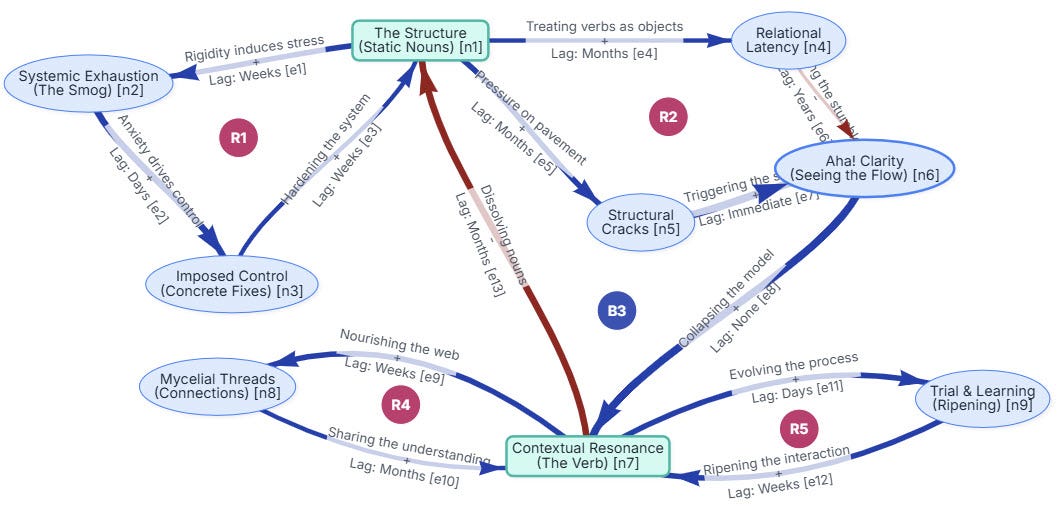
While the story provides the what, the following model provides the why of the situation. You can find additional information and download the model from the Systems Thinking Aha! folder. Learn to build these models at Free AI Tools.
I love the essay immediately, when it refers to rhizome-type ways of networking.
I suppose it's strongly emerging as a phenomenon, Gilles Deleuze and Félix Guattari will be soon often referred in organisational contexts. The Postnormal Era we are living requires it!
Subscribed your essays - waiting to see more of this.
hi Gene, What I most appreciate about this post is this one liner:
We realized that the “City” wasn’t the bricks at all—it was the high-frequency exchange of trust,
What would help me better understand the post and the principles is setting the context upfront, because I don't know what this refers to: "We weren’t building a city; we were babysitting a cemetery of static nouns".
What city were you trying to build? a company? an actual city?
What does this refer to: a cemetery of static nouns? Was this referred to in a previous post?
Eager reader, struggling to engage with the story ;-)