
Systemic Resilience: Navigating the 47th Presidency
An Aha! Paradox

Paid subscribers have access to all the elements used to create this post. They can be found in the Navigating the 4th Presidency folder. Collaborators have access to the tools used to develop components of this post.
The Roots Beneath the Ash
Title: The Roots Beneath the Ash
Plot Archetype: Rebirth
Theme: The loss of false security and the discovery of true agency.
Part I: The Long Winter (The Shadow of the Canopy)
For generations, we lived in the shade of a massive Iron Oak. It was so tall its branches scraped the sky, and we, the people living at its base, felt small but safe. We believed that as long as the Oak stood, the rain would not drown us, and the sun would not scorch us. We called the Oak “Washington,” and we treated it like a father.
When the winds began to howl—a fierce, chaotic gale that seemed to hate the Oak itself—we did what children do. We clung to the trunk. We looked up, waiting for the great branches to stop shaking, waiting for the tree to steady itself. We doom-scrolled through the storm, terrified by every cracking limb, paralyzing ourselves with the question: “Who will save the tree?”
We didn’t realize yet that the tree was already hollow. We were mourning a ghost.
Part II: The Scorch (The Crisis of R1)
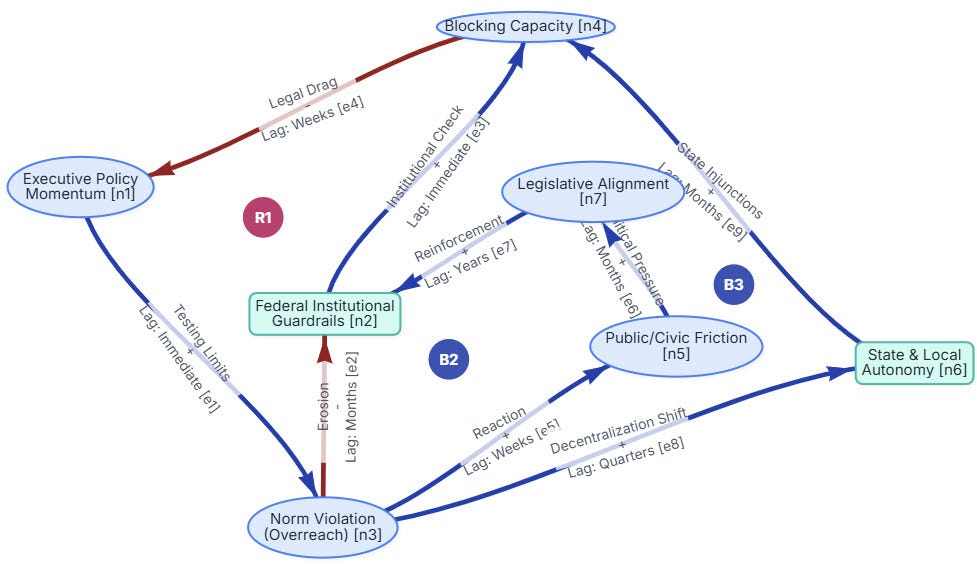
Then came the fire. It wasn’t a foreign invasion or a sudden collapse, but a slow, grinding heat. The “Executive Momentum” grew so hot it burned through the bark. The “Guardrails”—those old, trusted knots in the wood—turned to ash in our hands.
The fear in the country was a physical weight. It was the fear of orphans. We watched the norms evaporate, the “checks and balances” snap like dry twigs. The air was filled with the smoke of things we used to trust: the impartiality of justice, the civility of discourse, the certainty of tomorrow.
We screamed at the fire. We marched. We sued. But the fire didn’t care. It was fed by the very friction we created. We were trapped in a loop of outrage and erosion, watching the sky fall, waiting for a savior who wasn’t coming.
Part III: The Mycelium (The Synthesis of B3)
But then, when the despair was absolute, something shifted.
It started not in the capital, but in the quiet, forgotten places. In a town council meeting in Ohio. In a state legislature in Colorado. In a neighborhood association in Georgia.
As the canopy burned above, the people looked down. They realized that while the Iron Oak was dying, the forest was alive. They discovered the Mycelium—the ancient, invisible network of local laws, state powers, and community bonds that ran deep beneath the soil, untouched by the fire above.
A Governor stood up and said, “The fire stops at my border.”
A Mayor whispered, “Here, in this city, we protect our own.”
A neighbor knocked on a door and said, “I don’t care who is President. I care if you have enough to eat.”
Part IV: The Spring (The Kinetic Result)
The Rebirth wasn’t a restoration of the old Oak. It was the growth of a million new saplings.
We stopped looking up for permission to survive. We realized that the “Republic” wasn’t a building in D.C.; it was the pact we made with each other. The chaos at the top became irrelevant noise, drowned out by the hum of work at the bottom.
The fire eventually burned itself out, starved of attention. But we didn’t go back to sleep. We had learned the truth: The strength of the forest isn’t in the height of its tallest tree, but in the depth of its connected roots. We had survived not by saving the King, but by becoming the Kingdom.
The Aha! Paradox: Local Resilience
1. The Anchor (The Delusion)
The “Parental” Theory of Government.
The load-bearing delusion is the subconscious belief that the Federal Government is the “parent” of the nation—the entity responsible for setting the rules, keeping the peace, and ensuring safety. We assume that if the parent becomes erratic or absent, the “family” (the citizenry) will inevitably collapse. We believe the Republic is defined by what happens in the Oval Office, rather than what happens in the neighborhood.
2. The Default (The Status Quo)
Spectator Anxiety (The “Refresh” Trap).
The standard path is to treat the presidency as a reality TV show where the viewer has no agency. Citizens engage in “doom-scrolling,” obsessively tracking every executive order, tweet, or breach of norms, and then looking to “Capital City Heroes” (judges, special counsels, or rival politicians) to intervene. This feeds the delusion by reinforcing the idea that power is exclusively vertical—that salvation can only come from above.
3. The Bottleneck (The Constraint)
The “Zero-Federal” Constraint.
Constraint: You are strictly forbidden from using Federal Courts, Congressional oversight, or the next Presidential election as a solution. You must assume Washington, D.C. is a closed system that will yield no relief for four years.
The Insight: When you remove the “Top-Down” fix, you are forced to realize that the American system was originally designed as a horizontal redundancy engine. If the vertical brake fails, the horizontal brakes (states, municipalities, civic guilds) are the only remaining mechanism. The bottleneck forces you to look at the tools within your physical reach.
4. The Collision (The Isomorph)
Ecological Succession (The Forest Fire).
In forestry, a “stand-replacing fire” (the crisis) burns down the dominant canopy (the established federal norms/bureaucracy). This looks like a disaster, but in ecology, it is a necessary phase called release. The fire clears the “shade” created by the old canopy, allowing sunlight to finally hit the forest floor. This triggers the dormant seeds in the understory (local governance and civic participation) to explode in growth.
The Perspective: The presidency is not the forest; it is just the canopy. Its “burning” is not the end of the ecosystem; it is the energy trigger for the understory (Act III / Loop B3 in your model) to take over dominance.
5. The Reversal (The Truth)
The “Weakness” is the Strength.
We usually view the gridlock and friction between States and the Federal Government as a bug—a sign of dysfunction.
The Truth: In this context, friction is a feature. The system’s survival depends on the Federal Government failing to impose its will efficiently. We should not be trying to “fix” the efficiency of government; we should be celebrating the inefficiency (The Federalist Safety Valve) that prevents the rapid transmission of error from the top to the bottom. The “Lie” is that we need unity; the “Truth” is that we need compartmentalization.
6. The Kinetic Result (The Action)
The Aha! Insight: The Republic does not survive by fighting the fire in the canopy; it survives by watering the roots. Stability is no longer a national project; it is a hyper-local one.
The First Domino: Attend one local government meeting (City Council, School Board, or Zoning Commission) within the next 14 days. Do not speak about national politics. Speak only about a specific local ordinance. This physical act re-wires your brain to recognize where your actual agency lies.ha! Paradox: Local Resilience
Gene, A wonderful, creatively written story. Thanks both to you,the idea initiator and parameter setter, and perhaps congrats to Gemini for poetic moving writing.
My first thought was to forward this to David Brooks, Thom Hartmann, or Ezra Klein. Then I thought this is one subsystem, one path in a cluster of interwoven systems. I think of the book, The Curse of Goliath, saying that all empires collapse with inevitable capture of most of the wealth by a small elite who become rigid rulers - and in rigidity the empire collapses..each and every time. I think of Pikety and the relentless accumulation of wealth, how weath then captures the government leading to a corporate fascism polarizing and destroying trust everywhere - driving us to extreme individualism as in the book, 1984. I see even the local school boards and local politics becoming politicized and polarized, families polarized, the ability to think captured by addictive social media, the greed and speed and destruction of late stage capitalism.
So what does the individual do? They move from the oppressive red states if they have the resources, or move to Canada or other friendly countries, or if wealthy buy an island. We are living in a time where all efforts to work together are called terrorism or communism. The zeitgeist is that compromise is becoming taboo. So what is one to do in this winter of greed, hatred, and decline.
The stoics would say, Do what your conscience says is right even if you die trying. Live right, do right and be as happy as you can be. It used to be that many people would go to church for comfort - even the slaves prayed to a Christian God to relieve their suffering. And now too many churches are polarized, and forces of hatred and control themselves.
For me, the realization that 90% of the voting public have the cognitive capability to deal only with issues with a one-year time span - that's why politicians talk about kitchen table issues - like inflation, the price of gas. When many of society's problems need to be solved by dealing with 50 -100 year time horizons. Income gaps, climate change, AI are long term issues where the the majority of voters have no clue.
So we soldier on and do our best.
The US's current problems were largely created by the corporate elite's successful implementation of the Powell lMemorandum af around 1972. The right wings plan to take over the media, universities, and to buy the govt itself. They have succeeded masterfully.
Perhaps this level of analysis is too large complex for causal loop diagram systems analysis, but congratulations Gene for doing outstanding work with pieces of all that I have described. The challenge is how to put it all together in an analysis and story for the reader to grasp.