
Systemic Hope: A Deeper Dive

Comprehensive Analysis: The Purchase of Systemic Hope
This document provides a comprehensive analysis of the causal loop diagram “The Purchase of Systemic Hope,” based on the model’s structure, feedback loops, and archetypes.
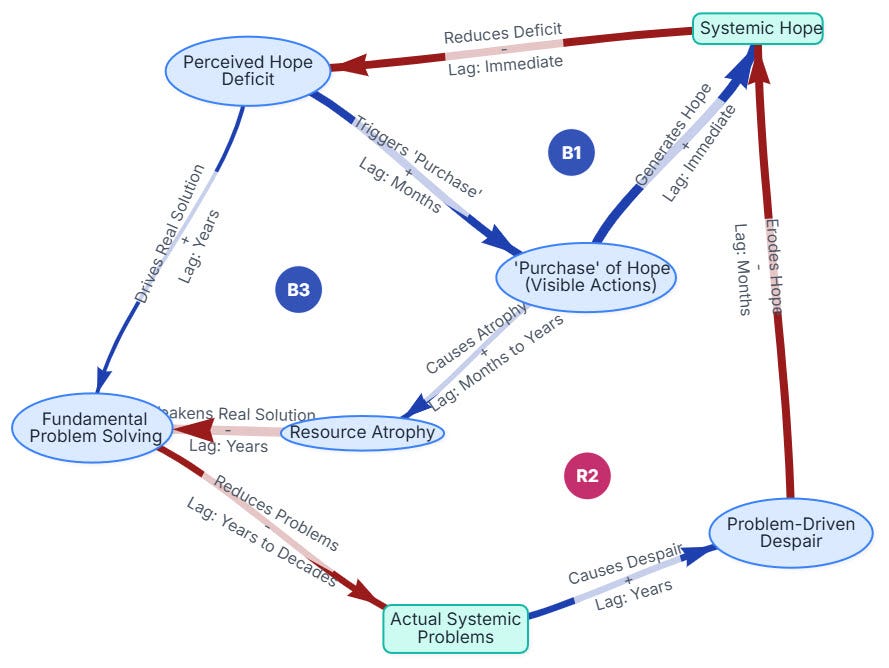
1. Model Explanation
The model illustrates the dynamic of a system grappling with a “crisis of hope.” The core problem begins with Actual Systemic Problems (n4), such as inequality or climate instability. These unsolved problems generate Problem-Driven Despair (n7), which erodes the stock of Systemic Hope (n1).
This erosion of hope creates a Perceived Hope Deficit (n2), which is the primary symptom the system tries to solve. The system has two ways to respond:
The Symptomatic Solution (B1: The Quick Fix): This is a fast-acting response. The
Perceived Hope Deficit(n2) triggers a‘Purchase’ of Hope(n3) through highly visible, symbolic, or short-term actions. These actions successfully (and quickly) replenish the stock ofSystemic Hope(n1), which in turn reduces the “hope deficit.” This provides immediate relief.The Fundamental Solution (B3: The Fundamental Solution): This is a slow-acting response. The “hope deficit” (n2) also triggers
Fundamental Problem Solving(n5). This is the only action that actually reduces theActual Systemic Problems(n4). By solving the root cause, it reducesProblem-Driven Despair(n7) and creates authentic, sustainableSystemic Hope(n1).
The central tragedy of the model is the “Shifting the Burden” dynamic. The “fix” (n3) is not benign; it has a corrosive side effect. It causes Resource Atrophy (n6)—diverting time, money, and political will—which directly weakens the system’s capacity for Fundamental Problem Solving (n5).
This creates a vicious, reinforcing cycle (R2: The Addiction Spiral):
We use the “fix” (B1).
This atrophies our ability to use the “solution” (B3).
The real problems (n4) get worse.
This creates more despair (n7) and a larger hope deficit (n2).
The larger deficit demands an even stronger use of the “fix” (B1).
The system becomes addicted to the “purchase” of hope, while its capacity to create real hope withers away.
Source: Systemic Hope (Archetypes Experimental)
2. Wisdom
The core wisdom of this model is that actions which provide immediate emotional relief from a systemic problem are often the very actions that prevent its fundamental solution.
The system becomes trapped by prioritizing the feeling of progress (high Systemic Hope) over actual progress (low Actual Systemic Problems). The “purchase” of hope is a substitute for the work of hope. This model warns that in complex systems, the most seductive short-term solutions are often the most dangerous in the long term, creating a dependency that is structurally identical to an addiction.
3. Donella Meadows’ Leverage Points
Here is an analysis of intervention points, from lowest to highest leverage:
12. Numbers (Parameters): (Low Leverage)
Trying to increase the “effectiveness” of the
‘Purchase’ of Hope(e3) or the speed ofFundamental Problem Solving(e5).Result: This is ineffective. Making the “fix” (B1) more efficient only strengthens the addictive loop (R2). Marginally improving the fundamental solution (B3) is insufficient if it’s being actively starved of resources.
10. Buffers (Stocks): (Low-Medium Leverage)
Trying to build a massive, one-time buffer of
Systemic Hope(n1) through a PR campaign.Result: This buffer will inevitably be drained by
Problem-Driven Despair(n7) as long as the underlyingActual Systemic Problems(n4) are not addressed.
7. Strength of Balancing Loops (B1 & B3): (Medium Leverage)
Weakening B1: This involves making the “purchase” of hope less appealing or effective. This could be done through critical media, public education, or transparency that exposes symbolic actions as hollow.
Strengthening B3: This is a key intervention. It involves shortening the lags and strengthening the links of the fundamental solution (e.g.,
e4,e5). This means building permanent institutions, skills, and public patience for long-term, complex work.
6. Strength of Reinforcing Loops (R2): (Medium-High Leverage)
Weakening R2: This is the most critical structural intervention. The goal is to sever the side-effect link (
e8ande9).Intervention: Create rules that decouple the “fix” from “atrophy.” For example: “For every $1 we spend on symbolic ‘hope-building’ initiatives (n3), we must allocate $10 to the long-term R&D and structural work (n5).” This starves the addiction by protecting the fundamental solution’s resources.
4. The Goals of the System: (High Leverage)
The system is currently (and implicitly) organized around the goal of “Minimize the
Perceived Hope Deficit.” This goal is easily met by the “fix” (B1).Intervention: Explicitly change the goal to “Minimize the
Actual Systemic Problems.” This goal can only be met by the fundamental solution (B3). All metrics, incentives, and reporting must be realigned to this new, more difficult goal.
2. The Paradigm of the System: (Highest Leverage)
The current paradigm is: “We must feel like we are making progress now.” This emotional need for immediacy guarantees the system will choose B1 over B3.
Intervention: A paradigm shift to: “We must engage in the real work, even if it is slow, difficult, and doesn’t provide an immediate emotional payoff.” This is a cultural shift from valuing visible activity to valuing meaningful impact, and from seeking comfort to embracing responsibility.
4. Knowledge
The model prompts us to ask new questions and seek new data:
Measuring Stocks: How can we create reliable, real-time indicators for the stocks?
Systemic Hope(n1): e.g., Public trust in institutions, long-term economic optimism surveys, social cohesion metrics.Actual Systemic Problems(n4): e.g., Gini coefficient (inequality), atmospheric CO2 (climate), debt-to-GDP ratios (economic fragility).
Measuring the “Side Effect”: How do we quantify
Resource Atrophy(n6)? We must track budgets, talent allocation, and political attention. E.g., “What percentage of our budget is allocated to short-term, visible projects (n3) vs. long-term, fundamental infrastructure or research (n5)?”Assessing Lags: What is the actual lag time on the fundamental solution (B3)? If the public believes it’s 100 years, but it’s really 10, they will be more willing to support it.
Link Strength: How strong is the “atrophy” link (
e9)? Is it a 1:1 tradeoff, or is it worse (every $1 on “fix” costs $2 of “solution”)?
5. Systems Archetypes
The model is a classic “Shifting the Burden” archetype with an “Addiction” dynamic.
The Problem:
Perceived Hope Deficit(n2).The Symptomatic Solution (B1: The Quick Fix): Quickly addresses the symptom (the deficit) by
‘Purchasing’ Hope(n3).The Fundamental Solution (B3: The Fundamental Solution): Slowly addresses the root cause (the
Actual Systemic Problems) viaFundamental Problem Solving(n5).The Side Effect (R2: The Addiction Spiral): The use of the symptomatic solution (B1) creates
Resource Atrophy(n6), which weakens the fundamental solution (B3). This makes the root problem worse, which increases the symptom, which creates an even greater need for the symptomatic solution. The system becomes addicted to the “fix” and loses its ability to heal itself.
6. Primary Principles
Symptomatic solutions are faster than fundamental ones. The system will always gravitate toward the path of least resistance and shortest lag time.
The “fix” is not free. The cost of the symptomatic solution is not just the resources it consumes, but its active sabotage of the fundamental solution.
The problem will always re-assert itself. A root cause that is not addressed will continue to generate symptoms, often with increasing intensity.
A system organized to “fix symptoms” will structurally resist “solving problems.”
7. First Principles
A gap between a desired state (hope) and a perceived state (despair) creates pressure for action.
Actions can either address the symptom (the gap) or the cause (the problem).
Actions that address the symptom are almost always faster and more visible.
Resources (time, money, attention, political will) are finite.
Applying resources to one action (the symptom) makes them unavailable for another (the cause).
Systems with reinforcing feedback (addiction) will, if left unchecked, drive themselves to a state of collapse.
8. Key Insights
Hope is an Output, Not an Input: The model shows that “purchased hope” (n3) is a fragile input, while authentic hope is the output of solving real problems (B3).
The “Fix” is Actively Harmful: The most profound insight is that the “fix” isn’t just a neutral, wasteful distraction. It is an iatrogenic solution—a cure that actively causes a worse disease by attacking the system’s immune response (its problem-solving capacity).
The Addiction is Structural, Not Moral: The system does not “shift the burden” because its actors are weak or foolish. It does so because the structure of the system (shorter lags in B1) rewards this behavior.
The Critical Variable is Hidden: The most important variable in the model is
Resource Atrophy(n6) and its link (e9) to weakeningFundamental Problem Solving. This link is almost always invisible, unmeasured, and undiscussed. Making it visible is a primary act of systems leadership.
9. Future Implications
If the behavior of this system remains unchanged:
The
Actual Systemic Problems(n4) will continue to grow, as the capacity forFundamental Problem Solving(n5) withers.The “purchases” of hope (n3) will need to become ever larger, more expensive, and more dramatic to generate the same amount of
Systemic Hope(n1).The system’s
Systemic Hopewill become brittle, characterized by wild swings as each “purchase” is quickly overwhelmed by the reality ofProblem-Driven Despair(n7).Eventually, the system will face a choice:
The
Actual Systemic Problemsgrow so large they cause a non-linear, catastrophic collapse (e.g., environmental tipping points, social or economic failure).The “addiction” (R2) completely destroys the capacity for
Fundamental Problem Solving(n5), making recovery impossible, leading to a slower, managed decline.
10. Synthesis: Core Wisdom & Highest Leverage
Core Wisdom:
The model reveals that our well-intentioned desire for immediate emotional relief from systemic problems (by “purchasing hope”) creates an addictive trap. This “fix” starves the actual solutions of resources, guaranteeing that the problems will worsen and our dependency will deepen.
Highest Leverage Point:
The highest leverage point is a Paradigm Shift (Meadows’ #2). We must transcend the paradigm of “We need to feel better now” and adopt the paradigm of “We must commit to the real, slow, and difficult work, especially when it doesn’t provide an immediate feeling of hope.”
This paradigm shift is operationally expressed by changing The Goal (Meadows’ #4): from “managing the symptom of hopelessness” to “solving the problem of systemic failure.” This, in turn, requires Weakening the Reinforcing Loop (Meadows’ #6) by creating a new rule: “We must protect the fundamental solution (B3) from the resource atrophy (n6) caused by the quick fix (B1).”