
Stochastic Terrorism: A Deeper Dive

Model Explanation and Future Implications
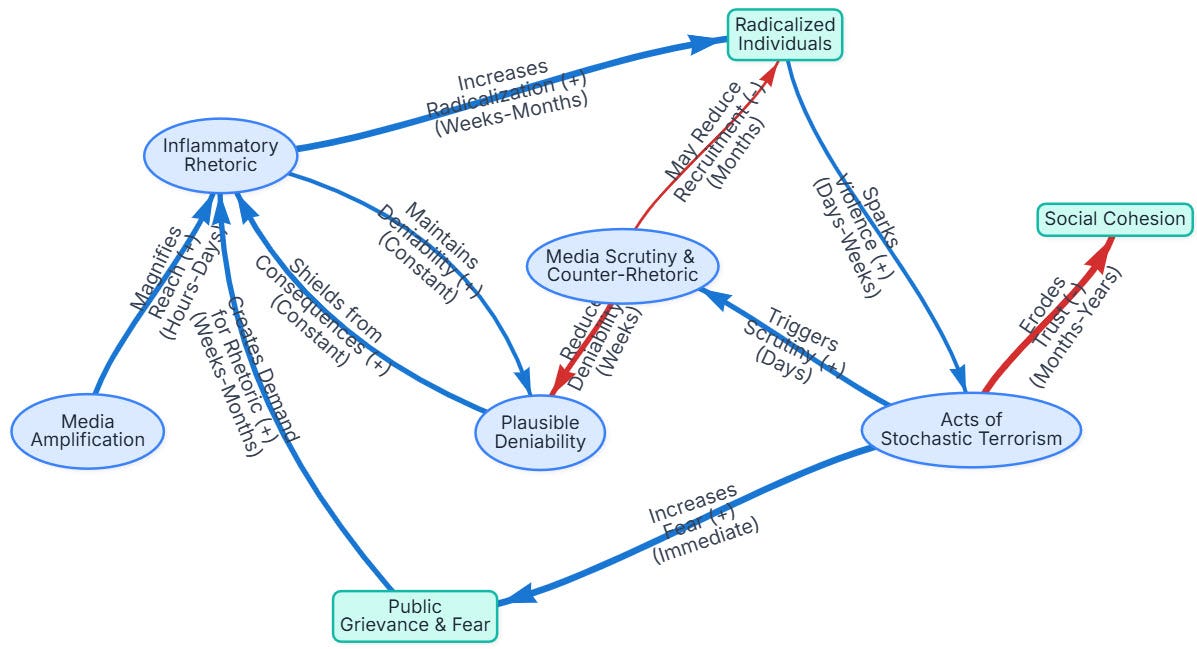
This causal loop diagram illustrates the complex system that produces stochastic terrorism—violent acts committed by radicalized individuals who are influenced by public rhetoric but not directly commanded by it. The model reveals a self-reinforcing engine of radicalization and a competing, weaker balancing loop of public accountability.
Source: Stochastic Terrorism
The Core Engine (Loop R1 - The Radicalization Engine): The primary driver is a vicious cycle. Inflammatory Rhetoric, often targeting a specific group, is amplified by media and algorithms. This increased exposure cultivates a pool of Radicalized Individuals by validating and intensifying their Public Grievance & Fear. Over time, this raises the probability of an Act of Stochastic Terrorism. Such an act, in turn, increases public fear, creating a more fertile ground and a greater "demand" for the very same inflammatory rhetoric that started the cycle.
The Accountability Response (Loop B2 - The Public Accountability Response): In opposition to this is a balancing loop. A violent act triggers Media Scrutiny and Counter-Rhetoric, which can challenge the Plausible Deniability of the figures spreading the initial rhetoric. In theory, this accountability should create consequences that temper the inflammatory language.
Future Implications: The model's structure strongly suggests a dangerous future if the reinforcing loop (R1) continues to dominate the balancing loop (B2). The key implications are:
Escalating Violence: As long as R1 spins faster than B2 can counter it, we can expect an increase in the frequency and possibly the severity of violent acts. Each act fuels the next by further polarizing the public and normalizing extreme rhetoric.
Erosion of Social Cohesion: As indicated by the link from "Acts of Stochastic Terrorism" to "Social Cohesion," this cycle is corrosive to societal trust. It fractures society into polarized camps, making dialogue and consensus-building nearly impossible.
Normalization of Extremism: The constant amplification of inflammatory language shifts the Overton Window—the range of ideas the public is willing to consider. What was once considered extreme becomes mainstream, making the system even more volatile.
Primary Insights of the Model
Violence is a Symptom, Not the Root Cause: The most critical insight is that the violent acts themselves are an emergent property of the system, not the starting point. Focusing solely on the perpetrators misses the engine that produces them. The real drivers are the inflammatory rhetoric and its amplification.
Plausible Deniability is the System's Linchpin: The variable of "Plausible Deniability" is the critical enabler that allows the reinforcing loop to spin without consequence. It disconnects the cause (rhetoric) from the effect (violence) in the minds of many, preventing the balancing loop of accountability from functioning effectively.
The Problem is Self-Reinforcing: The model clearly shows that stochastic terrorism is not just a series of isolated incidents but a self-perpetuating cycle. The fear and grievance created by one attack directly fuel the conditions for the next, highlighting why reactive, event-focused responses are insufficient.
Primary Archetypes Driving the Model
The dynamics of this model are driven by two classic systems archetypes:
"Shifting the Burden": This is the dominant archetype. The fundamental problem is the grievance and fear fueled by inflammatory rhetoric. Society, instead of addressing this fundamental problem directly (the "symptomatic solution" of Loop B2, which tries to assign blame after an event), often shifts the burden to a "problem-solving" process that focuses only on the violent actors. By focusing on the individual perpetrators ("Acts of Stochastic Terrorism"), we neglect the systemic solution of addressing the rhetoric that radicalizes them in the first place. The side effect is the strengthening of the reinforcing Radicalization Engine (R1).
"Escalation": While less pronounced, an "Escalation" dynamic exists between the purveyors of "Inflammatory Rhetoric" and those promoting "Counter-Rhetoric." Each side may react to the other by increasing the intensity and reach of their messaging, leading to a more polarized and volatile information environment, which ultimately strengthens the main R1 loop.
Leverage Points for Intervention
Based on Donella Meadows' hierarchy of leverage points, here are the most effective places to intervene in this system, from least to most effective:
12. Constants, parameters, numbers: (Least Effective)
Intervention: Increasing sentences for perpetrators of stochastic terrorism.
Analysis: This is the weakest leverage point. While necessary, it only addresses the outcome ("Acts of Stochastic Terrorism") after the fact and does little to slow the engine (R1) that produces more radicalized individuals.
9. The length of delays, relative to the rate of system change:
Intervention: Speeding up the attribution of violence to rhetoric.
Analysis: Shortening the delay between a violent act and the widespread public connection to the inspiring rhetoric (strengthening the B2 loop) can make "Plausible Deniability" harder to maintain. This is a moderately effective intervention.
6. The structure of information flows:
Intervention: Modifying social media algorithms to de-amplify inflammatory rhetoric and boost counter-narratives.
Analysis: This is a high-impact leverage point. It directly targets "Media Amplification," which is the accelerator for the entire reinforcing loop (R1). Changing who sees what information fundamentally alters the system's behavior.
4. The power to add, change, evolve, or self-organize system structure:
Intervention: Fostering robust, independent media and educational initiatives focused on critical thinking and media literacy.
Analysis: This intervention gives the system the ability to self-correct. An informed citizenry is more resilient to radicalization and less susceptible to inflammatory rhetoric, effectively weakening the link between "Rhetoric" and "Radicalized Individuals."
2. The mindset or paradigm out of which the system arises: (Most Effective)
Intervention: Shifting the cultural paradigm from blaming individuals ("lone wolves") to recognizing the systemic responsibility of those who create a climate of hate.
Analysis: This is the most powerful leverage point. If the shared social understanding becomes "inflammatory rhetoric produces violence," then "Plausible Deniability" collapses. This fundamentally changes the goals and rules of the system, forcing accountability and creating immense pressure to change the nature of public discourse.