
Robots and Learning How to Work
An Aha! Mystery Investigation

The Situation
The Hidden Trap: Companies are excited to use robots and smart computers to do entry-level jobs because machines don’t need a paycheck. This makes the company look rich on paper. But if companies delete all the starter jobs, young people can never get their foot in the door to learn how to become the next generation of bosses and experts.
The Goal: Using cool new technology to help workers learn, rather than using it to replace humans and empty out the workforce.
The Automation Paradox: The Case of the Vanishing Expert
The quiet hum of a new server rack now occupies the exact footprint where an entry-level analyst’s desk sat just a week prior. Up in the boardroom, executives are reviewing a flawless spreadsheet that highlights a sudden, sharp decrease in operational costs. This single, quiet swap on the operational floor is celebrated as a strategic victory, a triumph of efficiency over overhead. This is the load-bearing delusion of modern corporate scaling, the widespread belief that deploying machines to eliminate starter roles simply trims the fat and accelerates immediate paper wealth. Everyone accepts this as inevitable progress, but it is a systemic illusion, a classic case of shifting the burden where the immediate relief of a slashed payroll merely masks the severing of the company’s own future.
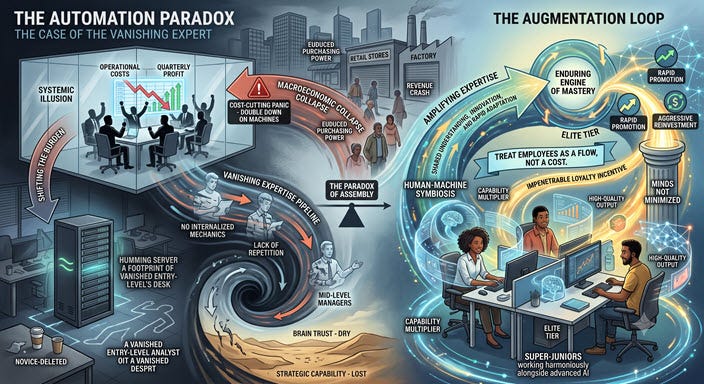
To understand the crime scene, we must accept the foundational axiom that a company contains no static objects. There are only processes, temporary bundles of relationships, and continuous flows of experiential energy. By treating human capital as a fixed line-item to be erased, the organization’s current environment is intentionally frozen in a state of deliberate gridlock. The executives have optimized for upstream velocity, achieving an immediate quarterly profit margin, entirely at the expense of downstream exhaustion.
This introduces the core paradox of assembly. The system has been optimized solely for the cheapness of its initial creation, designing an environment where tasks are performed for the lowest possible cost today, which inevitably generates an exponential debt of friction at the end of the lifecycle. Let us trace this invisible relational flow. You automate a mundane entry-level role to save capital. And? The task is completed by a machine, but the foundational experiential learning that accompanied it vanishes from the building. And? Without that daily repetition, young workers never internalize the mechanics of the industry. And? Half a decade later, the pool of mid-level managers shrinks drastically. And? In ten years, the pipeline of seasoned subject matter experts goes completely dry. The company awakens one quarter to realize it has hollowed out its own brain trust, losing all strategic capability because the seedbed of future mastery was traded for a momentary bump in stock price.
The unfolding discovery extends far beyond the walls of the corporate headquarters. You eliminate the vast pool of starter roles across the market. And? The everyday wage distribution that sustains the community halts. And? The macroeconomic purchasing power of the general public evaporates. And? Without disposable income, the very consumers you rely on can no longer afford to buy your products. Revenue begins to crash. When this central indicator of organizational health drops, the panicked reaction of leadership is entirely predictable. They double down on their machine addiction. Cost-cutting panic surges, and they feed even more roles to the automated systems to survive the quarter. This is not the work of a personalized, malicious enemy in the C-suite. It is an archetypal pattern playing out flawlessly, a predictable mechanism where the system’s design ensures that short-sighted survival behaviors actively cannibalize the enterprise.
To escape this self-destructive spiral, the organization must pivot toward a profound structural leverage point. The strategy must shift away from using automation as a cheap replacement and turn toward an augmentation loop. Rather than hiring ten novices or deploying ten autonomous robots, the enterprise curates a smaller, elite tier of three workers and equips them with advanced AI. These super-juniors now work harmoniously alongside the technology, turning their output into a capability multiplier. For the visionaries in the room, there is a profound beauty in making these invisible connections transparent, witnessing a human-machine symbiosis that organically scales intelligence. For the pragmatists, the focus rests on the immediate utility of a new architecture that attacks the root cause of the talent drought, permanently reducing operational friction while maintaining a high bar for quality.
Yet, this new systemic flow introduces a final, inevitable pressure. The incredible, augmented capability of these super-juniors will quickly attract the attention of desperate competitors who previously fired all their own staff and now face a total talent vacuum. The threat of poaching becomes severe. Surviving this requires anchoring the organization in a mindset of continuous trial and learning. The immense financial value generated by these highly productive juniors must be aggressively reinvested back into their own compensation and rapid promotion. Recognizing that shared understanding permanently alters the flow of energy, the company builds an impenetrable loyalty incentive. By treating employees not as a cost to be minimized but as a flow of expertise to be amplified, the enterprise transforms a looming demographic collapse into an enduring engine of mastery.
The Investigation & The Relationships
What is presented here is not intended as a solution, but as food for thought regarding the interdependence of relationships and their implications.
Thanks for this article. I think it would stimulate thinking about the future if more people see it.