
Requisite Organization: A Deeper Dive

Analysis of the Requisite Organization Model
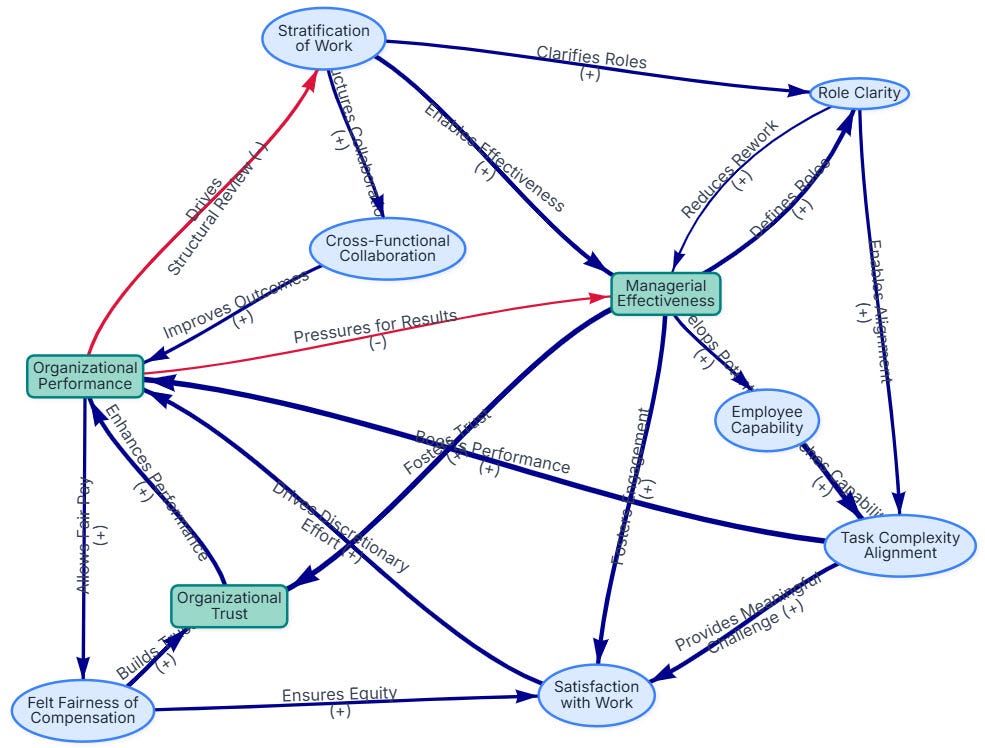
Source: Requisite Organization
Model Explanation
This Causal Loop Diagram illustrates the core tenets of Requisite Organization theory. It models an organization as a dynamic system where sustainable performance is not an isolated goal but an emergent property of a well-designed structure. The central idea is that when an organization's structure is properly stratified and its roles are clear, it creates the conditions for effective management. This, in turn, allows for the proper alignment of employee capability with task complexity. When this alignment occurs within a context of fairness and trust, the system enters a virtuous cycle of high engagement and performance.
The model's key accumulating "stocks" (the conditions that build up or erode over time) are Organizational Performance, Organizational Trust, and Managerial Effectiveness. The dynamics of the system are driven by the flows and variables that influence these stocks. For instance, a well-defined Stratification of Work is a prerequisite that enables Managerial Effectiveness. This effectiveness then fosters Role Clarity and develops Employee Capability. Crucially, the system's health is deeply tied to perceptions of fairness, where strong Organizational Performance allows for resources to be allocated to ensure Felt Fairness of Compensation, which is a primary driver in building Organizational Trust.
Wisdom
The core wisdom of this model is that sustainable success is the output of a healthy system, not an input to be forced upon it. Many leadership paradigms treat performance as a target to be hit through sheer force of will, pressure, and short-term incentives. This model reveals that such actions often trigger balancing loops that are ultimately destructive. True, lasting performance is a consequence—an outcome that naturally emerges when the organization is viewed as a human system that requires clarity, trust, and a fundamental respect for individual capability. The model teaches that leaders are not just commanders; they are systems architects, and their primary role is to cultivate the conditions for success rather than to relentlessly demand it.
Leverage Points (in accordance with Donella Meadows)
Analyzing the model through the lens of Donella Meadows' hierarchy of leverage points reveals where interventions are most powerful.
Low Leverage (Parameters & Buffers): Interventions like slightly adjusting compensation bands without addressing the underlying logic of fairness, or adding more project managers to buffer poor cross-functional collaboration, would have minimal lasting impact. These are akin to treating symptoms.
Medium Leverage (Feedback Loops): A more effective approach is to influence the feedback loops.
Strengthening Reinforcing Loops: Actively working to strengthen the virtuous cycles is a powerful strategy. For example, investing in management training to improve coaching (e5) directly strengthens the Capability and Performance Loop (B8). Similarly, celebrating successes that result from effective collaboration reinforces the Structural Correction Loop (B3).
Weakening Destructive Loops: The most common mistake organizations make is strengthening the Performance Pressure Trap (B4). A high-leverage action is to intentionally weaken this loop by training leaders to respond to performance dips not with pressure, but with diagnostic questions about role clarity, task alignment, and managerial support.
High Leverage (System Goals & Paradigm): The most powerful leverage points lie at the top of Meadows' hierarchy.
#3 - The Goal of the System: An organization focused solely on short-term financial performance will perpetually trigger the destructive balancing loops. Shifting the goal to include "creating a trustworthy and effective system for value creation" fundamentally alters the behavior of all actors.
#2 - The Mindset or Paradigm: This is the highest leverage point in the model. The paradigm of Requisite Organization is a shift from viewing employees as resources to be managed to seeing them as capable individuals whose potential can be unlocked by a well-designed system. The act of committing to proper Stratification of Work is the physical manifestation of this paradigm shift. It is a declaration that structure and clarity are the foundation of performance.
Knowledge
The model provides several key pieces of actionable knowledge for organizational leaders:
Structure is a Prerequisite, Not a Luxury: A manager's individual talent can be nullified by a poor structure. Without proper Stratification of Work, managers lack the context and authority to be effective. An organization must get the structure right before it can expect its managers to succeed.
Fairness is a Performance Multiplier: Felt Fairness of Compensation is not merely a "hygiene factor" to prevent dissatisfaction. The model shows it is a direct and powerful driver of Organizational Trust, which in turn enhances performance by fostering discretionary effort and reducing friction.
Alignment is the Engine of Engagement: The single greatest source of both productivity and job satisfaction is the alignment of an individual's capability with the complexity of their work. Mismatch—either through under-utilization or being overwhelmed—is a primary source of organizational dysfunction and disengagement.
Systems Archetypes
Several classic systems archetypes are present within this model, helping to explain common organizational behaviors.
Shifting the Burden: The Performance Pressure Trap (B4) is a classic "Shifting the Burden" archetype. The fundamental problem is a lack of managerial effectiveness or trust. The symptomatic solution is to apply pressure for results. This provides a short-term illusion of action but weakens the organization's ability to invest in the fundamental solution: improving its management systems and building trust.
Limits to Growth: The entire model can be seen as a "Limits to Growth" structure. An organization can grow on the strength of its people and market opportunity for a time (R2, R3). However, if the underlying structure (Stratification of Work) is not sound, it becomes the limiting factor that throttles further growth, as evidenced by the Structural Correction Loop (B3).
Success to the Successful: The reinforcing loops (R1, R2, R3) embody this archetype. An organization that is already effective is better able to invest in the systems and people that make it even more effective, creating a widening gap between itself and dysfunctional competitors.
Primary Principles
The model operates on three primary principles:
Structure Dictates Behavior: An individual's performance is more a function of the system they are in than their personal motivation. A logical structure with clear roles will naturally elicit more effective behavior.
Trust is the Currency of Performance: In the absence of trust, employees hedge their efforts and focus on self-preservation. In a high-trust environment, they invest their full capabilities toward organizational goals. This trust is not built on hope, but on the predictable fairness of the system.
Value is Added at Every Level: A requisite organization is designed so that each managerial layer adds a distinct and necessary level of value by processing more complex information and providing a longer-term context than the layer below it.
Key Insights
The "Squeeze" is a False Economy: The most common reaction to poor performance—increasing pressure—is a direct cause of future failure. It actively damages the stocks of Managerial Effectiveness and Organizational Trust.
Managerial Effectiveness is the System's Keystone: Notice how the Managerial Effectiveness node is a central hub, connecting structure, people, and performance. Investing in selecting and developing effective managers provides the highest return because they influence nearly every other part of the system.
Structure is a Long-Term Game: The balancing loop that connects performance back to stratification (B3) is the slowest loop in the model. This explains why organizations can persist with dysfunctional structures for years, accumulating damage before the pain becomes great enough to force a fundamental change.
Future Implications
The model points to two divergent futures for any organization, depending on the principles its leadership chooses to follow.
The Virtuous Spiral (The Requisite Path): If leaders embrace their role as system architects and focus on the high-leverage points of structure, clarity, and fairness, the powerful reinforcing loops (R1, R2, R3) will take hold. The organization will become a magnet for talent, characterized by high trust, innovation, and sustainable performance. It becomes an organism that learns and adapts, where problems are solved at the appropriate level and energy is directed towards external goals, not internal friction.
The Vicious Spiral (The Doom Loop): If leaders ignore the system and focus only on extracting short-term results, they will activate the destructive balancing loops (B4, B5). Applying pressure will erode trust and managerial effectiveness. Talented employees will leave, to be replaced by those willing to tolerate ambiguity and unfairness. The organization will become brittle, political, and stagnant, forever fighting the same internal fires and becoming increasingly vulnerable to external shocks.
Synthesis: Core Wisdom and Highest Leverage Point
Core Wisdom: Sustainable organizational excellence is not achieved by managing people or results directly. It is the natural outcome of designing and nurturing a trustworthy system where work is stratified logically, roles are defined clearly, and human capability is respected and aligned with task complexity.
Highest Leverage Point: The single most powerful intervention is to shift the leadership paradigm from "managing results" to "cultivating the system that produces results." The first and most critical physical manifestation of this paradigm shift is the commitment to creating a proper Stratification of Work, as this is the foundational element upon which all other systemic health and performance depend.