
Project 2025: A Deeper Dive

Comprehensive Analysis of the Project 2025 Causal Loop Diagram
This analysis explores the system dynamics model depicting the potential implementation and consequences of Project 2025 (P2025).
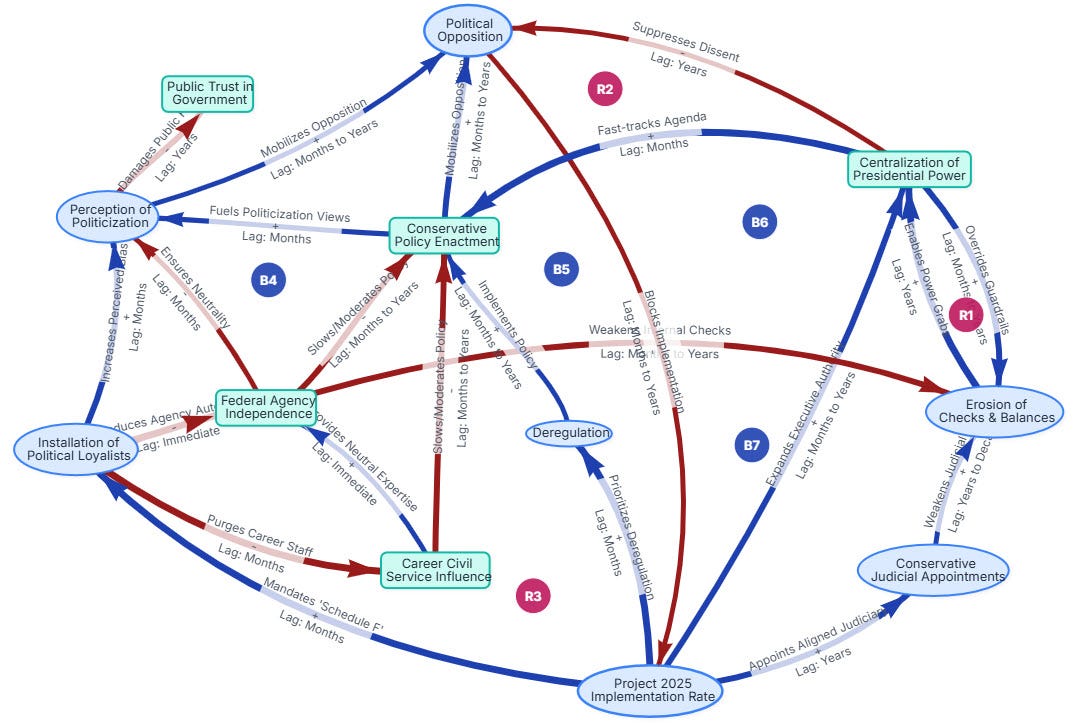
Model Explanation
The model illustrates the core theory behind Project 2025: increasing the implementation rate (n1) drives the centralization of presidential power (n2), primarily through mechanisms like installing political loyalists (n5) which erodes agency independence (n3) and civil service influence (n4). This centralized power (n2) further enables implementation (n1, via e1 then e21 to n7), bypasses checks and balances (n6, via e7), and directly fast-tracks conservative policy enactment (n7, via e21).
Three key reinforcing loops (R1, R2, R3) capture this engine of power consolidation and implementation acceleration:
R1 (Power Consolidation): Centralized power (n2) erodes checks and balances (n6), which further enables power centralization (n2).
R2 (Authoritarian Reinforcement): Implementation (n1) centralizes power (n2), which can suppress opposition (n10), thereby removing blocks to further implementation (n1).
R3 (Power Centralization Engine): A larger loop showing how implementation (n1) installs loyalists (n5), reduces agency independence (n3), erodes checks (n6), centralizes power (n2), suppresses opposition (n10), and ultimately enables more implementation (n1).
However, the model also includes significant balancing feedback loops (B4-B7) representing potential resistance or unintended consequences:
B4 & B5 (Politicization Backlash via Personnel/Agencies): Implementation (n1) -> Loyalists (n5) -> increases Perception of Politicization (n9, directly via e14 or indirectly via reduced Agency Independence n3/e13) -> Mobilizes Opposition (n10) -> Blocks Implementation (n1).
B6 & B7 (Policy Enactment Backlash): Successful Conservative Policy Enactment (n7) itself -> Mobilizes Opposition (n10, directly via e23 or via increased Politicization Perception n9/e16) -> Blocks Implementation (n1) needed for further policy enactment.
The model suggests a central tension between the reinforcing drive to centralize power and implement the agenda, and the balancing forces of political opposition mobilized by the perceived politicization and the actual enactment of policies.
Source: Project 2025 (Archetypes Experimental)
Wisdom
The model’s core wisdom lies in illustrating that attempts to rapidly centralize power and bypass institutional norms, even if initially successful in achieving policy goals, inherently generate resistance that can limit or undermine those very goals. The act of consolidating power and the visible outcomes of that power (policy enactment, personnel changes) are themselves the seeds of opposition. It suggests that such strategies may face inherent instability and pushback rooted in the system’s structure (checks and balances, public perception, political mobilization). Furthermore, the erosion of public trust (n8), driven by perceived politicization (n9), represents a potentially significant long-term, harder-to-reverse consequence affecting future governance regardless of political outcomes.
Donella Meadows’ Leverage Points
Applying Meadows’ framework reveals potential intervention points, ordered roughly from lowest to highest leverage:
Constants, parameters, numbers (Weakest): Adjusting the strength (width) or lag times of specific links (e.g., how quickly opposition mobilizes - e16/e23 lag, or how effectively it blocks implementation - e17 strength). Low leverage, as the core structure dominates.
Sizes of buffers: The ‘stock’ of Public Trust (n8), Agency Independence (n3), or Civil Service Influence (n4) act as buffers. Strengthening these stocks before implementation begins could increase resilience. Moderate-low leverage once erosion starts.
Structure of material stocks and flows: Not highly applicable here, as the model focuses on political/social dynamics.
Lengths of delays: Shortening the delay between politicization/policy enactment (n9/n7) and opposition mobilization (n10) could strengthen the balancing loops (B4-B7). Moderate leverage.
Strength of negative feedback loops: Strengthening the balancing loops (B4-B7). This involves increasing the effectiveness of Political Opposition (n10) in blocking implementation (e17), or increasing the sensitivity of Opposition (n10) to Politicization (n9 via e16) or Policy Enactment (n7 via e23). Moderate-high leverage.
Gain around positive feedback loops: Weakening the reinforcing loops (R1-R3). This could involve strengthening Checks & Balances (n6) to resist erosion (making e7/e11 weaker) or making it harder for centralized power (n2) to suppress dissent (weakening e18). Moderate-high leverage.
Structure of information flows: Ensuring information about implementation actions (n1), loyalist installation (n5), and policy enactment (n7) reaches the public and potential opposition effectively, fueling the Perception of Politicization (n9) and Opposition Mobilization (n10). High leverage. Transparency is key.
Rules of the system: Formal rules like civil service protections (affecting n4/n5), laws governing agency independence (n3), judicial review processes (n6/n12), and congressional oversight powers (n6). Modifying these rules (as P2025 intends) or defending them offers high leverage.
Power to add, change, evolve, or self-organize system structure: The ability of political opposition (n10), civil society, or even internal government actors (n4) to create new forms of resistance or oversight not initially accounted for. Very high leverage, but unpredictable.
Goals of the system: The explicit goal of P2025 is to enact a specific conservative agenda through centralized power. A competing goal is maintaining traditional checks and balances, agency neutrality, and public trust. The conflict between these goals drives the dynamics. Shifting the perceived legitimacy or priority of these goals has very high leverage.
Mindset or paradigm out of which the system arises: The underlying belief system driving P2025 (e.g., Unitary Executive Theory, view of the administrative state). Challenging or changing this paradigm, or strengthening the opposing paradigm (e.g., belief in separation of powers, neutral competence), is the second highest leverage point.
Power to transcend paradigms (Highest): Realizing that any paradigm, including the one driving P2025 or the one defending the status quo, is an incomplete view of the world. This allows for seeing the system as a whole and potentially finding entirely new ways to structure governance that achieve desired outcomes without triggering destructive dynamics. Highest leverage, but most difficult.
Knowledge
The model contains specific knowledge claims about causal relationships:
P2025 Implementation (n1) directly enables actions like Installing Loyalists (n5), Deregulation (n11), and Judicial Appointments (n10), and conceptually leads to Centralized Power (n2).
Installing Loyalists (n5) directly degrades Civil Service Influence (n4) and Agency Independence (n3), and increases the Perception of Politicization (n9).
Centralized Power (n2) enables overriding Checks & Balances (n6), suppressing Opposition (n10), and fast-tracking Policy Enactment (n7).
Erosion of Checks (n6), weakened Agency Independence (n3), and sympathetic Judicial Appointments (n12) all reinforce Centralized Power (n2).
Traditional brakes on policy enactment include Agency Independence (n3) and Civil Service Influence (n4).
Perception of Politicization (n9), fueled by installing loyalists (n5), reduced agency independence (n3), and policy enactment (n7), erodes Public Trust (n8) and mobilizes Opposition (n10).
Political Opposition (n10), mobilized by politicization (n9) and policy enactment (n7), acts to block further Implementation (n1).
Systems Archetypes
Two primary archetypes are evident:
Limits to Growth (arch1): The reinforcing “engine” loops (R1, R2, R3) drive the growth of P2025 Implementation (n1) and Centralized Power (n2). However, this very growth and its associated actions (installing loyalists n5, enacting policy n7) trigger the “limiting condition” – the mobilization of Political Opposition (n10) fueled by the Perception of Politicization (n9). This activates the balancing “backlash” loops (B4, B5, B6, B7) which push back on the Implementation Rate (n1), potentially slowing or halting the growth.
Shifting the Burden (arch2): The “problem” is the difficulty in achieving Conservative Policy Enactment (n7) against the inertia and rules represented by Agency Independence (n3) and Civil Service Influence (n4). The “fundamental solution” involves working through or reforming these structures (implicitly slow). The “symptomatic solution” is to bypass them by using Centralized Presidential Power (n2) and Installing Loyalists (n5) to directly enact policy (n7 via e21). This “quick fix” creates the “side effect” of increased Perception of Politicization (n9) and mobilized Opposition (n10), triggering the backlash loops (B4, B5, B6, B7) and potentially eroding Public Trust (n8), making future governance harder regardless of the policy outcome. The reliance on the symptomatic solution may atrophy the ability to use the fundamental one.
Primary Principles
Feedback Dominance: The long-term behavior will depend on whether the reinforcing loops (R1-R3) dominate, leading to sustained power centralization, or if the balancing loops (B4-B7) become strong enough to limit or stall implementation.
Policy Resistance: The system actively resists the changes P2025 aims to impose, primarily through the mobilization of political opposition triggered by the implementation itself.
Escalation (potential): While not explicitly modeled as a separate archetype, the dynamic between implementation (n1 -> n2) and opposition (n10 -> n1) could escalate if each side reacts more strongly over time. R2 specifically shows how power (n2) can be used to suppress opposition (n10), potentially breaking the balancing loops.
Unintended Consequences: The pursuit of policy enactment (n7) via power centralization (n2) and bypassing norms (n3, n4) unintentionally generates opposition (n10) and erodes public trust (n8).
Key Insights
The P2025 strategy relies heavily on reinforcing loops that consolidate power and weaken checks.
The strategy itself generates the seeds of its own potential limitation through political backlash triggered by its core actions (personnel changes, policy enactment).
Public perception (n9) acts as a critical intermediary, translating system changes into political opposition (n10).
The erosion of public trust (n8) is a significant potential side effect with long-term implications beyond the immediate policy goals.
The effectiveness of political opposition (n10) in actually blocking implementation (n1) is a key uncertainty determining the system’s outcome.
Future implications
If R-loops dominate: Expect continued centralization of power, significant erosion of agency independence and civil service norms, potentially successful suppression of opposition, and rapid enactment of the P2025 agenda, but likely accompanied by severely diminished public trust.
If B-loops dominate: Expect implementation to stall or slow significantly due to legal challenges, congressional action, and public resistance. Power centralization may be limited. However, the conflict itself could still damage public trust.
Oscillation: The system might oscillate between periods of rapid implementation triggering strong backlash, followed by periods of stalemate or slow reversal as opposition gains traction.
Long-term Erosion: Regardless of the policy outcomes, the perceived politicization (n9) generated during the conflict could lead to a lasting decline in public trust (n8), making effective governance harder for future administrations of any party.
Synthesis: Core Wisdom & Highest Leverage
Core Wisdom: Aggressively centralizing executive power to bypass institutional checks inherently triggers counter-balancing forces fueled by perceived politicization and policy outcomes, potentially limiting the initial goals and causing long-term damage to public trust.
Highest Leverage Point (within the model’s scope, aiming for stability/balance): The highest leverage point appears to be intervening at the level of Paradigms (Meadows’ #2) and Goals (Meadows’ #3). This involves strengthening the societal belief in, and the operational priority of, the goals of limited government, checks and balances, agency neutrality, and the rule of law, directly challenging the Unitary Executive Theory paradigm underlying Project 2025. Operationally, this translates to reinforcing the Rules of the System (Meadows’ #5) – defending civil service protections, agency mandates, judicial independence, and oversight powers – which directly counteracts the mechanisms driving the reinforcing loops and strengthens the system’s inherent balancing forces. Focusing solely on opposing individual policies (affecting n7) or personnel (n5) may be lower leverage than defending the institutional structures and the governing paradigm itself.