
Post Capitalism: A Deeper Dive

Analysis of the Post-Capitalism Model
1. Model Explanation
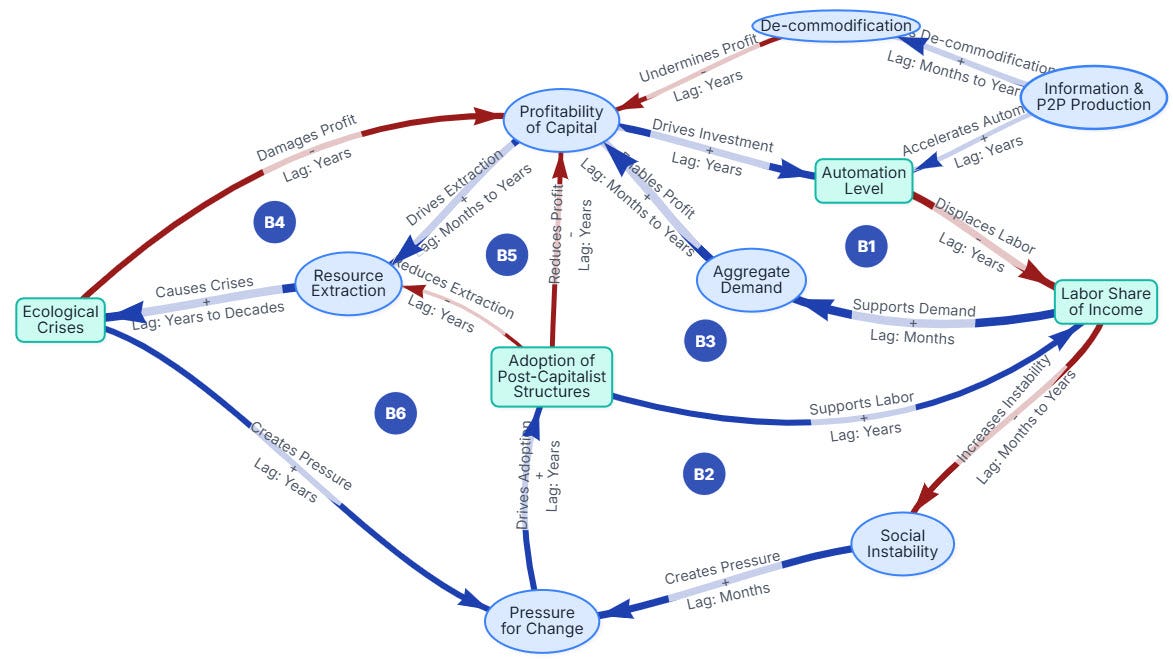
This Causal Loop Diagram (CLD) models the transition from a capitalist economic system to a “post-capitalist” one. The system’s central organizing principle is the “Profitability of Capital” (n3), which acts as the primary engine for investment and accumulation.
The model’s core narrative is built on two fundamental internal contradictions (both “Limits to Growth” archetypes) and one major external disruptor.
The Economic/Social Contradiction (Loop B1): The pursuit of profit (n3) drives investment in “Automation” (n1). This automation displaces human labor, eroding the “Labor Share of Income” (n2). A lower labor share, in turn, suppresses “Aggregate Demand” (n5), as workers have less purchasing power. This weak demand ultimately makes it difficult to realize sales, thus undermining the “Profitability of Capital” (n3) that started the cycle.
The Ecological Contradiction (Loop B4): The pursuit of profit (n3) also drives “Resource Extraction” (n11) to fuel production. This flow of extraction and waste accumulates as “Ecological Crises” (n10) (e.g., climate change, resource depletion). These crises eventually impose severe real-world costs (e.g., supply chain disruptions, carbon taxes, damaged infrastructure), which directly “Damage Profitability” (n3), limiting the very growth engine that caused the problem.
These two crises—social and ecological—do not exist in isolation. Their consequences, “Social Instability” (n4) and the visible “Ecological Crises” (n10), both converge on a single, crucial variable: “Pressure for Change” (n6).
This pressure acts as the system’s “immune response,” driving the “Adoption of Post-Capitalist Structures” (n7) (e.g., Universal Basic Income, worker co-ops, commons-based governance). This new stock of structures forms a series of new, long-term balancing loops (B2, B3, B5, B6) that attempt to correct the system’s failures by directly supporting labor (n2), reducing extraction (n11), and constraining the primacy of profit (n3).
Finally, an external driver, “Information & P2P Production” (n8), acts as both an accelerant and a solvent. It accelerates the crisis by making “Automation” (n1) cheaper and faster. Simultaneously, it solvents the old system by driving “De-commodification” (n9), which directly “Undermines Profit” (n3) by providing free, high-quality alternatives (e.g., open-source software).
Source: Post Capitalism (Archetypes Experimental)
2. Wisdom
The core wisdom of this model is that a complex system organized around a single, optimizing goal (maximizing “Profitability of Capital”) will eventually be constrained or forced into transition by the very consequences of its own success. The system’s “limits” are not just external (like the environment) but also internal (like aggregate demand).
This model reframes the end of an economic era not as a singular event or the victory of an opposing ideology, but as a process of transition driven by the system’s own self-defeating feedback loops and its inability to solve the problems it creates. The system’s illnesses (instability, crises) become the primary catalysts (pressure) for its cure (new structures).
3. Donella Meadows’ Leverage Points
Analyzing the model through the lens of Donella Meadows’ leverage points reveals the most effective places to intervene.
Low Leverage (Parameters, Buffers): Intervening at the level of parameters (e.g., trying to increase wage subsidies to boost “Labor Share” (n2) or building more resilient infrastructure to buffer “Ecological Crises” (n10)) would be low-leverage. These are “fixes” that fight against the system’s fundamental logic and goals, and their effect would likely be temporary.
Medium Leverage (Feedback Loops): A more effective intervention is to alter the strength and speed of the key balancing loops.
Strengthening B2 & B3 (Social Response): Decreasing the lag and increasing the gain between “Social Instability” (n4) and “Pressure for Change” (n6). This translates to strengthening democratic responsiveness, supporting social movements, and increasing political accountability.
Strengthening B4 & B5 (Ecological Response): Directly and quickly linking “Ecological Crises” (n10) to “Profitability” (n3) or “Pressure for Change” (n6). Carbon taxes, cap-and-trade, and strong environmental regulations are all examples of strengthening these balancing loops.
High Leverage (The Goal): The model explicitly identifies an “Eroding Goals” archetype. The goal of the system is “Profitability of Capital” (n3). The “Adoption of Post-Capitalist Structures” (n7) is the physical manifestation of an attempt to change that goal. Interventions that directly build this stock (n7)—such as funding co-ops, establishing public data trusts, or chartering B-Corps—are high-leverage because they introduce a new, competing goal into the system.
Highest Leverage (The Paradigm): The highest leverage point is the mindset or paradigm from which the system arises—the shared belief that maximizing profit is the goal. The entire model functions as an argument against this paradigm. The most profound intervention is to accelerate the societal shift in understanding that this goal is self-limiting and must be transcended. The P2P/De-commodification dynamic (n8, n9) is a powerful force at this level, as it demonstrates a viable, alternative paradigm of production that is not based on profit at all.
4. Knowledge
Stocks (4): “Automation Level” (n1), “Labor Share of Income” (n2), “Adoption of Post-Capitalist Structures” (n7), “Ecological Crises” (n10).
Key Drivers (2): “Profitability of Capital” (n3) as the central endogenous driver, and “Information & P2P Production” (n8) as a key exogenous driver.
Key Nodes (2): “Pressure for Change” (n6) as the point of crisis convergence, and “Adoption of Post-Capitalist Structures” (n7) as the primary intervention/solution point.
Balancing Loops (6):
B1: The Crisis of Aggregate Demand (Economic self-contradiction)
B2: Social Response to Inequality (Social self-correction)
B3: The Full Socio-Economic Correction (Policy-driven correction)
B4: Ecological Limits to Growth (Ecological self-contradiction)
B5: Ecological Pressure on Profit (Policy-driven ecological correction)
B6: Structural Shift to Sustainability (Structural solution to ecology)
Reinforcing Loops (0): The model notably contains zero reinforcing loops. This is a deliberate modeling choice. It signifies that the system is not in its early growth phase (which would be dominated by R-loops) but in a state of maturity, crisis, and transition, where its behavior is governed by limits and balancing feedback.
5. Systems Archetypes
Limits to Growth (Dual): This is the model’s primary structure. The central growth engine (”Profitability of Capital” n3) initiates two “growth” actions: “Automation” (n1) and “Resource Extraction” (n11). Each action hits a major limit, creating a balancing loop that slows the engine.
Limit 1 (B1): Automation (n1) erodes “Labor Share” (n2), which kills “Aggregate Demand” (n5), which limits “Profitability” (n3).
Limit 2 (B4): Extraction (n11) creates “Ecological Crises” (n10), which impose costs and limit “Profitability” (n3). The system is simultaneously hitting a social/demand ceiling and an ecological/supply-chain floor.
Eroding Goals: The system’s goal is to maximize “Profitability” (n3). The undesirable consequences of this pursuit (”Social Instability” n4, “Ecological Crises” n10) create “Pressure for Change” (n6). This pressure forces the “Adoption of Post-Capitalist Structures” (n7). These new structures, in turn, directly attack the original goal (link
e9from n7 to n3, “Reduces Profit”). The system is forced to erode its own goal to ensure its survival, shifting its objective from maximization to stability. The external “De-commodification” (n9) dynamic also functions as an “Eroding Goals” force by undermining profit from the outside.
6. Primary Principles
Internal Contradiction: The system’s own logic is self-defeating (B1). The drive for profit through automation destroys the basis for profit (demand).
Externalized Costs & Delayed Feedback: The system functions by externalizing its social (eroding n2) and ecological (inflating n10) costs. The feedback from these costs (B2, B4) is slow and delayed, allowing the problems to accumulate to crisis levels before a response is mounted.
Convergence of Crises: The model posits that social and ecological problems are not separate. They are two symptoms of the same underlying driver (n3) and they converge to create a single, unified “Pressure for Change” (n6).
7. Key Insights
The “Limits to Growth” are Dual: The crisis of capitalism is not just ecological (a Malthusian limit) and not just social (a Marxist limit). It is both, and they are happening simultaneously, reinforcing each other.
Crisis is the Catalyst: “Pressure for Change” (n6) is the pivotal node. The model argues that the system will not fundamentally transition without sufficient “pain” from “Social Instability” (n4) and “Ecological Crises” (n10).
The External Disruptor: The role of “Information & P2P Production” (n8) is a critical insight. It acts as a pincer movement: it accelerates one crisis (automation) while simultaneously providing the seeds of a solution (de-commodification,
n9, and new structures) that undermine the old system’s logic.
8. Future Implications
The model implies that the coming decades will be defined by the tension between the system’s “business-as-usual” logic and the strengthening of these balancing loops.
Intensifying Instability: We should expect “Social Instability” (n4) and “Ecological Crises” (n10) to worsen as long as “Profitability” (n3) remains the primary goal.
The Policy Battleground: The key political and social battles will be fought over the “Adoption of Post-Capitalist Structures” (n7). Efforts to implement these (UBI, co-ops, commons) will be met with resistance from forces seeking to protect “Profitability” (n3).
The Inevitable Erosion of Profit: The model suggests that the weakening of “Profitability” (n3) is inevitable, as it is being “attacked” from four sides: low demand (B1), high ecological costs (B4), new taxes/regulations (B3, B5), and the external force of de-commodification (from n9).
9. Synthesis: Core Wisdom & Highest Leverage Point
Core Wisdom: The transition to a “post-capitalist” economy is not an external event, but an emergent property of the current system’s own success. A system designed to maximize a single variable (profit) becomes brittle and eventually generates consequences (social and ecological) that erode its own foundation.
Highest Leverage Point: The highest leverage point is to transcend the paradigm that “Profitability of Capital” (n3) is the ultimate goal. In this model, this is achieved by accelerating the adoption of new goals. The most powerful intervention is to deliberately build the stock of “Adoption of Post-Capitalist Structures” (n7), as this stock is the physical embodiment of a new paradigm. This intervention simultaneously weakens the old system’s driver (via e9) and strengthens the new system’s corrective, stabilizing loops (B2, B6).