
Populism: A Deeper Dive

Comprehensive Analysis of the Populism Model
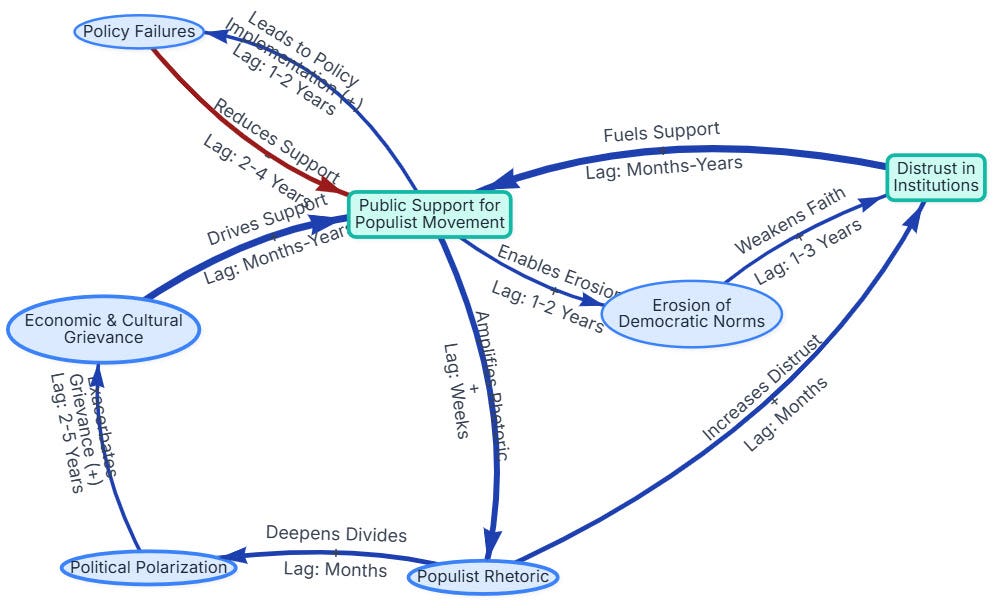
Model Explanation
This Causal Loop Diagram (CLD) illustrates the core dynamics of a populist movement’s rise and its societal impact. The model is centered around two primary stocks: Public Support for the Populist Movement and the underlying Distrust in Institutions.
The system is driven by Economic & Cultural Grievance, a latent frustration within a population that feels left behind or culturally threatened. This grievance doesn’t automatically translate to political action. It is activated by Populist Rhetoric, which frames these grievances as a struggle between “the people” and a corrupt “elite.” This rhetoric resonates powerfully when there is already significant Distrust in Institutions (like government and media), leading to an increase in Public Support for the Populist Movement.
This dynamic creates several powerful reinforcing (or vicious) feedback loops:
R1: The Distrust Spiral: Increased support amplifies the populist rhetoric, which in turn attacks and erodes trust in institutions, making the population even more receptive to the initial message.
R2: The Polarization Spiral: The rhetoric deepens Political Polarization, which leads to gridlock and an inability to solve the original grievances, causing them to fester and generate even more support for the populist movement.
R3: The Democratic Erosion Spiral: Strong public support gives populist leaders the mandate to weaken democratic norms. This act further damages institutional integrity, increasing distrust and solidifying the movement’s base.
The model also contains a crucial, long-term balancing loop:
B1: The Reality Check: With enough public support, the movement gains power and implements its agenda. If these policies fail to solve the grievances and result in negative outcomes (Policy Failures), public support may eventually wane, creating a potential, albeit delayed, course correction.
Source: Populism (Archetypes Experimental)
Wisdom
The core wisdom of this model is that populism is a symptom, not the disease. The disease is the combination of legitimate public grievance and a deep-seated distrust in the institutions designed to address it.
The populist movement emerges as a “symptomatic solution”—a powerful and emotionally resonant cure that offers immediate validation and a clear enemy. However, the model reveals this cure to be a tragic trap. The very mechanisms that make populism grow (stoking distrust, deepening polarization, and eroding democratic norms) are the ones that ultimately prevent the society from solving the fundamental problems that caused the pain in the first place. The system feeds on itself, becoming a self-perpetuating cycle of grievance and division that can lead a society into a state of permanent dysfunction.
Leverage Points in Accordance with Donella Meadows
Applying Donella Meadows’ hierarchy of leverage points helps identify the most effective places to intervene in this system:
Constants, parameters, numbers (Lowest Leverage):
Intervention: Fact-checking individual statements within the Populist Rhetoric.
Analysis: This is the least effective point. While important, it operates at the surface level. The rhetoric’s power is emotional, not factual, and in a system with high Distrust in Institutions, sources of fact-checking are often dismissed as part of the “elite.”
The sizes of buffers and other stabilizing stocks (Low Leverage):
Intervention: Bolstering the stock of Distrust in Institutions by promoting civic education or media literacy programs.
Analysis: While beneficial, building trust is a slow process and acts as a buffer, not a fundamental fix. A deep well of grievance can quickly overwhelm a shallow well of trust.
The structure of information flows (Medium Leverage):
Intervention: Creating and promoting independent, trusted media sources that break through polarized information bubbles and transparently report on Policy Failures.
Analysis: This is a significant leverage point. It strengthens the “Reality Check” (B1) loop by ensuring the consequences of policy are clearly and credibly communicated, potentially shortening the delay between failure and the erosion of public support.
The power to add, change, evolve, or self-organize system structure (High Leverage):
Intervention: Implementing democratic reforms that reduce polarization and gridlock, such as electoral reform or campaign finance laws. Strengthening the independence and accountability of institutions (judiciary, press).
Analysis: This is a high-leverage intervention. It directly alters the structure that creates the vicious cycles. By making institutions more responsive and less susceptible to partisan capture, it weakens the “Distrust Spiral” (R1) and “Polarization Spiral” (R2).
The mindset or paradigm out of which the system arises (Highest Leverage):
Intervention: Shifting the societal paradigm from a zero-sum conflict between “us vs. them” to a shared understanding of common challenges and a commitment to solving the underlying Economic & Cultural Grievances.
Analysis: This is the highest and most difficult leverage point. It involves transcending the very mindset that gives populism its power. It requires leadership that re-frames the national narrative around shared goals and validates grievances without resorting to scapegoating, thereby making the divisive rhetoric of populism less appealing.
Knowledge
The model is built on the following real-world knowledge and established relationships:
Widespread economic pain and feelings of cultural displacement are primary drivers of support for anti-establishment movements.
Declining trust in government, media, and other institutions is a strong predictor of populist success.
Populist rhetoric systematically employs anti-elitist and divisive language to build a coalition of supporters.
This rhetoric, when amplified, has been shown to increase affective polarization (the dislike of political opponents).
High levels of polarization lead to legislative gridlock, hindering a government’s ability to pass meaningful policy.
When populist leaders gain power, they often take actions to weaken institutional checks and balances (e.g., attacking the judiciary, delegitimizing the press).
Ultimately, a government’s long-term survival depends on its performance. Persistent policy failures eventually erode the support of even the most ardent followers.
Systems Archetypes
The primary archetype at play is “Shifting the Burden.”
The Problem: Deep and unresolved Economic & Cultural Grievance.
The Symptomatic Solution: The public shifts the burden of solving their problems onto a populist movement. This is an easy, emotionally satisfying fix that is sustained by the “Polarization Spiral” (R2) and the “Distrust Spiral” (R1). It feels like action is being taken.
The Fundamental Solution (Neglected): The difficult, complex, and slow work of developing and implementing effective policies to address the root causes of the grievance.
Side Effects: The symptomatic solution creates powerful side effects. The reinforcing loops (R1, R2, R3) strengthen the movement while simultaneously causing Political Polarization and the Erosion of Democratic Norms. These side effects make the fundamental solution (effective, consensus-based governance) increasingly difficult, if not impossible, to achieve. The system becomes addicted to the symptomatic solution, even as it makes the original problem worse.
Primary Principles
Structure Determines Behavior: The behavior of the system (the rise of populism) is a direct result of its underlying structure—the interconnectedness of grievance, distrust, and rhetoric.
Symptoms are Deceiving: Populist rhetoric is a symptom of deeper issues. Attacking the rhetoric without addressing the grievance is like treating a fever without fighting the infection.
Vicious Cycles Dominate: The system is dominated by reinforcing loops. Once they gain momentum, they are difficult to stop and can lead to a rapid deterioration of social cohesion and democratic health.
Delays Matter: The balancing “Reality Check” loop has a significant delay. The negative consequences of policy failures take years to become undeniable, by which time immense damage to institutions and social trust may have already occurred.
Key Insights
Trust is the Immune System of Democracy: A society with high trust in its institutions is far more resilient to the virus of divisive populist rhetoric. The erosion of this trust is the critical vulnerability.
Grievance is the Fuel, Rhetoric is the Spark: Grievance alone is just potential energy. Populist rhetoric is the spark that ignites it into a powerful political fire.
The Goal is Power, Not Solutions: The reinforcing loops reveal that the system’s immediate goal becomes self-perpetuation—maintaining power by amplifying distrust and polarization—rather than solving the problems that created the movement.
The System Can Get Stuck: The “Shifting the Burden” structure can lock a society into a long-term pattern of dysfunction, where it continually applies a “fix” that makes the problem worse.
Future Implications
If the reinforcing loops (R1, R2, R3) continue to dominate, the model predicts a grim future. The society will become progressively more polarized, ungovernable, and distrustful. Democratic norms will continue to decay, potentially leading to a stable but less free and less functional form of government (competitive authoritarianism). The original grievances will remain unaddressed, ensuring a permanent undercurrent of anger and resentment.
If the balancing “Reality Check” loop (B1) eventually activates with sufficient force, a course correction is possible. However, this is likely to occur only after a period of significant crisis or profound policy failure. The path to recovery would be long and difficult, as it would require not only solving the original problems but also rebuilding the immense amount of social and institutional trust that was destroyed.
Synthesis
Core Wisdom: Populism is a tragic feedback loop where the seductive cure for societal grievance—a rhetoric that divides and distrusts—becomes a more potent poison than the original disease, ultimately eroding the very foundations of the society it claims to save.
Highest Leverage Point: The highest point of leverage is to change the paradigm and the goals of the system. This means shifting the collective focus away from the zero-sum goal of political victory (which perpetuates the loops) and towards the transcendent goal of genuinely and visibly addressing the Economic & Cultural Grievances. A society that successfully makes its people feel secure, respected, and hopeful about the future removes the fuel that populist fires need to burn. Model Explanation
This Causal Loop Diagram (CLD) illustrates the core dynamics of a populist movement’s rise and its societal impact. The model is centered around two primary stocks: Public Support for the Populist Movement and the underlying Distrust in Institutions.
The system is driven by Economic & Cultural Grievance, a latent frustration within a population that feels left behind or culturally threatened. This grievance doesn’t automatically translate to political action. It is activated by Populist Rhetoric, which frames these grievances as a struggle between “the people” and a corrupt “elite.” This rhetoric resonates powerfully when there is already significant Distrust in Institutions (like government and media), leading to an increase in Public Support for the Populist Movement.
This dynamic creates several powerful reinforcing (or vicious) feedback loops:
R1: The Distrust Spiral: Increased support amplifies the populist rhetoric, which in turn attacks and erodes trust in institutions, making the population even more receptive to the initial message.
R2: The Polarization Spiral: The rhetoric deepens Political Polarization, which leads to gridlock and an inability to solve the original grievances, causing them to fester and generate even more support for the populist movement.
R3: The Democratic Erosion Spiral: Strong public support gives populist leaders the mandate to weaken democratic norms. This act further damages institutional integrity, increasing distrust and solidifying the movement’s base.
The model also contains a crucial, long-term balancing loop:
B1: The Reality Check: With enough public support, the movement gains power and implements its agenda. If these policies fail to solve the grievances and result in negative outcomes (Policy Failures), public support may eventually wane, creating a potential, albeit delayed, course correction.
Wisdom
The core wisdom of this model is that populism is a symptom, not the disease. The disease is the combination of legitimate public grievance and a deep-seated distrust in the institutions designed to address it.
The populist movement emerges as a “symptomatic solution”—a powerful and emotionally resonant cure that offers immediate validation and a clear enemy. However, the model reveals this cure to be a tragic trap. The very mechanisms that make populism grow (stoking distrust, deepening polarization, and eroding democratic norms) are the ones that ultimately prevent the society from solving the fundamental problems that caused the pain in the first place. The system feeds on itself, becoming a self-perpetuating cycle of grievance and division that can lead a society into a state of permanent dysfunction.
Leverage Points in Accordance with Donella Meadows
Applying Donella Meadows’ hierarchy of leverage points helps identify the most effective places to intervene in this system:
Constants, parameters, numbers (Lowest Leverage):
Intervention: Fact-checking individual statements within the Populist Rhetoric.
Analysis: This is the least effective point. While important, it operates at the surface level. The rhetoric’s power is emotional, not factual, and in a system with high Distrust in Institutions, sources of fact-checking are often dismissed as part of the “elite.”
The sizes of buffers and other stabilizing stocks (Low Leverage):
Intervention: Bolstering the stock of Distrust in Institutions by promoting civic education or media literacy programs.
Analysis: While beneficial, building trust is a slow process and acts as a buffer, not a fundamental fix. A deep well of grievance can quickly overwhelm a shallow well of trust.
The structure of information flows (Medium Leverage):
Intervention: Creating and promoting independent, trusted media sources that break through polarized information bubbles and transparently report on Policy Failures.
Analysis: This is a significant leverage point. It strengthens the “Reality Check” (B1) loop by ensuring the consequences of policy are clearly and credibly communicated, potentially shortening the delay between failure and the erosion of public support.
The power to add, change, evolve, or self-organize system structure (High Leverage):
Intervention: Implementing democratic reforms that reduce polarization and gridlock, such as electoral reform or campaign finance laws. Strengthening the independence and accountability of institutions (judiciary, press).
Analysis: This is a high-leverage intervention. It directly alters the structure that creates the vicious cycles. By making institutions more responsive and less susceptible to partisan capture, it weakens the “Distrust Spiral” (R1) and “Polarization Spiral” (R2).
The mindset or paradigm out of which the system arises (Highest Leverage):
Intervention: Shifting the societal paradigm from a zero-sum conflict between “us vs. them” to a shared understanding of common challenges and a commitment to solving the underlying Economic & Cultural Grievances.
Analysis: This is the highest and most difficult leverage point. It involves transcending the very mindset that gives populism its power. It requires leadership that re-frames the national narrative around shared goals and validates grievances without resorting to scapegoating, thereby making the divisive rhetoric of populism less appealing.
Knowledge
The model is built on the following real-world knowledge and established relationships:
Widespread economic pain and feelings of cultural displacement are primary drivers of support for anti-establishment movements.
Declining trust in government, media, and other institutions is a strong predictor of populist success.
Populist rhetoric systematically employs anti-elitist and divisive language to build a coalition of supporters.
This rhetoric, when amplified, has been shown to increase affective polarization (the dislike of political opponents).
High levels of polarization lead to legislative gridlock, hindering a government’s ability to pass meaningful policy.
When populist leaders gain power, they often take actions to weaken institutional checks and balances (e.g., attacking the judiciary, delegitimizing the press).
Ultimately, a government’s long-term survival depends on its performance. Persistent policy failures eventually erode the support of even the most ardent followers.
Systems Archetypes
The primary archetype at play is “Shifting the Burden.”
The Problem: Deep and unresolved Economic & Cultural Grievance.
The Symptomatic Solution: The public shifts the burden of solving their problems onto a populist movement. This is an easy, emotionally satisfying fix that is sustained by the “Polarization Spiral” (R2) and the “Distrust Spiral” (R1). It feels like action is being taken.
The Fundamental Solution (Neglected): The difficult, complex, and slow work of developing and implementing effective policies to address the root causes of the grievance.
Side Effects: The symptomatic solution creates powerful side effects. The reinforcing loops (R1, R2, R3) strengthen the movement while simultaneously causing Political Polarization and the Erosion of Democratic Norms. These side effects make the fundamental solution (effective, consensus-based governance) increasingly difficult, if not impossible, to achieve. The system becomes addicted to the symptomatic solution, even as it makes the original problem worse.
Primary Principles
Structure Determines Behavior: The behavior of the system (the rise of populism) is a direct result of its underlying structure—the interconnectedness of grievance, distrust, and rhetoric.
Symptoms are Deceiving: Populist rhetoric is a symptom of deeper issues. Attacking the rhetoric without addressing the grievance is like treating a fever without fighting the infection.
Vicious Cycles Dominate: The system is dominated by reinforcing loops. Once they gain momentum, they are difficult to stop and can lead to a rapid deterioration of social cohesion and democratic health.
Delays Matter: The balancing “Reality Check” loop has a significant delay. The negative consequences of policy failures take years to become undeniable, by which time immense damage to institutions and social trust may have already occurred.
Key Insights
Trust is the Immune System of Democracy: A society with high trust in its institutions is far more resilient to the virus of divisive populist rhetoric. The erosion of this trust is the critical vulnerability.
Grievance is the Fuel, Rhetoric is the Spark: Grievance alone is just potential energy. Populist rhetoric is the spark that ignites it into a powerful political fire.
The Goal is Power, Not Solutions: The reinforcing loops reveal that the system’s immediate goal becomes self-perpetuation—maintaining power by amplifying distrust and polarization—rather than solving the problems that created the movement.
The System Can Get Stuck: The “Shifting the Burden” structure can lock a society into a long-term pattern of dysfunction, where it continually applies a “fix” that makes the problem worse.
Future Implications
If the reinforcing loops (R1, R2, R3) continue to dominate, the model predicts a grim future. The society will become progressively more polarized, ungovernable, and distrustful. Democratic norms will continue to decay, potentially leading to a stable but less free and less functional form of government (competitive authoritarianism). The original grievances will remain unaddressed, ensuring a permanent undercurrent of anger and resentment.
If the balancing “Reality Check” loop (B1) eventually activates with sufficient force, a course correction is possible. However, this is likely to occur only after a period of significant crisis or profound policy failure. The path to recovery would be long and difficult, as it would require not only solving the original problems but also rebuilding the immense amount of social and institutional trust that was destroyed.
Synthesis
Core Wisdom: Populism is a tragic feedback loop where the seductive cure for societal grievance—a rhetoric that divides and distrusts—becomes a more potent poison than the original disease, ultimately eroding the very foundations of the society it claims to save.
Highest Leverage Point: The highest point of leverage is to change the paradigm and the goals of the system. This means shifting the collective focus away from the zero-sum goal of political victory (which perpetuates the loops) and towards the transcendent goal of genuinely and visibly addressing the Economic & Cultural Grievances. A society that successfully makes its people feel secure, respected, and hopeful about the future removes the fuel that populist fires need to burn. This requires leadership that can absorb complexity and unite people toward a common purpose, rendering the simplistic, divisive narrative of populism ineffective.