
Political Partisanship
Ana Aha! Mystery - Deciphering the Mess

The Breath of the Brittle Machine
The air in the capital had grown thick, not with the heat of summer, but with the heavy, grey dust of a machine that had forgotten how to move. For years, the people walked past the Great Engine of Governance, watching the gears chatter and spark without ever actually turning the wheels. It was a landscape of load-bearing delusions—the belief that if one side simply pushed harder against the other, the friction would somehow turn into forward motion. Instead, the energy leaked out in a constant, low-frequency hum of resentment. Leaders spent eighty hours a week not building roads or feeding the hungry, but reinforcing the barricades of their own survival, terrified that a single handshake across the aisle would be the spark that ended their careers. The first responsibility of the day was to admit the truth: the machine wasn’t broken by accident; it was functioning perfectly as a cage, where every ounce of human effort was being consumed by the friction of staying exactly where we were.
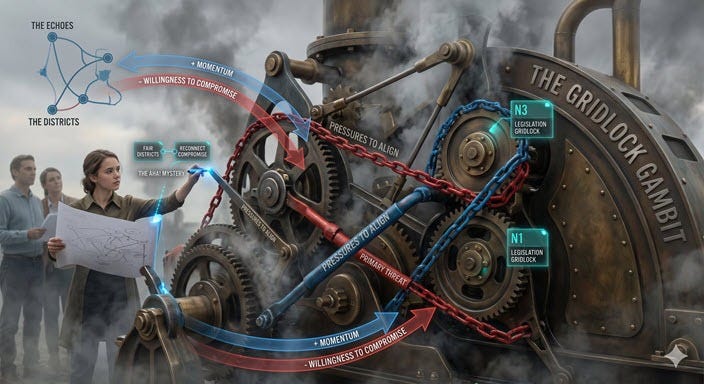
Deep within the heart of the marble halls lived a young architect named Elara, who had grown exhausted by the weight of the “Feedback Trap.” She watched as the public’s trust—once a deep, clear reservoir—evaporated into a mist of cynical anger. But then came the “Aha!” moment, a clarity that felt like a sudden cooling of a fever. She realized that the people weren’t the problem, and neither were the politicians; it was the “plumbing” of the districts and the “echoes” of the screens that had turned neighbors into enemies. Elara stopped trying to fix the people and started mapping the relationships. She made the critical move of showing the leaders that their fear of the primary challenge was a mirror reflecting a distorted image of the world. She began to propose new “circuit breakers”—fair lines drawn by math rather than malice, and a new way of sharing stories that celebrated the “Trial & Learning” of compromise rather than the purity of the stalemate.
The movement began as a quiet resonance. The visionaries saw the beauty in the invisible connections being restored, feeling the pulse of a system that could finally breathe again. The pragmatists felt the sudden reduction in friction; for the first time in a generation, the “What if?” of a new law didn’t feel like a threat, but like a tool that worked. The “Limits to Growth” that had once strangled the country began to stretch, making room for a new kind of momentum. As the first bills began to move through the cleared pipes, the reservoir of trust started to refill, drop by drop. It wasn’t a perfect machine, but it was a living one. And so, we say thank you—to the architects who looked past the noise, to the leaders who chose courage over the safety of the cage, and to the people who waited for the “Aha!” that finally brought the movement back to life.
The Story source file also contains First Principles, Core Wisdom, Systemic Paradoxes, Leverage Points, and Stakeholder Resonance.
The Story conveys what, the model shows why, and the transcript explains how. You can access the files associated with this post in the “Political Partisanship” folder. To try the Aha! Mystery process, send systemswiki@gmail.com an email, and I’ll send you the prompts.
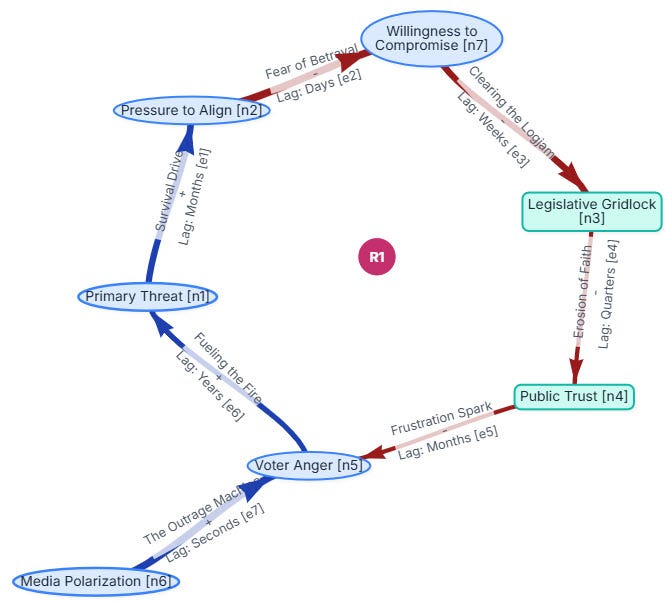
Prompt: Help me understand political partisanship, the relationships responsible for it, why Congress can seldom get anything done for the people, and what might be done about it.
Political Partisanship Dialog: https://gemini.google.com/share/b11c7eb0a76d
Gene,
Your story provoked my own AI conversation asking Gemini to elaborate on the chronology of increasing polarization, then asked for strategies to rebuild consensus - finding that a bought Congress would never pass such reforms and then asked it for more radical short term efforts to prevent further polarization. https://gemini.google.com/share/09d0be2057b7 It's complicated and perhaps beyond the scope of your Aha! methods. Could your methods deal with this extent of complexity. Could you feed in the ranked 25 causes of polarization and ask for a CLD and a story?