
Philanthropy: A Deeper Dive

Analysis of the Philanthropy Systems Model
This document provides a detailed analysis of the Causal Loop Diagram (CLD) for Philanthropy, based on the system’s defined variables, feedback loops, and archetypes.
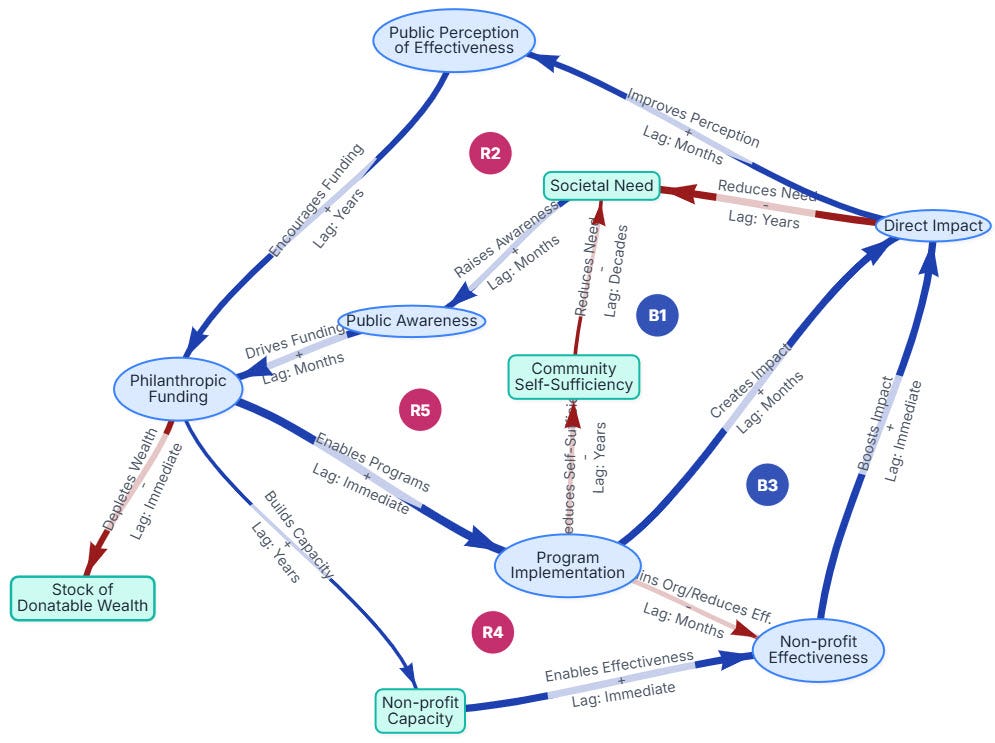
1. Model Explanation
The model illustrates the core dynamics of philanthropic action, revealing the tensions between short-term solutions and long-term systemic change.
The system’s engine is B1: The Primary Solution. This is the fundamental purpose of philanthropy: a Societal Need (n1) raises Public Awareness (n2), which drives Philanthropic Funding (n3). This funding enables Program Implementation (n4), creating a Direct Impact (n5) that, over time, reduces the initial Societal Need (n1).
This core loop is amplified by R2: The Virtuous Cycle. This reinforcing loop shows how success breeds success. Direct Impact (n5) improves the Public Perception of Effectiveness (n6), which in turn encourages more Philanthropic Funding (n3), driving even more implementation and impact.
However, this growth engine has a limit, described by B3: The Strain Loop. As Funding (n3) and Implementation (n4) scale up, they can outpace the organization’s Non-profit Capacity (n7). This creates strain, reducing Non-profit Effectiveness (n8) and weakening the Direct Impact (n5). A weaker impact damages Public Perception (n6), which ultimately slows or reverses funding.
The strategic solution to this limit is R4: Capacity Investment. This virtuous loop shows that wise donors invest Funding (n3) not just in programs, but also in Non-profit Capacity (n7) (e.g., staff, training, systems). This investment boosts Effectiveness (n8), which enhances Impact (n5) and Perception (n6), leading to more sustainable funding and growth.
Finally, the model reveals a critical unintended consequence in R5: The Dependency Spiral. This vicious cycle represents a “Fix that Fails.” The Program Implementation (n4) from the “fix” (B1), if poorly designed (e.g., as handouts), can erode Community Self-Sufficiency (n9). A less self-sufficient community becomes more dependent on aid, which in the long run increases the very Societal Need (n1) that philanthropy set out to solve.
Source: Philanthropy (Archetypes Experimental)
2. Wisdom
The core wisdom of this model is that effective philanthropy is not about addressing a need, but about changing the systemic structure that creates the need.
Ineffective philanthropy gets trapped in a “Fixes that Fail” archetype (B1 + R5), where short-term aid creates long-term dependency, ultimately worsening the problem.
Average philanthropy gets trapped in a “Limits to Growth” archetype (R2 + B3), where its own success leads to burnout and diminishing returns by failing to invest in capacity.
Wise philanthropy understands this. It uses its resources (n3) as a catalyst, not a permanent solution. It intentionally shifts its focus from maximizing short-term Direct Impact (n5) to building the long-term stocks of Non-profit Capacity (n7) and Community Self-Sufficiency (n9). The ultimate goal of wise philanthropy is to build a system that makes its own intervention obsolete.
3. Donella Meadows’ Leverage Points
The model highlights several of Meadows’ leverage points, in increasing order of effectiveness:
Low Leverage (Parameters & Stocks): Funding
B1: The Primary Solutionis the lowest-leverage action. It’s simply “pushing on the numbers” by trying to reduce theSocietal Need(n1) stock without changing the system’s structure.Medium Leverage (Feedback Loops): Managing
R2: The Virtuous Cycleby improvingPublic Perception(n6) is a medium-leverage act. This is what marketing and impact reports do. Intervening inB3: The Strain Loop(e.g., by slowing down) is also medium-leverage.High Leverage (Reinforcing Loops & Goals): The two highest leverage points in the model are:
Strengthening
R4: Capacity Investment: This involves changing the “rules of the system” to reward and fund investment inNon-profit Capacity(n7). This is far more powerful than just funding programs, as it strengthens the system’s ability to solve problems itself.Changing the Goal of the System: The highest leverage point is shifting the system’s goal away from
Direct Impact(n5) and towards buildingCommunity Self-Sufficiency(n9). This rewires the entire model, dissolves theR5: Dependency Spiral, and creates a true, permanent solution.
4. Knowledge
This model provides the following key knowledge for philanthropic stakeholders:
Public Perception of Effectiveness(n6) is a critical variable that functions as the “throttle” for theVirtuous Cycle(R2). Without it, funding dries up, regardless of actual impact.Growth has limits. Scaling program implementation (
n4) without proportionally scaling organizational capacity (n7) will lead to diminishing returns and burnout (B3).There is a fundamental, long-term trade-off between funding short-term programs (
n4) and building long-term capacity (n7).The design of an intervention is critical.
Program Implementation(n4) is not neutral; it can either buildSelf-Sufficiency(n9) or erode it (R5).
5. Systems Archetypes
The model clearly illustrates two classic systems archetypes:
Limits to Growth (arch1): The reinforcing
Virtuous Cycle(R2) acts as the growth engine: success inImpact(n5) leads to betterPerception(n6) and moreFunding(n3). This growth continues until it hits a limit. The limit is the balancingStrain Loop(B3), where scalingImplementation(n4) strainsNon-profit Effectiveness(n8), which dampens theImpact(n5) that powers the growth loop. The “solution” to this limit is not to push harder on R2, but to invest inR4: Capacity Investment, which strengthensCapacity(n7) and breaks theB3limit.Fixes that Fail (arch2): The “fix” is
B1: The Primary Solution, whereFunding(n3) andImplementation(n4) are applied to createImpact(n5) and reduce theSocietal Need(n1). The “fail” is the unintended, delayed consequence ofR5: The Dependency Spiral. This vicious cycle is triggered by the sameImplementation(n4), which erodesCommunity Self-Sufficiency(n9), ultimately leading to a greater long-termSocietal Need(n1) than before.
6. Primary Principles
Three primary principles for effective philanthropy emerge from the model:
Principle of Perception: Public perception of effectiveness is the fuel for sustained funding. It must be managed and nurtured just as carefully as the operations themselves (R2).
Principle of Capacity: Do not starve the core. Underfunding “overhead” (
Non-profit Capacityn7) in favor of programs (n4) is a false economy that guarantees burnout and failure (B3).Principle of Empowerment: Do no harm. The primary goal of any intervention (
n4) must be to buildCommunity Self-Sufficiency(n9). Aid that creates dependency (R5) is a systemic failure, no matter how good the short-term impact appears.
7. First Principles
These are the foundational, irreducible truths upon which the model is built:
A
Societal Need(n1) is a stock that exists because its inflows (problem creation) are greater than or equal to its outflows (problem resolution).Philanthropy (
n3,n4,n5) is an intervention designed to increase the outflow from theSocietal Needstock.A system’s behavior is dominated by its feedback loops, not its individual parts.
Unintended consequences (
R5) are almost always caused by delayed feedback from parts of the system that were ignored or not seen (likeCommunity Self-Sufficiencyn9).
8. Key Insights
Insight 1: The “Overhead” Debate is Solved. The tension between
B3(Strain) andR4(Capacity Investment) is the “overhead” debate. This model proves that funding capacity (n7) is not “waste,” but the only sustainable path to long-term effectiveness and growth.Insight 2: The Most Dangerous Loop is
R5. TheDependency Spiralis a long-term, reinforcing “vicious cycle” that hides behind the short-term, balancing “success” ofB1. Because its lag time is long, by the time the problem is visible, it’s deeply entrenched.Insight 3: The Most Powerful Loop is
R4. TheCapacity Investmentloop is the most powerful virtuous cycle. UnlikeR2, which is limited byB3,R4is a sustainable growth model that invests in the system’s ability to perform rather than just demanding more performance.
9. Future Implications
The model predicts several distinct futures based on the path chosen:
Status Quo (Focus on B1 & R2): Philanthropy focused on short-term, measurable impact will see diminishing returns. Non-profits will be trapped in a cycle of burnout and strain (
B3), and communities will risk becoming more dependent on aid (R5).The “Dependency” Future (Focus on B1, ignoring R5): A future where philanthropy focuses only on direct aid without empowerment will see
Societal Need(n1) temporarily decrease, only to rebound and grow larger in the long run asCommunity Self-Sufficiency(n9) is eroded.The “Capacity” Future (Focus on R4): A future where donors shift to funding
Non-profit Capacity(n7) will create a smaller number of highly effective, resilient, and scalable organizations. This will lead to greater, more sustainableDirect Impact(n5) over the long term.The “Empowerment” Future (Focus on n9): The most successful future is one where philanthropy’s primary goal becomes building
Community Self-Sufficiency(n9). This is the only path that creates a permanent solution and allows philanthropy to “work itself out of a job” by making theB1loop obsolete.
10. Synthesis: Core Wisdom & Highest Leverage Point
Core Wisdom: The purpose of philanthropy should not be to become a permanent solution (
B1), but to be a temporary catalyst. Its true function is to build the capacity of organizations (n7) and the self-sufficiency of communities (n9) to the point where the original intervention is no longer needed.Highest Leverage Point: The highest leverage point is to change the goal of the system. This means shifting the primary metric of success for all philanthropic action from “What Direct Impact did we create?” to “How much did we build Community Self-Sufficiency?” This single shift in purpose dissolves the “Fixes that Fail” archetype (
R5), correctly frames the “Limits to Growth” archetype (B3/R4), and aligns all actors with a sustainable, dignified, and permanent solution.