
Ocean Acidification: A Deeper Dive

Comprehensive Analysis of the Ocean Acidification Model
This document provides a detailed analysis of the Causal Loop Diagram for "Ocean Acidification," exploring its structure, underlying principles, key insights, and leverage points for intervention.
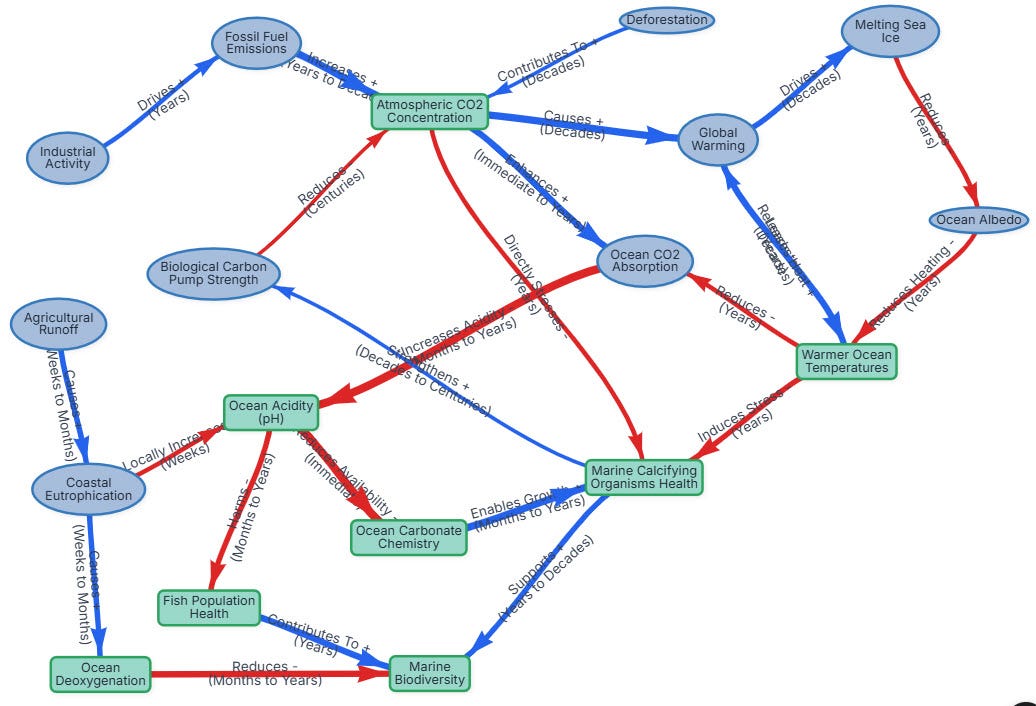
Source: Ocean Acidification
1. Model Explanation
The model illustrates that unchecked Industrial Activity, driven by a paradigm of economic growth, leads to increased Fossil Fuel Emissions and Deforestation. These actions are the primary inputs of excess Atmospheric CO2, which acts as a central driver for two interconnected crises:
The Acidification Pathway (Chemical): Atmospheric CO2 is absorbed by the ocean, forming carbonic acid. This process lowers the ocean's pH (Ocean Acidification) and reduces the availability of carbonate ions, which are essential building blocks for calcifying organisms like corals, plankton, and shellfish.
The Warming Pathway (Thermal): Atmospheric CO2 acts as a greenhouse gas, trapping heat and causing Global Warming. The ocean absorbs a vast majority of this excess heat, leading to Warmer Ocean Temperatures.
These two pathways are not independent. They interact and create powerful feedback loops that compound the damage. For example, warmer water holds less dissolved CO2, weakening the ocean's ability to act as a carbon sink. Simultaneously, both heat and acidity directly stress marine life, weakening the "biological carbon pump"—the process by which marine organisms transport carbon to the deep sea. The model also incorporates localized stressors like Agricultural Runoff, which creates coastal "dead zones" through eutrophication, further degrading marine ecosystems.
2. Wisdom: The Story the System Tells
The core wisdom of this model is a story of interconnectedness and tragic consequence. It reveals that what we perceive as separate environmental problems—climate change, ocean acidification, biodiversity loss, coastal dead zones—are in fact symptoms of a single, systemic imbalance. The planet's life-support systems, particularly the ocean, are not passive victims but active participants in regulating the climate. Our actions are systematically dismantling these regulatory mechanisms.
The model serves as a stark warning. The powerful reinforcing loops (R1-R5) function like a series of vicious cycles, pushing the system towards a state of escalating instability. The ocean's natural ability to heal and regulate, represented by the single, slow-acting balancing loop (B6), is being overwhelmed. The ultimate wisdom is that humanity's current paradigm—treating the biosphere as an infinite resource and an external dumping ground—is a tragic flaw. We are not just damaging the ocean; we are breaking a fundamental part of our own life-support system.
3. Leverage Points for Intervention (Donella Meadows Framework)
Understanding where to intervene in a complex system is critical. Using Donella Meadows's hierarchy of leverage points, we can identify the most effective actions:
Low Leverage (Constants & Parameters): Intervening here would be like trying to change the laws of chemistry (e.g., how CO2 reacts with water). These are not practical leverage points.
Medium Leverage (Feedback Loops & Information Flows):
Weaken Reinforcing Loops: Policies that directly target the drivers of the vicious cycles are effective. A carbon tax directly weakens the link between Industrial Activity and Emissions. Investing in reforestation weakens the impact of Deforestation.
Strengthen Balancing Loops: The key balancing loop, B6: Calcifier Self-Regulation, is slow and beleaguered. We can strengthen it by creating marine protected areas, actively restoring coral reefs and oyster beds, and reducing localized stressors like agricultural runoff. These actions give the ecosystem the breathing room it needs to begin recovery.
Improve Information Flows: This model itself is an intervention in the information flow. Widespread, transparent monitoring of ocean pH, temperature, and biodiversity, shared in a way that is emotionally and intellectually accessible (like the story "The Silence of the Tides"), is crucial to creating the political will for change.
High Leverage (System Rules, Goals, and Paradigm):
The Rules of the System (e.g., incentives, punishments, constraints): This is a very high-leverage area. Implementing a global carbon tax, ending fossil fuel subsidies, and creating binding international treaties on emissions and ocean protection fundamentally change the rules that govern the system's behavior.
The Goal of the System: The implicit goal driving this entire system is perpetual, resource-intensive economic growth. A powerful leverage point is to change this goal to one of sustainable human well-being within planetary boundaries. This would reorient economies around metrics like health, equity, and environmental stability rather than just GDP.
The Paradigm of the System: The highest leverage point of all. This is the shared mindset and belief system from which the goal and rules emerge. The current paradigm is one where humanity is separate from nature, and nature is a collection of resources to be exploited. Transcending this paradigm—by fostering a worldview that recognizes humanity as a deeply embedded part of the biosphere, with a profound responsibility for its stewardship—is the most fundamental and effective intervention. A shift in paradigm makes all the other changes not only possible, but natural.
4. Knowledge: The Factual Basis of the Model
The model is built on established scientific knowledge:
Chemistry: The process of CO2 dissolving in water to form carbonic acid, which lowers pH and reduces carbonate ion availability.
Physics: The greenhouse effect, where CO2 traps heat. The physics of water, where warmer water holds less dissolved gas. The physics of albedo, where reflective ice is replaced by absorptive dark water.
Biology: The dependence of calcifying organisms on carbonate ions. The physiological stress caused by heat and acidity on marine life. The function of the biological carbon pump.
Ecology: The interconnectedness of species, where the collapse of foundational species like corals and plankton leads to broader biodiversity loss. The process of eutrophication from nutrient runoff.
5. Systems Archetypes Identified
The model exhibits several classic systems archetypes:
Limits to Growth: The ocean's capacity to absorb CO2 and support life is a limit. Our "growth" in emissions is now colliding with this limit, causing the system's health to decline.
Shifting the Burden: For decades, instead of solving the root problem of emissions, we have shifted the burden of CO2 disposal to the ocean. The ocean handled this silently for a time, but now this "fix" is failing, creating severe side effects.
Tragedy of the Commons: The atmosphere and oceans are a global commons. By prioritizing individual economic gain through emissions, multiple actors are collectively degrading this shared resource, leading to a future where it is ruined for everyone.
Fixes that Fail: The "fix" of powering our economy with fossil fuels provided short-term prosperity but is now causing a long-term, systemic failure of the planetary climate and ocean systems.
6. Primary Principles Illustrated
Interconnectedness: No part of the system operates in isolation. Land use, industrial policy, and energy choices have direct, cascading consequences for the deep ocean.
Feedback Dominance: The system's behavior is currently dominated by a set of powerful, interconnected reinforcing loops that are accelerating the crisis. The natural balancing loops are too slow and weak to counteract them.
Delays are Critical: The immense time delays between emissions and their full consequences mean we are steering our future based on looking in the rearview mirror. The warming and acidification we see today are the result of past actions; the consequences of today's emissions are already locked in and will be felt for generations.
Non-Linearity and Tipping Points: The model strongly suggests the existence of tipping points. The collapse of the biological pump or the complete loss of summer sea ice could trigger abrupt, unpredictable, and potentially irreversible changes in the global system.
7. Key Insights
Ocean acidification and climate change are two heads of the same dragon; they are caused by the same driver (CO2) and are mutually reinforcing. They cannot be solved in isolation.
The ocean is not a bottomless sink. It is a complex, living system whose ability to regulate the planet is being actively degraded by our actions.
Solving this problem requires action on both global and local scales. While global emissions are the primary driver, reducing local stressors like agricultural runoff is also critical for building ecosystem resilience.
Because of the system's inertia and long delays, the urgency of action cannot be overstated. Waiting for the worst effects to become obvious will be too late to prevent them.
8. Future Implications
If the current reinforcing loops continue to dominate, the model points to a grim future, as chronicled in "The Silence of the Tides":
Ecological Collapse: Widespread loss of coral reefs, collapse of shellfisheries, and a dramatic decline in marine biodiversity, leading to a quieter, less productive ocean.
Economic Devastation: The failure of global fisheries and the loss of coastal tourism and protection (from reefs) will lead to trillions of dollars in economic damage and the loss of livelihoods for hundreds of millions of people.
Social and Political Instability: Mass displacement of coastal populations ("climate refugees"), conflicts over dwindling resources like fish stocks, and increased costs for disaster relief will strain social and political systems, potentially leading to widespread instability.
Synthesis: Core Wisdom and Highest Leverage Point
Core Wisdom: The model's ultimate message is that our societal paradigm of treating the planet's life-support systems as infinite, external resources in the pursuit of short-term growth is a tragic flaw. This worldview is systematically dismantling the very systems that ensure a stable, habitable planet. We are not separate from this system; we are the cause of its imbalance and will be the ultimate victims of its collapse.
Highest Leverage Point: The single most powerful place to intervene is to transcend this paradigm. This involves changing the fundamental goal of our global society from one of blind, resource-intensive growth to one of sustainable well-being and ecological regeneration. This is the highest leverage point because a shift in mindset is what makes all other interventions possible. When our goal changes, our rules, behaviors, and priorities naturally realign. It is the most challenging intervention, but it is the only one that addresses the root cause of the crisis.