
Misinformation/Disinformation: A Deeper Dive

Comprehensive Analysis of the Misinformation/Disinformation Causal Loop Diagram
1. Model Explanation
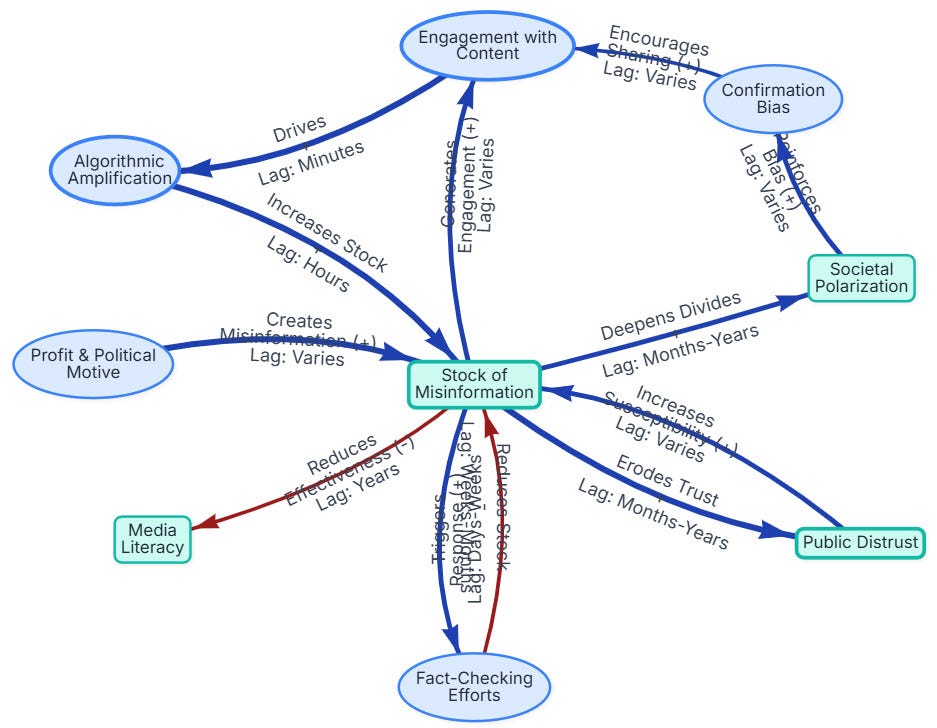
This Causal Loop Diagram (CLD) illustrates the complex, self-reinforcing dynamics that drive the creation, spread, and societal impact of misinformation. At its core is the Stock of Misinformation, which represents the total volume of false content in the information ecosystem.
The model demonstrates that this stock is not static; it grows and shrinks based on the interplay of several powerful feedback loops. Reinforcing loops, such as Viral Spread (R2) and the Distrust Spiral (R3), show how engagement, algorithms, and eroding public trust create vicious cycles that accelerate the spread of false narratives. The Polarization Engine (R4) reveals how misinformation both feeds on and deepens societal divisions.
Conversely, the model includes balancing forces. The Fact-Checking Response (B1) loop represents the reactive effort to debunk falsehoods. Other key variables like Media Literacy act as structural checks on the system’s runaway behavior. The model highlights how human cognitive biases (Confirmation Bias), technological factors (Algorithmic Amplification), and societal conditions (Polarization, Public Distrust) all interact to create a resilient and challenging systemic problem.
Source: Misinformation/Disinformation (Archetypes Experimental)
2. Wisdom
The core wisdom of this model is that misinformation is not a content problem, but a systemic one. It reveals that the volume of false information is a symptom of a deeper structural imbalance within our information ecosystem. The system’s structure—comprising platform algorithms optimized for engagement, deep societal polarization, and declining trust in institutions—creates the conditions for misinformation to thrive. Simply trying to remove false content (the “symptomatic solution”) without altering these underlying structures is like trying to bail out a sinking boat without plugging the leaks; the effort is endless and ultimately futile. True, lasting intervention requires shifting the focus from the content itself to reshaping the systemic structures that incentivize, amplify, and reward it.
3. Donella Meadows’ Leverage Points
Applying Donella Meadows’ 12 leverage points for intervening in a system helps identify the most effective places to focus efforts.
Low Leverage (Parameters & Buffers):
12. Constants, parameters, numbers: Changing the speed of algorithmic amplification or the number of fact-checkers. These are minor tweaks that don’t change the system’s behavior.
11. The sizes of buffers and other stabilizing stocks: Increasing the “buffer” of fact-checked articles. While helpful, this is a slow, reactive process that is easily overwhelmed by the speed of misinformation creation.
Medium Leverage (Feedback Loops & Information Flows):
7. The gain of driving positive feedback loops: Weakening the gain of the Viral Spread (R2) loop. For example, platforms could change algorithms to de-prioritize sensational, emotionally charged content, even if it’s highly engaging. This is a significant leverage point.
6. The strength of negative feedback loops: Strengthening the Fact-Checking Response (B1) loop by increasing funding for fact-checkers or making corrections more visible. This is the classic “symptomatic solution” in the “Shifting the Burden” archetype—necessary, but insufficient on its own.
5. The rules of the system (incentives, punishments, constraints): Changing the rules that govern platforms. This includes altering the Profit & Political Motive by demonetizing misinformation sites or creating legal accountability for the spread of harmful disinformation. This is a high-impact intervention.
High Leverage (Goals & Paradigms):
4. The power to add, change, evolve, or self-organize system structure: Fostering the growth of new platforms or information commons with different structures, such as those built on public-interest models rather than engagement-for-profit.
3. The goal of the system: This is a very high leverage point. The current goal of many platforms is to maximize Engagement with Content to drive ad revenue. Shifting this goal towards creating an “informed populace” or “societal well-being” would fundamentally change the system’s behavior.
2. The mindset or paradigm out of which the system arises: This is the highest leverage point. The current paradigm is that “more engagement is always better” and that platforms are neutral arbiters of content. The required paradigm shift is to recognize that information ecosystems are critical public infrastructure and that platforms have a responsibility for the health of that infrastructure. This shift informs all other interventions, from changing goals to rewriting rules.
4. Knowledge
The model operates through several key feedback loops and archetypes:
R2: Viral Spread: This is the primary engine of misinformation. The Stock of Misinformation generates high Engagement, which drives Algorithmic Amplification, which in turn rapidly increases the Stock of Misinformation.
R3: Distrust Spiral: The Stock of Misinformation erodes Public Distrust in institutions. As trust falls, people become more susceptible to misinformation, leading them to accept and share it, thus adding back to the Stock of Misinformation.
R4: Polarization Engine: The Stock of Misinformation deepens Societal Polarization. This intense division reinforces Confirmation Bias, making people more likely to engage with partisan falsehoods, which are then amplified by algorithms, further growing the Stock of Misinformation.
B1: Fact-Checking Response: This is a balancing loop. As the Stock of Misinformation grows, it triggers Fact-Checking Efforts, which work to debunk and remove false content, thereby reducing the stock.
5. Systems Archetypes
Two primary archetypes are visible:
Shifting the Burden: The “problem symptom” is the visible Stock of Misinformation. The “symptomatic solution” is deploying Fact-Checking Efforts (B1 loop), which provides immediate relief by debunking content. However, this distracts from the “fundamental solution,” which is increasing Media Literacy. As we rely more on fact-checkers, the pressure to invest in long-term educational solutions wanes, and the underlying vulnerability remains.
Success to the Successful: Factual information and misinformation are competing for the resource of public attention. Misinformation, being inherently more sensational, gains more Engagement and thus more Algorithmic Amplification. This “success” starves factual, nuanced content of the attention it needs, causing it to lose ground. The more successful the misinformation becomes, the more resources (attention, amplification) it commands, further cementing its dominance.
6. Primary Principles
The Structure of the System Produces Its Behavior: The relentless spread of misinformation is not accidental; it is a direct output of a system designed to maximize engagement above all else.
Feedback Loops Determine Dynamics: The reinforcing loops (R2, R3, R4) are currently stronger than the balancing loops (B1), causing the exponential growth of the problem.
Leverage Points are Often Counter-Intuitive: The most obvious place to intervene (fact-checking the content) is one of the least effective for long-term change. The most powerful interventions involve changing the system’s goals and paradigms.
7. Key Insights
Fact-checking, while essential, is a low-leverage intervention that treats a symptom, not the cause. It will always be outpaced by the creation of new misinformation.
The business model of engagement-based social media is a primary driver of the problem. Algorithmic amplification is the engine of the reinforcing loops.
Public distrust and societal polarization are both causes and effects of misinformation, creating a difficult-to-break “doom loop.”
Improving media literacy is a high-leverage, fundamental solution that makes the entire system more resilient by addressing the vulnerability at its source.
8. Future Implications
If the system’s structure remains unchanged, the model predicts:
Accelerating Polarization: The reinforcing loops will continue to deepen societal divides, making consensus and collective action on any issue more difficult.
Erosion of Shared Reality: As distrust grows, society will fragment into information silos with their own sets of “facts,” undermining the basis for democratic governance.
AI-Powered Misinformation: The “Profit & Political Motive” will leverage generative AI to create misinformation at a scale and speed that completely overwhelms fact-checking efforts, dramatically increasing the gain of the reinforcing loops.
9. Synthesis: Core Wisdom & Highest Leverage Point
The core wisdom is that misinformation is a systemic problem driven by flawed structures and incentives, not just bad content. The highest leverage point, therefore, is to change the paradigm from viewing social media as a neutral marketplace of ideas to seeing it as critical public infrastructure whose health must be actively managed.
This paradigm shift enables the second-highest leverage point: changing the goal of the system. Instead of optimizing solely for engagement, platforms must be redesigned and regulated to optimize for a healthier, more informed public sphere. This single change would weaken the reinforcing loops that spread falsehoods and create the conditions for truth to compete on a more level playing field.