
Mass Climate Migration: A Deeper Dive

Comprehensive Analysis of the Mass Climate Migration Model
This document provides a detailed systems analysis of the Causal Loop Diagram (CLD) for Mass Climate Migration. The analysis is structured to move from a foundational understanding of the model’s components to higher-level insights about its behavior, implications, and potential points for effective intervention.
Model Explanation
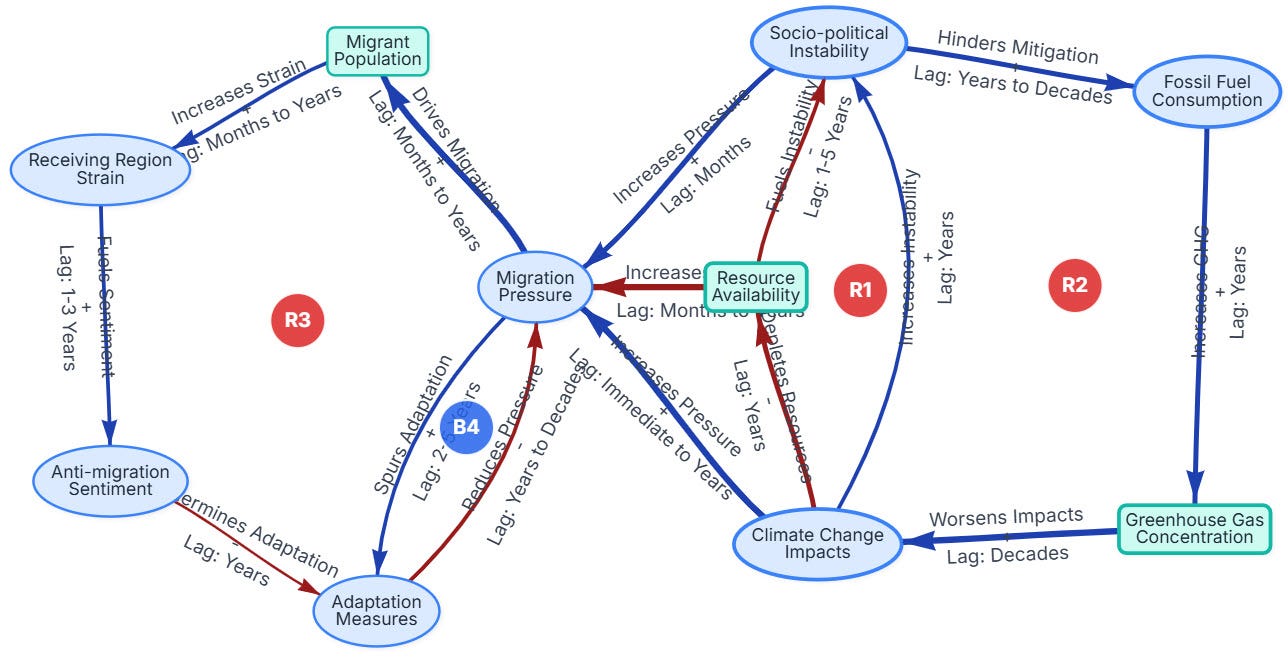
The model illustrates that mass climate migration is not an isolated event but an emergent property of a complex global system. At its core, the model is driven by Fossil Fuel Consumption, which increases the stock of Greenhouse Gas Concentration in the atmosphere. This stock drives Climate Change Impacts (e.g., droughts, sea-level rise), which in turn deplete the stock of critical Resource Availability (freshwater, arable land) and directly create uninhabitable conditions.
The degradation of resources and direct climate impacts create Migration Pressure, a key variable that acts as a signal of systemic stress. This pressure eventually leads to an increase in the Migrant Population. The model then explores two main responses to this migration:
A Problem-Solving Response: A balancing loop (B3) where
Migration Pressurespurs investment in long-term Adaptation Measures, which seek to address the root environmental causes and reduce the pressure to move.A Symptomatic Response: An escalating series of reinforcing loops where the
Migrant Populationcreates Receiving Region Strain, fueling Anti-migration Sentiment. This sentiment, in turn, undermines the will to fund the fundamental solution ofAdaptation Measures, creating a vicious cycle (R1) that ensures the initial problem worsens.
Furthermore, the model contains powerful reinforcing loops (R2, R4) showing how climate impacts and resource scarcity can fuel Socio-political Instability, which critically hinders global efforts to reduce Fossil Fuel Consumption, thereby accelerating the entire problem.
Source: Mass Climate Migration
Wisdom
The core wisdom revealed by this model is that climate migration is a feedback, not a failure. It is a natural, albeit tragic, response of a human system trying to adapt to a deteriorating environment. Treating migration as the primary problem to be solved—rather than as a symptom of a deeper systemic imbalance—is a critical error. This misplaced focus leads to reactive, symptomatic solutions (like border control and restrictive policies) that not only fail to address the root causes but actively create vicious cycles that undermine the fundamental solutions required for long-term stability.
Donella Meadows’ Leverage Points
Analyzing the model through the lens of Donella Meadows’ 12 Leverage Points reveals where interventions could be most effective, from least to most impactful.
9. The Length of Delays, Relative to the Rate of System Change: The model is filled with significant delays. There is a multi-decade lag between
Fossil Fuel Consumptionand the most severeClimate Change Impacts, and another multi-year lag beforeAdaptation Measurescan reduceMigration Pressure. Intervention: Dramatically shortening the delay on adaptation projects by pre-funding and streamlining their implementation in high-risk zones can help the balancing loop (B3) respond faster than the problem escalates.6. The Structure of Information Flows: The link between
Anti-migration Sentimentand the undermining ofAdaptation Measures(Edge e13) represents a critical, often invisible, information failure. People in receiving regions may not see how their political choices directly worsen the conditions that cause migration in the first place. Intervention: Creating clear, compelling information flows that connect local political actions in receiving countries to the funding and success of global climate adaptation projects.4. The Power to Add, Change, or Self-Organize System Structure: The system currently has a weak capacity for self-correction. The primary balancing loop (B3, The Adaptation Response) is slow and easily undermined. Intervention: This involves creating new system structures, such as international treaties that guarantee the right to migrate with dignity for climate refugees or establishing global funds for proactive relocation and adaptation that are insulated from short-term national politics. This adds resilience and new balancing loops to the system.
2. The Mindset or Paradigm Out of Which the System Arises: This is the highest leverage point. The current paradigm is twofold: (a) viewing economic growth based on
Fossil Fuel Consumptionas non-negotiable, and (b) viewing migration as a threat to be managed rather than a humanitarian crisis to be addressed at its source. Intervention: Shifting the paradigm from “national security vs. migrants” to “shared global stability vs. climate chaos.” This involves reframing adaptation not as aid or charity, but as a critical investment in global security and economic stability for all nations.
Knowledge
The model demonstrates the classic behavior of a system where reinforcing loops are overpowering the balancing loops.
Dominant Reinforcing Loops: The “Instability Spiral” (R2) and “Disaster-Instability Feedback” (R4) create an engine of accelerating collapse, where the system’s own breakdown fuels the driver of the initial problem (climate change). The “Hostility Cycle” (R1) acts as a second-order accelerator, not by worsening climate change directly, but by attacking the primary solution (adaptation).
A Weakened Balancing Loop: The “Adaptation Response” (B3) is the system’s primary hope for stability. However, the model shows it is slow (long delays) and directly undermined by the “Hostility Cycle.”
This dynamic—strong, fast reinforcing loops and a weak, slow, and attacked balancing loop—explains why the problem is so intractable and prone to getting exponentially worse.
Systems Archetypes
Shifting the Burden: This is the most prominent archetype in the model.
The Problem:
Migration Pressure(n4).The Fundamental Solution: Investing in long-term
Adaptation Measures(n8) to make vulnerable regions more resilient (Loop B3).The Symptomatic Solution: Reacting to the arrival of the
Migrant Population(n5), which createsReceiving Region Strain(n9) and leads to policies focused on managing the migrants themselves.The Side Effect: Focusing on the symptomatic solution generates the “Hostility Cycle” (R1), where
Anti-migration Sentiment(n10) leads to political choices thatUndermine Adaptation(e13), weakening the fundamental solution and guaranteeing more migration in the future.
Limits to Growth:
The Growth Engine: The global economy’s reliance on
Fossil Fuel Consumption(n6) drives economic activity but also increases theGreenhouse Gas Concentration(n1).The Limiting Condition: The growth is constrained by the planet’s finite
Resource Availability(n3) and stable climate.The Balancing Process: As the growth engine runs, it causes
Climate Change Impacts(n2) that erode the limiting condition. This activates multiple “slowing actions”—Socio-political Instability(n7) andMigration Pressure(n4)—which threaten to halt or reverse growth and stability. The reinforcing loops R2 and R4 act as accelerators on this process, hastening the approach to the limit.
Primary Principles
Policy Resistance: Any policy that focuses solely on restricting the flow of the
Migrant Populationwill ultimately fail and likely be counterproductive, as it does nothing to address theMigration Pressurethat drives the flow.Better Before Worse: The “Shifting the Burden” archetype demonstrates that focusing on the symptomatic solution (managing migrants) may provide short-term relief in receiving regions but guarantees a worse long-term outcome by neglecting the root cause.
Escalation: The reinforcing loops (R1, R2, R4) create an escalation dynamic. Political instability hinders climate action, leading to worse climate impacts, which causes more instability. This vicious cycle ensures that the problem grows at an ever-increasing rate if left unchecked.
Key Insights
Anti-migration sentiment is a direct accelerant of climate migration. By diverting funds and political will away from adaptation, it ensures that the very conditions causing people to move will worsen.
Socio-political instability is no longer just a consequence of climate change; it is a primary driver of it. Loops R2 and R4 show that a fragile global political system is incapable of undertaking the coordinated, long-term actions needed to mitigate climate change, thus locking in a future of worsening impacts.
There is a race between adaptation and hostility. The system’s outcome depends on which loop dominates: the slow, corrective balancing loop of “The Adaptation Response” (B3) or the faster, more emotionally charged reinforcing loop of “The Hostility Cycle” (R1).
Future Implications
If the system’s current structure remains unchanged, the reinforcing loops will continue to dominate. This implies:
Accelerating and Non-linear Migration: Migration flows will not increase linearly but in sudden, massive waves as environmental and social tipping points are crossed.
Rise of “Fortress” Politics: Nations will increasingly turn inward, focusing resources on border security and restrictive policies rather than international cooperation, as the “Hostility Cycle” (R1) strengthens.
Failure of Climate Goals: The “Instability Spiral” (R2) and “Disaster-Instability Feedback” (R4) suggest that as climate impacts worsen, our collective ability to address the root cause will diminish, making it nearly impossible to meet global emissions targets.
Systemic Collapse: The ultimate long-term behavior is a “Limits to Growth and Overshoot” scenario, where the erosion of resources and stability leads to a collapse in both population and economic activity.
Synthesis: Core Wisdom & Highest Leverage Point
The core wisdom of this model is that viewing climate migration through a lens of national security is a paradigm that leads to systemic failure. It creates a “Shifting the Burden” dynamic where we fight the symptom (migration) and, in doing so, starve the cure (adaptation), ensuring the disease (climate change) progresses.
Therefore, the highest leverage point is to change the paradigm. We must reframe the narrative away from “us vs. them” and towards a shared struggle against a common threat. The goal must shift from stopping migrants to preventing the conditions that force people to move. This means elevating the fundamental solution—strengthening the Adaptation Response (B3) and dismantling the Instability Spirals (R2, R4) through aggressive decarbonization—to the status of an urgent global security and economic imperative. By changing the goal of the system, we can redirect its powerful flows of resources and political will toward interventions that create lasting stability rather than those that only accelerate collapse.