
Marketing Myopia: A Deeper Dive

Comprehensive Analysis of the Marketing Myopia Model
This document provides a detailed analysis of the “Marketing Myopia” causal loop diagram, breaking down its core concepts, underlying principles, and strategic implications.
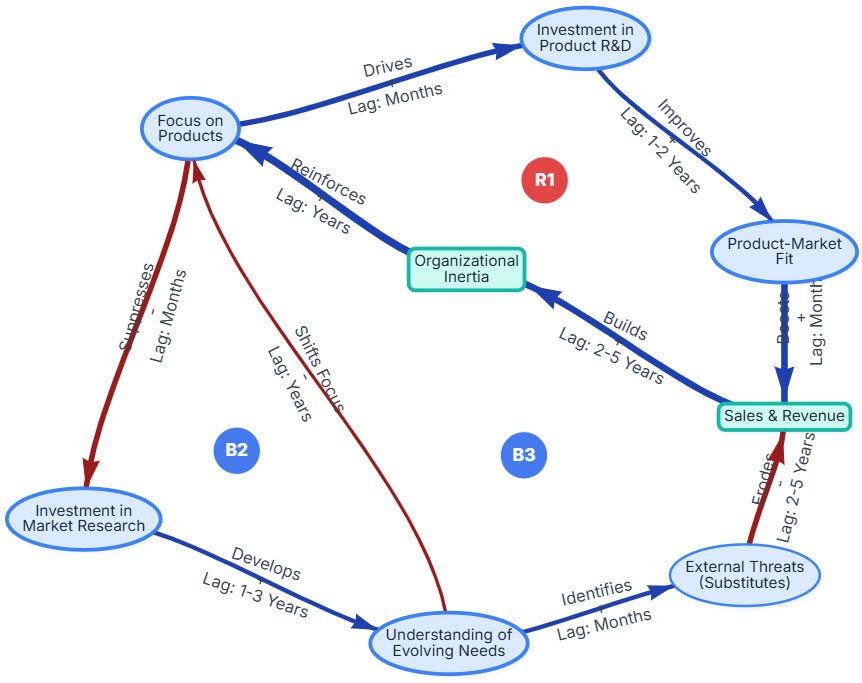
Model Explanation
The model illustrates the concept of “Marketing Myopia” as a systemic trap. It begins with a company’s intense Focus on Products, which drives Investment in Product R&D. This initially improves the perceived Product-Market Fit, leading to strong Sales & Revenue. This success, however, creates Organizational Inertia, reinforcing the initial product focus. This forms a powerful reinforcing loop, “The Myopia Trap” (R1), where success breeds a deeper inward focus.
Simultaneously, this product focus suppresses Investment in Market Research, leading to a poor Understanding of Evolving Needs. As a result, the company fails to identify External Threats (Substitutes). Over time, these substitutes erode sales, creating a crisis that may finally force the company to re-evaluate its strategy. The model shows that the very things that create short-term success can systematically blind an organization to the changes that will cause its long-term failure.
Source: Marketing Myopia
Wisdom
The core wisdom of the Marketing Myopia model is that an organization’s survival and growth depend on how it defines its business. A myopic company defines itself by the product it sells (e.g., “we are a railroad company”). A wise, market-oriented company defines itself by the customer need it serves (e.g., “we are in the transportation business”). True business security does not come from having a superior product, but from deeply understanding and adapting to evolving customer needs, even if it means making your current product obsolete.
Donella Meadows’ Leverage Points
When analyzed through the lens of Donella Meadows’ 12 leverage points for system intervention, several key points emerge:
12. Constants, parameters, numbers: Changing budget numbers (e.g., shifting 5% of the R&D budget to market research) is a low-leverage intervention. It can be a start, but the system’s structure will resist it.
6. The structure of information flows: Intervening here is more powerful. Actively ensuring that insights from market research are delivered directly and unfiltered to key decision-makers can challenge the prevailing product-centric view.
4. The power to add, change, evolve, or self-organize system structure: Creating a dedicated, empowered “new ventures” division that operates outside the rules and metrics of the core business can introduce the structural change needed to explore new markets.
2. The mindset or paradigm out of which the system arises: This is the highest leverage point. Changing the organization’s collective mindset from “we sell products” to “we serve customer needs” fundamentally alters every decision in the system—from budgeting to strategy to hiring. This paradigm shift directly attacks the root cause of myopia.
Knowledge
To operate successfully within the reality described by this model, an organization must possess specific knowledge:
Deep Customer Knowledge: Understanding not just how customers use the current product, but why. What fundamental need are they trying to solve?
Market Trend Awareness: Knowledge of technological, cultural, and economic shifts that could alter customer needs or enable new solutions.
Competitive & Substitute Landscape: A broad understanding of all the different ways a customer can solve their core problem, not just direct product competitors.
Internal Biases: Self-awareness of the company’s own organizational inertia and the cultural tendency to favor the familiar product-centric view.
Systems Archetypes
The model clearly demonstrates two classic systems archetypes:
Success to the Successful: The reinforcing loop “The Myopia Trap” (R1) perfectly embodies this archetype. The “successful” strategy of focusing on the existing product garners more resources (R&D investment), which leads to more success (sales), further solidifying its dominance. Meanwhile, the “unsuccessful” (or underfunded) strategy of market research is starved of resources, making it less likely to produce game-changing insights, thus justifying further underfunding.
Drifting Goals: The primary goal of the organization erodes from the abstract, long-term goal of “satisfying customer needs” to the tangible, short-term goal of “improving and selling our current product.” The reinforcing loop makes it easy and rewarding to focus on the product goal, while the balancing loop that would uphold the true goal (”The Market-Oriented Response”) is systematically weakened.
Primary Principles
Define your business by the need, not the product. This is the foundational principle for avoiding myopia.
Success breeds failure. The reinforcing nature of success can create the very blindness that leads to a downfall.
Invest in looking outward, not just inward. Dedicate resources to understanding the market, not just perfecting the product.
Be willing to make your own product obsolete. True innovation requires the courage to create the solution that will replace your current cash cow.
Organizational structure follows strategy. A myopic, product-focused strategy creates a rigid, inert organization. A market-oriented strategy requires a more flexible, adaptive structure.
Key Insights
Marketing myopia is not the result of a single bad decision, but a systemic process that unfolds over time.
Strong sales are a lagging indicator of success and can mask underlying strategic decay.
The greatest threat to a company often comes not from direct competitors, but from substitute solutions that serve the same core need differently.
The absence of a crisis is not a sign of health; it can be a symptom of a company that is not challenging itself or looking at the market honestly.
Future Implications
For Myopic Organizations: The future is predictable—a slow, and then sudden, decline into irrelevance. They will be blindsided by a shift in technology or consumer behavior, lose market share to more agile innovators, and will likely be forced into a painful and often unsuccessful crisis-mode transformation.
For Market-Oriented Organizations: The future is one of resilience and opportunity. By continuously adapting to customer needs, they can navigate technological shifts, create new markets, and sustain long-term growth. They treat their current products as just one of many possible solutions, always ready to build the next one.
Synthesis: Core Wisdom & Highest Leverage
The essential wisdom of the Marketing Myopia model is that an outward-facing, customer-centric orientation is the only sustainable strategy for long-term success. While a product focus can generate short-term returns, it creates a reinforcing cycle of blindness that inevitably leads to decline.
The highest point of leverage is therefore to change the fundamental paradigm of the organization. This is not simply about reallocating funds or creating a new department; it is about fundamentally shifting the company’s identity, culture, and purpose from being a producer of things to being a satisfier of needs.