
Kitchen Table Paradox: Affordability vs. Growth
An Aha! Paradox

The Ghost at the Table
The light in Elias’s kitchen had a hum to it that felt heavier than in years past. It wasn’t the bulb; it was the quiet calculation that now accompanied every click of the stovetop. For decades, Elias had been a man of the “Solid Center”—the kind of person who believed that if the gears of the great national engine were turning, his own small world would naturally stay greased. But lately, the engine’s roar sounded like a vacuum. He looked at the grocery receipt on the laminate counter. The numbers were larger, yet the bags were lighter. It was a physical contradiction, a load-bearing delusion he could no longer carry: the official word was “expansion,” but his reality was one of persistent, quiet contraction.
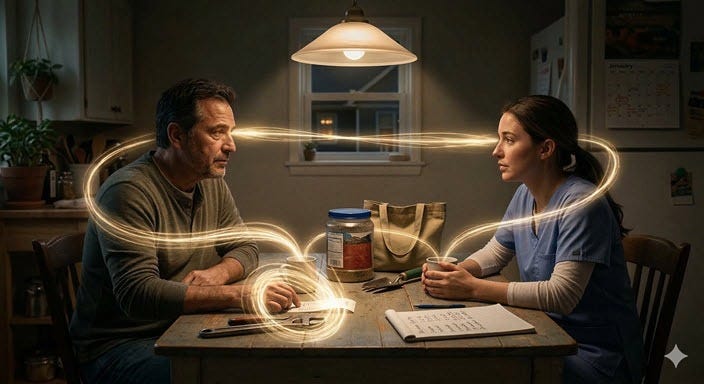
He felt the energy leaking out of his neighborhood like water through a cracked hull. Effort was being spent just to stay still. His neighbor, a young nurse named Sarah, was working double shifts not to get ahead, but to keep her “Buy Now, Pay Later” balance from eclipsed her rent. Their relationship had shifted from generative—sharing tools and Sunday coffee—to extractive. They now traded only anxieties, their conversations becoming bundles of shared exhaustion rather than shared hope. The “Truth of the Situation” was undeniable, yet unspoken: they were part of a system that was improving its parts—the indices, the margins, the quarterly yields—while the whole, the actual lived life of the street, was being starved of its vital heat.
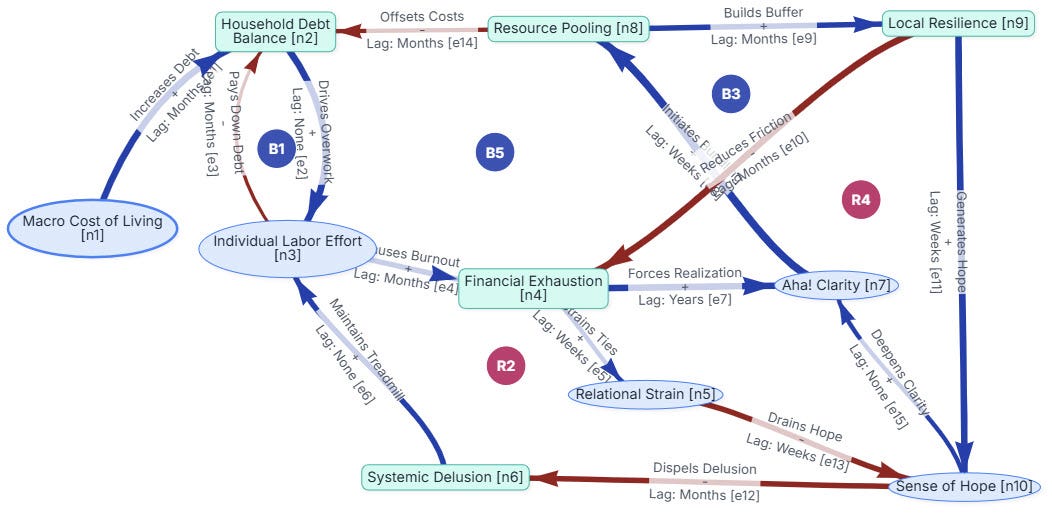
Elias began to see the pattern not as a personal failure, but as a predictable ghost in the machine. It was as if a Great Invisible Partition had been lowered between the value they created and the nourishment they received. He realized that they were trapped in a “Limits to Growth” cycle, where the more they pushed against the friction of cost, the more the system extracted from their reserves of time and health to maintain its own momentum. This wasn’t an enemy to be fought with anger, but a relationship to be redesigned with understanding. He decided to stop selling his labor to a void and start investing his “hope” into a new architecture of local resilience.
The first move was a quiet realignment of energy. He stopped looking at the “Things” he lacked and started looking at the “Relationships” he possessed. He and Sarah formed a “Resource Bundle.” They didn’t need two lawnmowers; they didn’t need separate bulk-buy memberships they couldn’t afford alone. They began to bridge the gap between their isolated struggles. By acknowledging the paradox—that they were “richer” on paper but “poorer” in practice—they found the leverage point. The friction reduced not because the prices dropped, but because the flow of mutual support turned a stagnant environment into a generative one. They were no longer victims of a macro-trend; they were architects of a micro-reality.
Standing in the kitchen now, the hum of the light felt different. The receipt was still there, and the numbers were still high, but the “Aha!” had arrived. He understood now that reality wasn’t the label the world affixed to his life, but the quality of the connections he chose to nourish. He looked out the window at the flickering lights of the street, feeling a profound sense of “Trial & Learning.” He whispered a quiet “Thank You” to the struggle itself, for it had defined a reality he finally understood well enough to change.
Systemic Reflection & Stakeholder Notes
First Principles & Foundational Axioms
The system is governed by the axiom that Macro-Efficiency $\neq$ Micro-Vitality. The narrative assumes that energy (capital/labor) is currently being diverted toward systemic maintenance (inflation/debt servicing) rather than household flourishing.
Core Wisdom & Systemic Paradoxes
The Paradox of Affordability: The more efficient a system becomes at extracting value, the less affordable the basic requirements of life become for those within the system.
The Paradox of Ownership: Individual ownership in a high-friction economy becomes a liability; shared relationship bundles (the “Resource Bundle”) act as a systemic lubricant.
Leverage Points
Relational Decoupling: Shifting the “Elephant” (the emotional driver) from national economic anxiety to local relational agency.
Aha! Clarity: Moving from “Trial & Error” (blaming the self for rising costs) to “Trial & Learning” (identifying the “Limits to Growth” archetype at play).
Stakeholder Resonances
The Visionary: Will resonate with the idea that “things” are merely labels for bundles of relationships, seeing the kitchen table as a node in a larger energy grid.
The Pragmatist: Will appreciate the “Critical Moves” of resource pooling and debt-loop identification as a way to reduce the “load” of daily survival.
While the story provides the what, the following model provides the why of the situation. You can find additional information and download the model from the Kitchen Table Paradox folder. Learn to build these models at Free AI Tools.
Gene, I love your current themes. They seem deep, profound. What concerns me is that in our late stage exploitive capitalism the string pullers are following themes in 1984, that of propagandizing and institutionalizing other, fear, hatred so that the USA, according to Pew, is the nation where the largest percent of the adult population believes that the others are immoral and evil. That's over 70% of Republicans and over 50% of Democrats. Social media is a further and powerful force for separation and individualism so that people are losing relationship skills. It's hard to imagine escaping from a 1984 system of surveillance. I recently read about Henry Fords Social Department where company inspectors made unannounced home visits to audit a workers family life and private behaviours making bonus pay contingent on "correct behaviours" and that he was an ardent antisemite, racist, and fierce antiunion or collectivist- studied and honoured by Hitler. Ford a pillar of modern US capitalism. Ford was moderated only when journalists watched his goons throw strikers off a bridge. Do we now live in a world of Miss Rachet from One Flew Over the Coocoo's nest?