
Internet Anger vs. Working Together
An Aha! Mystery Investigation

The Situation
The Hidden Trap: Social media apps are designed to make money by keeping your eyes glued to the screen. The computer programs figured out that the easiest way to keep you watching is to show you things that make you angry, mean, or upset. This creates a giant loop where people scream at each other online, making it impossible for a town or country to agree on how to fix real problems.
The Goal: Redesigning our internet spaces so they reward people for being nice, listening, and solving problems together instead of starting arguments.
The Case of the Fractured Town Hall and the Civic Engine
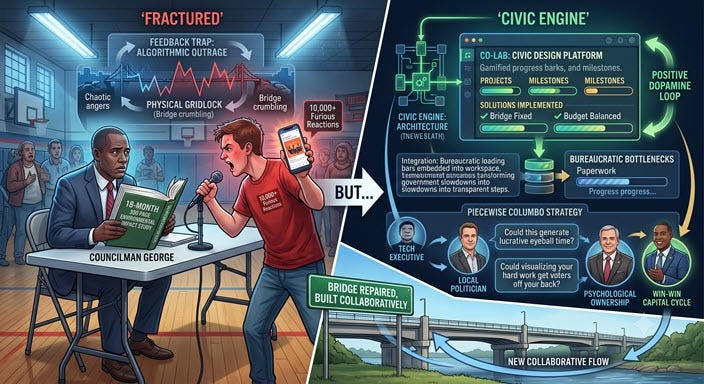
Councilman George sits at the front of a fluorescent-lit gymnasium, staring blankly at a furious citizen shouting into a microphone about a crumbling bridge. The citizen is clutching a smartphone, citing a viral post that has accumulated ten thousand furious reactions in the last two hours. George, meanwhile, is clutching a three-hundred-page environmental impact study that will take eighteen months to review. This is not just a clash of generations or a breakdown in civility. It is a violent collision of two fundamentally incompatible speeds. The localized friction point is right here, at the microphone, where a digital spark that took three seconds to manufacture slams into a civic apparatus that requires three fiscal quarters to move an inch.
The widespread, comfortable explanation for this gridlock is a moral one. We tell ourselves that social media has simply made people more toxic, or that government officials are inherently lazy and incompetent. We shift the burden of responsibility onto the character of the individuals involved, hoping that a new algorithm policy or a newly elected official will magically restore community cohesion. But this is a superficial illusion. There are no static villains here, only processes, feedback loops, and temporary flows of energy.
The reality is that this environment is intentionally frozen in a state of deliberate gridlock. The entire architecture of the modern public square is designed to optimize upstream velocity at the exact expense of downstream exhaustion. Social platforms deploy algorithmic outrage to exploit our biological threat-detection systems, capturing human attention to maximize total eyeball time. This attention is the raw inventory sold to advertisers, funneling massive profits back to the platforms to reinvest in even better outrage-generating algorithms. The system is operating perfectly, harvesting the cheap, instant energy of anger, while leaving the slow-moving, expensive burden of actual problem-solving stranded in the physical world.
This creates a profound structural contradiction. By optimizing solely for the cheapness and speed of initial engagement, the system generates an exponential debt of real-world friction. Digital outrage easily spills out of the screen, manifesting as civic fragmentation where citizens bring raw, unprocessed anger into physical town halls. And? The resulting bureaucratic gridlock ensures that nothing gets fixed. And? That ongoing real-world dysfunction provides fresh, highly visible failures for the community to be furious about all over again. The feedback trap is perfectly closed, continually feeding on its own wreckage.
To break a self-sustaining loop, you cannot simply argue with it. You have to capture its kinetic energy and build a dam. Imagine a new digital architecture that intercepts that initial surge of algorithmic anger and funnels it into a collaborative civic workspace. Instead of a void for complaints, it becomes a structured environment for building real solutions. But a platform for complex problem-solving requires immense, sustained psychological effort from its users. And? If you ask angry people to do hard work, they will simply leave, unless you give them an immediate return on their cognitive investment. You must trigger a gamified, positive feedback loop—a visible milestone system, much like the progress bars in a simulation game like SimCity. The effort yields a tangible visual reward, providing the steady dopamine drip necessary to sustain civic endurance.
Yet, even this beautifully gamified engine will inevitably slam into a predictable, mechanical pattern: the limits to growth caused by bureaucratic bottlenecks. No matter how much digital momentum the citizens generate, their blueprints eventually hit the grinding reality of government paperwork. Left unchecked, this real-world latency acts as a brick wall. When citizens see their digital progress stall indefinitely in reality, their motivation is actively crushed. The system’s growth engine dies not from a lack of user energy, but from a rigid, unyielding structural delay.
Overcoming this bottleneck requires weaving the slow-moving officials directly into the fast-moving digital workspace. The bureaucratic roadblocks must be transformed into transparent loading bars, making the government’s procedural steps part of the game’s visible milestones. But tech barons and local politicians share a common immune response: they instinctively reject radical overhauls imposed upon them by outsiders. To integrate them, you must deploy a piecewise Columbo strategy. You do not pitch a revolution; you walk into the room, scratch your head, and ask disarming, Socratic questions. You ask the tech executive if a platform demanding thousands of hours of civic design might accidentally generate unprecedented, highly lucrative eyeball time. You ask the politician if visualizing their hard work might finally get voters off their back.
By guiding these powerful stakeholders through a perimeter of gentle inquiries, you cultivate a profound psychological ownership. The executives and the politicians slowly arrive at the conclusion themselves, convinced they invented the collaborative engine. The executives fund the workspace because it scales a new win-win capital cycle. The politicians willingly submit to bureaucratic app integration because it transforms their latency into celebrated progress. Ultimately, the sustained civic effort produces successfully implemented real-world solutions. Bridges are fixed. Budgets are balanced. The tangible results drastically reduce the underlying fragmentation, permanently altering the flow of energy in the community. It is a testament to continuous trial and learning, proving that when invisible relational flows are made transparent, we can stop fighting the symptoms and finally begin to design for the cure.
The Investigation & The Relationships
What is presented here is not intended as a solution, but as food for thought regarding the interdependence of relationships and their implications.
Some interesting things developing. I second your hope. All ideas encouraged and accepted.
Some strategy this! 👏🏻👏🏻👏🏻👏🏻
"... tech barons and local politicians share a common immune response: they instinctively reject radical overhauls imposed upon them by outsiders. To integrate them, you must deploy a piecewise Columbo strategy. You do not pitch a revolution; you walk into the room, scratch your head, and ask disarming, Socratic questions. You ask the tech executive if a platform demanding thousands of hours of civic design might accidentally generate unprecedented, highly lucrative eyeball time. You ask the politician if visualizing their hard work might finally get voters off their back."