
Integrating Efficiency & Resilience
An Aha! Paradox

Paid subscribers have access to all the elements used to create this post. They can be found in the Integrating Efficiency & Resilience folder. Collaborators have access to the tools used to develop components of this post.
The Architect of Empty Space
Plot Archetype: Rebirth
Core Theme: The transformation from rigid efficiency to fluid resilience.
The Story
Elena was known in the C-Suite as “The Razor.” It was a compliment. In her three years as COO of Aethelgard Logistics, she had shaved forty million dollars off the operating budget. Her philosophy was simple, mathematical, and ruthless: If it isn’t moving, it’s dead weight.
She viewed the company like a machine. Every gear had to grind perfectly against the next. Gaps were inefficiencies. Redundancies were waste. She eliminated the “floater” shifts. She sold off the backup warehouses. She streamlined the supply chain until it was a taut, humming wire of pure profit.
The stock price soared. The board applauded. The machine was perfect.
Then came the Silence.
It wasn’t a market crash or a competitor. It was a solar flare—a geomagnetic storm that fried the delicate, hyper-optimized sensor arrays that guided their automated fleets.
In the control room, the screens went black. The hum of the machine stopped.
Elena stood by the floor-to-ceiling glass of her office, looking down at the operations floor. It should have been a hiccup. A delay. But she had designed a system with zero slack. There were no manual overrides because manual labor was inefficient. There were no paper backups because paper was slow. There were no generalist staff to reroute the cargo because she had replaced them with specialized algorithms.
The silence on the floor was heavy. It wasn’t peace; it was the sound of a billion dollars of inventory rotting in stalled containers.
“Get the manual routing team,” Elena barked at her assistant, Marcus.
Marcus looked down, his face pale. “You fired them in Q1, Elena. The ‘Legacy Reduction’ initiative.”
“Then get the shift supervisors to coordinate.”
“They... they don’t know how to talk to each other, ma’am. We siloed them to increase focus. The North Atlantic team doesn’t have the contact info for the European Rail team. The API handled the handoffs.”
Elena felt a cold snap in her chest. She had built a castle of diamond, harder than anything on earth, and just as brittle. She had removed the mortar to save money on cement, and now, the bricks were grinding each other to dust.
She went down to the floor. The panic was palpable. Specialists—brilliant men and women who knew their specific vertical perfectly—were shouting, running into invisible walls. They were rigid struts in a collapsing dome, unconnected, unable to flex.
In the middle of the chaos sat an old man named Arthur.
Arthur was a “legacy artifact.” He was the last of the floaters, kept on only because his pension was too complex to liquidate immediately. Elena had marked him for termination next Friday. He wasn’t efficient. He spent half his day walking around, chatting with the drivers, drinking coffee with the warehouse leads, learning the names of the rail operators.
Elena watched him. Arthur wasn’t panicking. He was on a landline phone—an archaic beige thing he had kept in his drawer.
“Yeah, Jim,” Arthur said calmly. “I know the system is down. Listen, call Sarah in Dispatch. No, the computer won’t connect you. Use her cell. I wrote it down last Christmas. Tell her to route the grain through the scenic route. Yeah, the old B-Road. I know it’s slower. But it’s open.”
He hung up and dialed again. “Miguel? It’s Arthur. The sensors are fried. You’re going to have to drive by feel. Remember how we did it in ‘98? Good. Go.”
Elena watched, mesmerized.
Arthur wasn’t doing a job. He was being the network.
For years, Elena had seen Arthur’s coffee breaks as “time theft.” She had seen his wandering as “idleness.” She was wrong. Arthur wasn’t wasting time; he was weaving cables. Every conversation, every favor, every shared joke was a strand of tension wire connecting the rigid parts of her company.
He was the slack she had tried to cut. And right now, he was the only thing holding the roof up.
Elena walked over to his desk. The chaos seemed to bend around him.
“Arthur,” she said, her voice trembling.
He looked up, wary. He knew his termination date. “Ms. Vance.”
“How are you doing this?”
“Doing what?”
“Fixing it. The machine is broken.”
Arthur smiled, a sad, weathered shifting of lines. “The machine is broken, ma’am. But the people aren’t. You just stopped letting them hold hands.”
The realization hit Elena like a physical blow—the “Aha!” moment that shattered her worldview. She had optimized for the parts, ignoring the connections. She had treated resilience as a tax, when it was actually the glue.
She pulled a chair—an empty chair she would have previously ordered removed to save floor space—and sat down next to him.
“Who do we call next?” she asked.
Arthur handed her a sticky note with a phone number scrawled in pencil. “Call the union rep in Chicago. Ask him about his daughter. Then ask him for the trucks.”
Elena picked up the phone. She didn’t feel like a Razor anymore. She felt like a Weaver. And for the first time in three years, the company didn’t feel like a fragile diamond. It felt like a living thing.
Stakeholder Modifications
1. For The Board of Directors (The Investors)
Narrative Shift: Frame the story as a “Risk Management Parable.”
The Hook: Focus on the terrifying speed of the collapse. The stock price dropping to zero in hours.
The Lesson: Position Arthur not just as a nice old man, but as a “Latent Asset.”
Key Phrase: “We thought we were buying efficiency, but we were selling our survival insurance. The variance in the system wasn’t waste; it was our hedging strategy.”
2. For Middle Management (The Squeeze)
Narrative Shift: Focus on the “Permission to Breathe.”
The Hook: Highlight the managers’ anxiety. They wanted to help each other, but the KPIs forbade it. The silos were their prison cells.
The Lesson: Elena’s transformation isn’t just about strategy; it’s about changing the rules of the game. She stops measuring “Task Completion Rate” and starts measuring “Cross-Team Support.”
Key Phrase: “You don’t get fired for the empty space on your calendar anymore. That space is where you build the relationships that save us when the servers die.”
3. For Frontline Employees (The Nodes)
Narrative Shift: Focus on “Dignity and Agency.”
The Hook: Focus on Arthur. He is the hero because of his humanity, not his productivity.
The Lesson: The “Razor” didn’t save the day; the guy who drank coffee and remembered birthdays did. It validates their intuitive knowledge that “work” is more than just metrics.
Key Phrase:“They tried to replace your judgment with a script. But when the script burned, your judgment was the only light left in the building.”
The Aha! Paradox: Integrating Efficiency AND Resilience
1. The Anchor (The Delusion)
The “Insurance Premium” Fallacy.
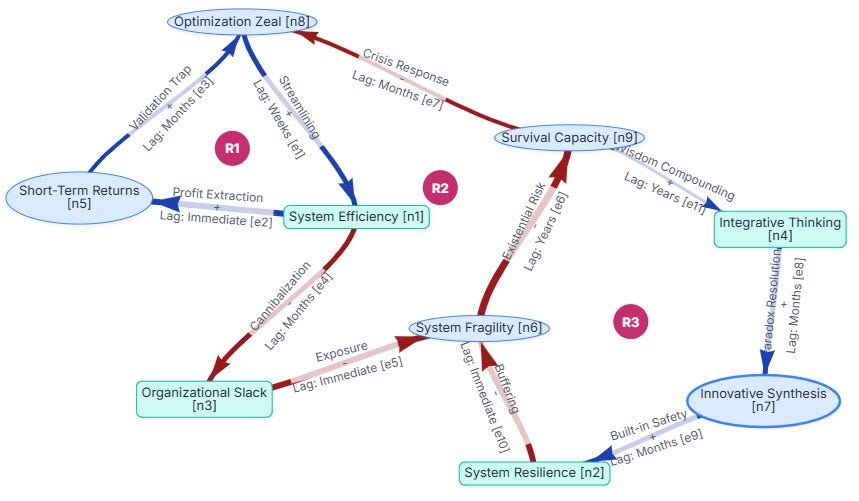
The Load-Bearing Delusion is that Resilience is a “tax” you pay to protect Efficiency. Leaders view Efficiency as the engine (profit generation) and Resilience as the bumper (cost center). This mental model assumes a zero-sum game: to get more safety, you must subtract from speed or profitability. This belief locks the organization into a permanent state of compromise, where they are either “lean and risky” or “safe and bloated.”
2. The Default (The Status Quo)
The Panic Pendulum.
Because of the Anchor, the system oscillates violently. In stable times, the “Optimizers” dominate, stripping away buffers and “waste” to maximize short-term margins. When a shock inevitably hits (a supply chain break, a server outage), the system crashes hard. In the aftermath, the “Protectors” take over, panic-spending on massive redundancies and stockpiles. This kills margins, eventually leading back to the Optimizers. The organization never integrates the two; it just toggles between fragile profits and expensive safety.
3. The Bottleneck (The Constraint)
The “Zero-Redundancy” Rule.
To force a breakthrough, we impose this strict constraint: You are forbidden from achieving resilience by adding “more” (more staff, more inventory, more budget). You must increase the system’s ability to survive a shock while simultaneously removing mass.
The Insight: If you cannot use redundancy (spare parts) to stay safe, you are forced to use interconnectivity (fluidity). Resilience stops being about “having backups” and starts being about the ability of existing resources to instantly change function.
4. The Collision (The Isomorph)
Tensegrity (Buckminster Fuller’s Architecture).
Traditional structures (like a stone wall) rely on Compression (mass/heaviness) for stability. If you remove a stone, the wall weakens. This is the “Safety = Expense” model.
We collide this with Tensegrity (Tensional Integrity). In a tensegrity structure (like a geodesic dome or the human cytoskeleton), stability comes from Tension distributed across a network of cables. The rigid parts (struts) do not touch; they float.
The New Perspective: A tensegrity structure is incredibly lightweight (Efficient) because it distributes stress instantly across the entire network (Resilient). The harder you push on one node, the more the whole system responds. It proves that the lightest structure can also be the strongest, provided the connections are right.
5. The Reversal (The Truth)
Resilience is not a Tax; it is the Ultimate Efficiency.
We flip the Anchor: Efficiency without Resilience is actually the most wasteful state possible.
Why? Because a “lean” system that collapses for three days loses more value than a “robust” system costs in a year. Therefore, Resilience is not the opposite of Efficiency; it is the preservation of Efficiency over time.
The Truth: You do not trade efficiency for resilience. You trade local optimization (squeezing one department) for systemic optimization (fluidity across the whole). True efficiency is “mobilizing slack,” ensuring every resource can flow to where the stress is.
6. The Kinetic Result (The Action)
The Aha! Insight: Fragility comes from rigid specialization; Resilience comes from fluid connectivity. You don’t need more resources; you need resources that can do more than one thing.
The First Domino: The “Zero-Notice” Role Swap.
This Friday, identify a critical process. Without warning, forbid the primary owner from touching it for 2 hours. Force a colleague from an adjacent team to handle it, using only existing documentation. Do not intervene. If they fail, you have found a “compression fracture” (fragility). If they succeed (even slowly), you have proven your system has “tensegrity”—resilience that costs $0 to maintain.
First Principles
Ashby’s Law of Requisite Variety: A system can only be stable if its internal variety (control mechanisms) is greater than or equal to the variety of its environment (disturbances). “Hyper-efficiency” reduces internal variety, mathematically guaranteeing failure in a complex environment.
The Concavity of Fragility: Efficient systems are “concave” to volatility—they gain small benefits from stability but suffer massive, disproportionate losses from volatility. Resilient systems are “convex”—they are positioned to survive or gain from volatility.
The Biology of Redundancy: Evolution prioritizes “degeneracy” (different structures performing the same function) over pure efficiency. This is not waste; it is the structural prerequisite for adaptation.
Core Wisdom
The “Or” is the Enemy: In Hampden-Turner’s dilemma theory, Efficiency and Resilience are not trade-offs; they are mutually enabling. You cannot be efficiently profitable if you are dead (resilience enables efficiency), and you cannot be resilient if you are bankrupt (efficiency enables resilience).
Slack is Potential Energy: In physics, a drawn bowstring is not “wasting” space; it is storing potential energy. Similarly, organizational slack is not “waste”; it is operational potential energy waiting to be converted into kinetic action during a crisis.
Tension > Compression: Strength does not come from rigidity (which shatters). Strength comes from tension (which distributes). A resilient organization is held together by the quality of its connections, not the mass of its resources.
Leverage Points
Linguistic Reframing: The highest leverage point is language. Stop calling white space “waste.” Label it “Shock Absorption Capacity” or “Maneuver Space.” When the label changes, the accounting treatment allows it to exist.
The “Jenga” Rule: Implement a policy: For every “efficiency block” removed (e.g., cutting a backup server, reducing headcount), a “connectivity cable” must be added (e.g., cross-training remaining staff, automating failovers). You can reduce mass, but only if you increase connectivity.
Optimize for TTR (Time-to-Recovery): Shift the primary KPI from Unit Cost to Time-to-Recovery. If saving $10k increases TTR from 1 hour to 1 week, the model flags it as “False Efficiency.”
I love this story!