
Illusory Truth Effect: A Deeper Dive

A Comprehensive Analysis of the Illusory Truth Effect Model
This document provides a detailed analysis of the causal loop diagram (CLD) modeling the “Illusory Truth Effect.” It explores the model’s structure, behavior, and the deeper insights it offers into this powerful cognitive bias.
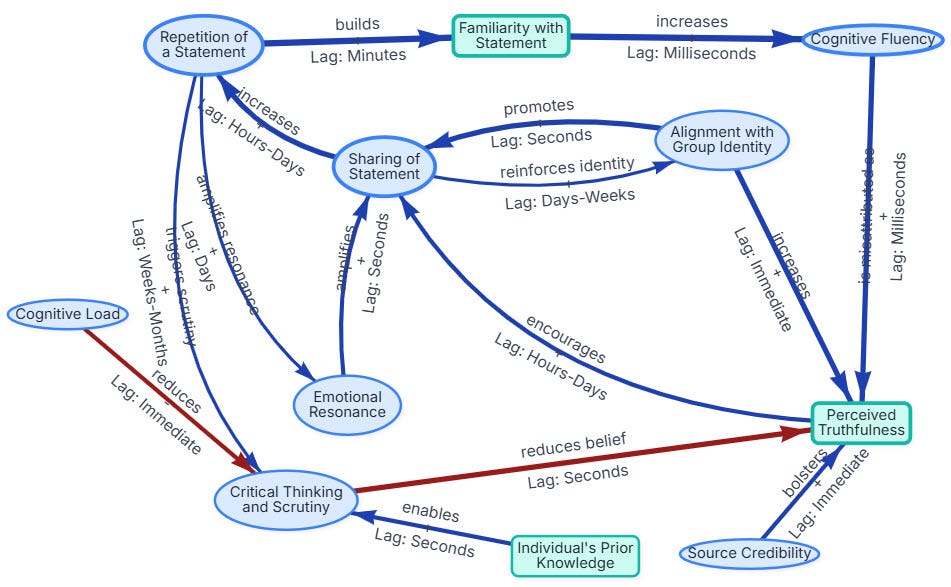
1. Model Explanation
The model illustrates how the repetition of information, regardless of its factual accuracy, can increase its perceived truthfulness. This system is driven by several interconnected feedback loops:
The Core Engine (R1: The Echo Chamber): This is the primary reinforcing loop. Increased
Repetition of a StatementbuildsFamiliarityandCognitive Fluency(the ease of processing). The human brain often misinterprets this fluency as a sign of accuracy, increasing the statement’sPerceived Truthfulness. This, in turn, encourages moreSharing of the Statement, which feeds back into and amplifies the initialRepetition.Amplifying Loops (R2 & R3):
R2: Identity Reinforcement: This loop shows how statements that align with a person’s
Group Identityare shared more readily to signal belonging. This sharing reinforces the group’s identity, making them even more receptive to similar statements in the future.R3: Emotional Contagion:
Emotional Resonancemakes a statement more likely to be shared. The resulting repetition can, in turn, amplify the emotional charge of the topic, creating a powerful viral loop driven by emotion rather than reason.
Balancing Forces (B1 and External Factors):
B1: Skeptical Backlash: The model includes a crucial balancing loop. As repetition becomes excessive, it can trigger
Critical Thinking and Scrutinyfrom external sources (like fact-checkers) or discerning individuals. This scrutiny counteracts the effect, reducingPerceived Truthfulnessand dampening the cycle.External Factors: The system is influenced by variables like an individual’s
Prior KnowledgeandCognitive Load(stress or distraction), which respectively enable or inhibit critical thinking.Source Credibilitycan also provide a shortcut to perceived truthfulness, bypassing the repetition mechanism.
Source: Illusory Truth Effect (Archetypes Experimental)
2. Wisdom
The highest-level wisdom derived from this model is that our subjective feeling of truth is not an inherent quality of information, but rather an emergent property of a dynamic system. What feels true is often merely what is familiar, emotionally resonant, and socially validated. The model reveals that the brain’s efficiency-seeking mechanisms (heuristics) can be systematically exploited, intentionally or not, to manufacture belief. The core insight is to distrust the feeling of “truthiness” and recognize that familiarity is not a reliable proxy for fact.
3. Donella Meadows’ Leverage Points
Analyzing the model through the lens of Donella Meadows’ 12 leverage points reveals the most effective places to intervene to counter the Illusory Truth Effect:
Low Leverage (Parameters & Buffers):
#12, #11, #10 (Constants, parameters, numbers): Trying to simply “out-repeat” a falsehood with a fact is a low-leverage intervention. It engages in a brute-force battle within the reinforcing loop rather than changing the loop’s structure.
#9 (Length of delays): Shortening the delay for fact-checking (part of B1) can help, but it doesn’t stop the reinforcing loops from spinning in the first place.
Medium Leverage (Feedback Loops & Information Flows):
#7 (Strength of negative feedback loops): This is a key leverage point. Strengthening the “Skeptical Backlash” loop (B1) by investing in and promoting media literacy, fact-checking organizations, and educational initiatives that teach critical thinking is highly effective.
#6 (Strength of positive feedback loops): Weakening the reinforcing loops is also effective. Social media platforms could change algorithms to slow the spread of viral, emotionally charged content (R3) or introduce “circuit breakers” on rapidly accelerating shares (R1).
#5 (Information flows): Making the system more transparent by clearly labeling sources, highlighting potential biases, or providing easy access to contrary viewpoints can give individuals the information needed to engage their critical thinking.
High Leverage (Goals & Paradigms):
#3 (The goal of the system): The current information ecosystem is often optimized for engagement (clicks, shares), which favors emotional and identity-affirming content, thus accelerating the R2 and R3 loops. Changing the goal of these platforms toward promoting informed understanding would be a very high-leverage intervention.
#2 (The mindset or paradigm out of which the system arises): This is the highest and most powerful leverage point. The paradigm is the deeply held, often unstated belief that “what is easy to process is true.” Transcending this paradigm by fostering a collective mindset of intellectual humility and active verification is the most profound intervention. It involves shifting the culture from valuing quick, certain answers to valuing nuance, curiosity, and the willingness to question one’s own perceptions.
4. Knowledge
This section details the factual structure of the model:
Stocks (Rectangles):
Familiarity with Statement,Perceived Truthfulness,Individual’s Prior Knowledge. These are the accumulations in the system.Variables (Ovals): All other nodes, representing flows or influencing factors.
Key Causal Links (Abridged):
Repetition→(+)Familiarity→(+)Cognitive Fluency→(+)Perceived Truthfulness→(+)Sharing→(+)Repetition(Core R1 Loop)Sharing→(+)Alignment with Group Identity→(+)Sharing(R2 Loop)Repetition→(+)Emotional Resonance→(+)Sharing→(+)Repetition(R3 Loop)Repetition→(+)Critical Thinking→(-)Perceived Truthfulness(Part of B1 Loop)Cognitive Load→(-)Critical ThinkingPrior Knowledge→(+)Critical Thinking
5. Systems Archetypes
The primary archetype at play is “Success to the Successful.”
Explanation: A statement that gains an initial advantage in repetition (due to chance, emotion, or a targeted push) becomes the “successful” competitor. This success begets more success: it becomes more familiar and feels truer, which leads to more shares, allocating even more “repetition resources” to it. This dynamic effectively starves out competing viewpoints, which may be more accurate but are less familiar. The archetype explains how, in an information marketplace, truth does not necessarily win. Familiarity and repetition win.
6. Primary Principles
Structure Determines Behavior: The structure of the system—with its powerful, fast-acting reinforcing loops and slower, weaker balancing loops—is perfectly designed to produce the Illusory Truth Effect. Social media platforms, with their frictionless sharing and engagement-based algorithms, are a structural embodiment of this.
Mental Models Define the System: The entire system is built upon a flawed mental model or heuristic: “Fluency equals Truth.” The system’s behavior is a direct result of the brain’s reliance on this cognitive shortcut.
Feedback Loops Drive Behavior: The reinforcing “Echo Chamber,” “Identity Reinforcement,” and “Emotional Contagion” loops are the engines that create and amplify the effect, demonstrating how small initial events can lead to large-scale belief formation.
7. Key Insights
Truth Can Be Manufactured: Repetition is a powerful mechanism for creating a perception of truth, even in the absence of evidence.
Emotion and Identity are Accelerants: Emotional content and identity-confirming narratives are not just noise; they are powerful fuels for the feedback loops that spread misinformation.
Critical Thinking is an Active Defense: The most reliable defense is not passive exposure to facts but the active, energy-intensive process of scrutiny. Our default cognitive state makes us vulnerable.
Context is Crucial: Our susceptibility to this effect is not static. It increases dramatically when we are tired, stressed, or distracted (
Cognitive Load).
8. Future Implications
The proliferation of Artificial Intelligence and Large Language Models presents a significant future challenge. AI can generate and disseminate vast quantities of plausible, emotionally tuned, and identity-affirming content at a scale and speed never before seen. This has the potential to dramatically accelerate the reinforcing loops (R1, R2, R3) in the model. The Repetition of a Statement can increase by orders of magnitude, overwhelming the much slower human-based balancing loop of Skeptical Backlash (B1). In this future, the ability to apply critical thinking and the paradigm of questioning one’s own sense of truth will become an even more essential skill for navigating the information environment.
9. Synthesis: Core Wisdom and Highest Leverage Point
Core Wisdom: The model teaches us that our feeling of truth is a fallible output of a system, not a direct perception of reality. This feeling is constructed from the dynamics of repetition, emotion, and social validation.
The Highest Leverage Point: The most profound and lasting intervention is to change the paradigm by cultivating a widespread culture of metacognition (thinking about how we think). This means moving the goal of information consumption away from seeking speed, fluency, and validation, and toward a goal of achieving accuracy and genuine understanding. The most powerful action is to pause when something feels true and ask a simple, internal question: “Does this feel true because it is familiar, or because I have verified that it is factual?” Fostering this internal “observer” is the highest leverage point for building resilience against the Illusory Truth Effect in ourselves and our society.