

Check out all the postings since last Wednesday.
Comprehensive Analysis: HEXACO Model & Dark Personalities
1. Model Explanation
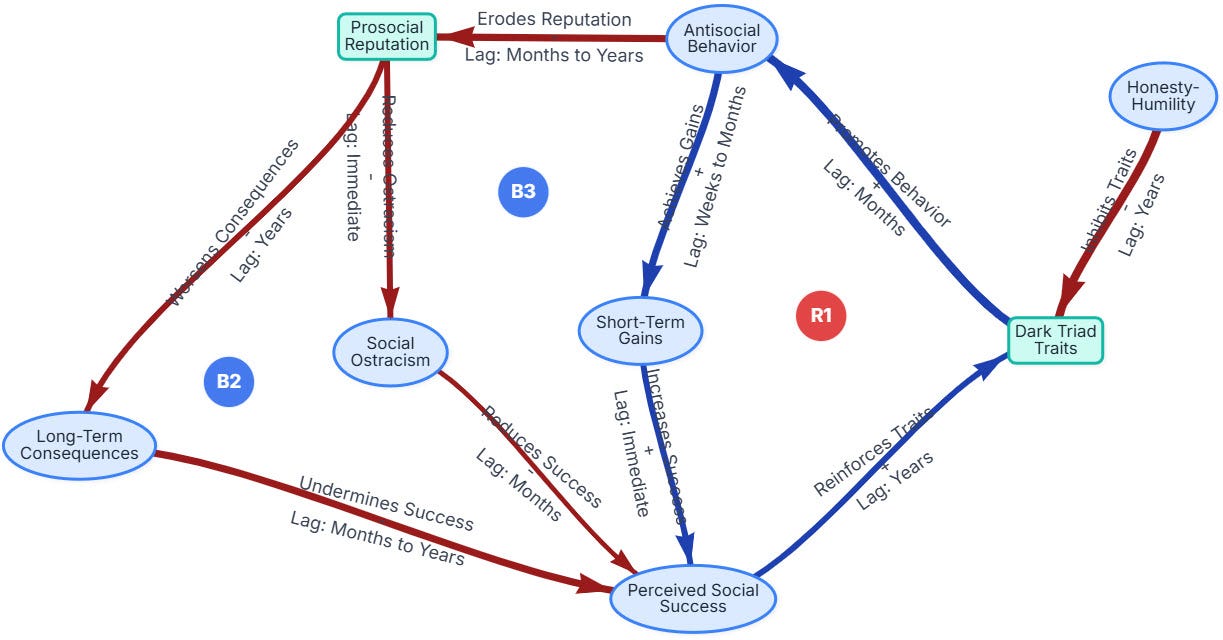
This causal loop diagram illustrates the dynamic interplay between the HEXACO personality framework, specifically the Honesty-Humility dimension, and the cluster of traits known as the Dark Triad (Narcissism, Machiavellianism, Psychopathy).
The model’s central thesis is that low Honesty-Humility is a key precondition for the flourishing of Dark Triad Traits. These traits, in turn, promote Antisocial Behavior (manipulation, exploitation) as a strategy for social advancement.
The system contains a powerful reinforcing loop (R1: The Dark Spiral) where antisocial acts yield Short-Term Gains, reinforcing the individual’s Perceived Social Success and strengthening their underlying Dark Triad disposition. However, this “engine of success” sows the seeds of its own demise by activating two significant balancing loops over longer time horizons. Antisocial Behavior slowly erodes an individual’s Prosocial Reputation (a critical stock), leading to Social Ostracism (B3) and accumulating Long-Term Consequences like career failure and loss of trust (B2). These balancing forces ultimately undermine the perceived success of the antisocial strategy, counteracting the reinforcing spiral.
Source: HEXACO Model & Dark Personalities (Archetypes Experimental)
2. Wisdom
The core wisdom of this model is that social strategies based on exploitation and deceit are inherently unstable and self-defeating over the long term. While the reinforcing “Dark Spiral” (R1) can create an illusion of rapid success, it simultaneously depletes the vital, slow-moving stock of Prosocial Reputation. The system reveals that reputation is not just a passive byproduct of behavior but an active governing component. Once eroded, its absence triggers powerful balancing forces (social rejection and tangible long-term failures) that eventually overwhelm and reverse the initial short-term gains. Therefore, the model’s ultimate insight is that integrity and sincerity (Honesty-Humility) are not merely moral ideals but the most robust and sustainable foundation for long-term social and professional success.
3. Donella Meadows’ Leverage Points
Analyzing the model through the lens of Donella Meadows’ framework reveals several points for intervention, ranked from lowest to highest leverage:
12. Constants, Parameters, Numbers: (Lowest Leverage) Trying to change the strength of a single link, such as reducing the impact of Antisocial Behavior on Short-Term Gains (
e6). This is akin to trying to make manipulation slightly less effective, which is difficult and doesn’t change the underlying structure.9. Length of Delays: Shortening the delay between Antisocial Behavior and the resulting Long-Term Consequences (
e3,e9). If a damaged reputation led to negative outcomes more quickly, the balancing loops (B2, B3) would become more powerful, making the manipulative strategy less appealing. This is a powerful, but difficult, point of intervention.7. Strength of Negative Feedback Loops: Strengthening the balancing loops. For example, creating social or organizational systems that are highly transparent and quick to penalize antisocial behavior would strengthen B2 and B3. This makes the consequences of poor reputation more immediate and severe, thus weakening the dominance of the R1 spiral.
6. Strength of Positive Feedback Loops: Weakening the reinforcing loop, R1: The Dark Spiral. This could be achieved by creating an environment where manipulative tactics are less likely to result in Short-Term Gains. For instance, performance review systems that value teamwork and peer feedback over individual, cutthroat metrics would weaken the
e6link.4. The Power to Add, Change, Evolve, or Self-Organize System Structure: Introducing a new node or link. For example, adding “Self-Reflection” that is negatively influenced by Dark Triad Traits but positively influences Honesty-Humility. This creates a new potential balancing structure.
2. The Mindset or Paradigm out of which the System Arises: (Highest Leverage) The highest leverage point is to change the fundamental paradigm that governs the individual’s behavior. The system as depicted is driven by a paradigm of “success via exploitation.” The most effective intervention is to transcend this paradigm by fostering the one embodied by Honesty-Humility: “success via genuine cooperation and fairness.” Interventions aimed at education, character development, and cultivating empathy directly target this paradigm. By increasing the stock of Honesty-Humility, you fundamentally alter the goal of the system and weaken the entire engine of the Dark Spiral at its source.
4. Knowledge
Systems Archetypes
Shifting the Burden: The “problem” is a need for social success. The fundamental solution is to build a Prosocial Reputation through genuine, honest interaction (stemming from high Honesty-Humility). However, the individual “shifts the burden” to a seemingly easier, symptomatic solution: using Antisocial Behavior to achieve Short-Term Gains. This quick fix (R1) is addictive and diverts energy from the fundamental solution, while creating unintended long-term side effects (the balancing loops B2 and B3) that eventually make the problem worse.
Success to the Successful: An individual with high Honesty-Humility builds a strong Prosocial Reputation, leading to a virtuous cycle of trust and opportunity (a loop not fully depicted but implied). In contrast, the individual with low Honesty-Humility allocates their energy to the “Dark Spiral” (R1). Initially, success seems to flow to this “successful” manipulative strategy. However, as the balancing loops of Social Ostracism and Long-Term Consequences gain strength, success and resources are systematically drained from the antisocial individual and shift toward those with a stronger reputational foundation.
Primary Principles
Reputation is a Stock: Prosocial Reputation behaves like a capital stock. It is slow to build, depreciates with antisocial behavior, and its level (or lack thereof) governs the effectiveness of future social interactions.
Delay Determines Dominance: The reinforcing loop (R1) operates on a short delay, making it dominant in the short term. The balancing loops (B2, B3) have much longer delays, making their corrective influence feel disconnected from the initial behavior, but ultimately more powerful.
Character as a System Inhibitor: High Honesty-Humility acts as a powerful inhibitor at the very start of the causal chain, preventing the entire “Dark Spiral” from gaining momentum.
Key Insights
The “Dark Spiral” (R1) is a seductive trap. Its rapid feedback makes exploitative behavior seem highly effective, reinforcing the traits that drive it.
The system has a “tipping point.” There is a level of reputational damage beyond which the balancing forces of social rejection and consequences become so strong that they inevitably overwhelm any short-term gains.
Focusing solely on punishing Antisocial Behavior is a low-leverage intervention. The more effective strategy is to cultivate the character trait (Honesty-Humility) that makes the behavior less likely to occur in the first place.
5. Future Implications
The model predicts a consistent life-cycle for individuals operating with a low Honesty-Humility paradigm. They are likely to experience a period of rapid, seemingly impressive success, often appearing as “rising stars” in competitive environments. However, as the delays in the system resolve, their trajectory will stagnate and eventually decline. They will find it increasingly difficult to build alliances, lead teams effectively, and maintain their social or professional standing as the stock of their reputation becomes depleted. For organizations, the model implies that cultures that reward Short-Term Gains at all costs inadvertently foster and promote the Dark Spiral, leading to a toxic environment and long-term institutional decay.
6. Synthesis: Core Wisdom & Highest Leverage Point
The essential wisdom of this model is that in the complex system of human social interaction, strategies built on a foundation of integrity (Honesty-Humility) are inherently more stable and successful in the long run than those built on exploitation.
The highest leverage point is to change the underlying paradigm from a zero-sum game of personal gain to a positive-sum game of mutual cooperation. This directly corresponds to fostering and selecting for the trait of Honesty-Humility. By intervening at this level—through education, cultural values, and personal development—we don’t just treat the symptom (Antisocial Behavior) or mitigate a consequence (Long-Term Consequences); we alter the fundamental goal and structure of the entire system, rendering the “Dark Spiral” impotent and making prosocial strategies the most logical and effective path to sustainable success.