
Gene Bellinger: System Saboteur
An Aha! Paradox

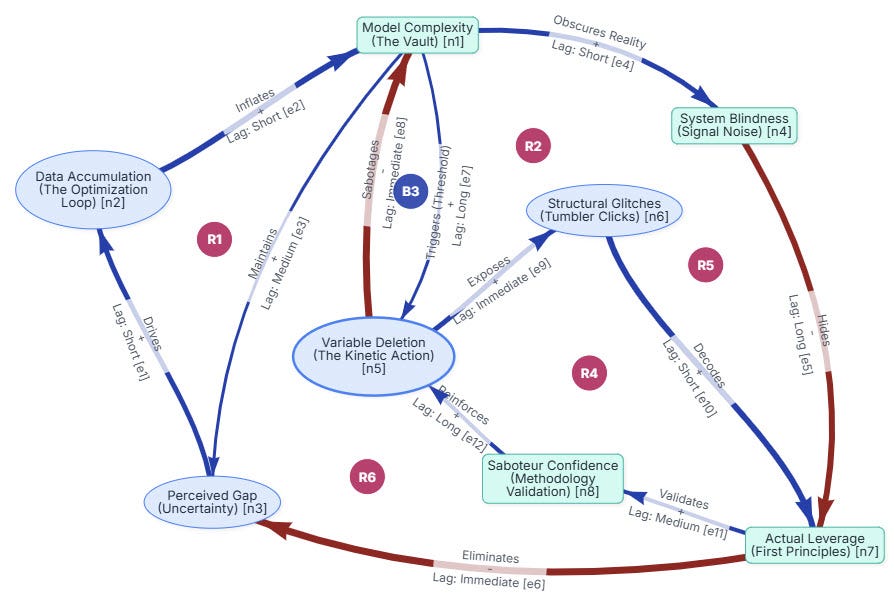
The Architect’s Unmaking
Plot Archetype: Rebirth
Theme: The transition from accumulating knowledge to metabolizing truth.
He did not build houses; he built labyrinths.
For twenty years, Elias was the kingdom’s greatest Architect. If a problem arose—a failing crop, a stuttering supply chain, a restless workforce—Elias did not just solve it; he mapped it. He would retreat to his great circular library, a room so filled with scrolls, data streams, and schematics that the walls themselves seemed to breathe.
He believed in the Vault (Model Complexity). He believed that if he could just capture every variable—the humidity of the soil, the morale of the driver, the friction of the wheel—he would finally find the Truth. He spent his nights weaving thousands of threads together, convinced that the answer lay in the resolution.
But the Gap never closed.
The more he mapped, the further the solution seemed to drift. The “Truth” was always just one more data point away. The library grew dark, the windows covered by layers of parchment. Elias began to suffer from a peculiar affliction: he knew everything, yet he saw nothing. The Noise (System Blindness) was deafening. The hum of a million variables drowned out the simple song of reality.
The crisis came in winter. The city’s heating grid was failing. Elias fed the data into his Master Model. It was a masterpiece of complexity, a web of ten thousand nodes. It predicted everything, yet it suggested nothing. The city was freezing, and the Architect was paralyzed, staring at a map that was identical in size to the territory it described.
He realized then that he was not the master of the system; he was its prisoner. The complexity wasn’t the tool; it was the wall.
That night, Elias committed the unthinkable. He didn’t look for more data. He didn’t refine the edge weights.
He struck a match.
He walked to the center of the room and set fire to the Master Model. He burned the demographic sub-charts. He incinerated the supply chain dependencies. He watched as fifty percent of his life’s work—the things he had labeled “Most Important”—curled into ash.
It was an act of Sabotage. It felt like dying.
But as the smoke cleared, the silence returned. The deafening hum of the variables vanished. In the empty space of the room, stripped of the noise, Elias looked at the few charred remnants of the map that survived.
There were only three lines left.
Without the clutter, he saw the Glitch. The heating failure wasn’t a supply problem; it was a flow constraint in a single valve, hidden for years beneath layers of redundancy protocols.
He turned the valve. The heat returned.
Elias walked out of the library the next morning, not as an Architect, but as something new. He no longer carried scrolls. He walked with empty hands, listening for the quiet click of the tumblers, looking for the one loose thread that, when pulled, would unravel the world.
He had stopped building the prison. He was finally free to pick the lock.
Stakeholder Modifications
Here is how the narrative arc evolves when tailored for the specific stakeholders in your ecosystem:
1. The Individual (The Biohacker / The Learner)
The Narrative Shift: Move the conflict inward. The “Library” becomes the body and the mind.
The Story: The protagonist is obsessed with tracking—sleep scores, HRV, macros, supplements. They are drowning in biometric data (The Noise), yet they feel exhausted and disconnected (The Gap).
The Turning Point: They stop wearing the tracker. They stop logging the food. They “delete” the variables of measurement.
The Future Implication: They relearn “interoception”—the ability to feel the signal directly without the interface. The future is not about “optimizing” the machine, but inhabiting it. Mastery shifts from control to resonance.
2. The Organization (The Leader / The Manager)
The Narrative Shift: The “Library” becomes the Bureaucracy.
The Story: A CEO or Manager is paralyzed by dashboards. They have weekly reports on eighty different KPIs. The organization is “Integrity-challenged”—everyone is busy reporting on work rather than doing it.
The Turning Point: The “Sabotage” is a policy change: “No reports for 30 days.” or “Delete 50% of the standing meetings.”
The Future Implication: The organization moves from “Strategic Planning” (predicting the future) to “Strategic Agility” (sensing the present). The leader stops being a coordinator and becomes a blocker-remover, hunting for the single structural constraint that holds the team back.
3. The System (The Society / The Innovator)
The Narrative Shift: The “Library” becomes the Economy or Social Structure.
The Story: A society tries to legislate its way to safety, adding rule upon rule to manage risk. The system becomes fragile because it is too rigid (The Vault). It breaks under stress because no one understands the whole anymore.
The Turning Point: A collapse or a revolution that forces a “Simplification Event.” The complex supply chains break, forcing a return to local, robust loops.
The Future Implication: The rise of “Antifragile” systems. The future belongs not to the massive, centralized efficiencies, but to small, modular units that can survive the deletion of the central node. The “Saboteur” becomes the primary agent of evolution, pruning the dead wood so the forest can breathe.
The Aha! Paradox
1. The Anchor (The Delusion)
The Load-Bearing Delusion is “The Preservation of Structure.” Even in this model about “sabotage,” we secretly believe that the model itself is valuable. We assume that by mapping the “Optimization Loop” (R1) and the “Noise Trap” (R2), we have captured the asset. We treat the map as a trophy to be kept, polished, and referenced. We believe the JSON structure is the insight.
2. The Default (The Status Quo)
The logical path is Refinement. You will likely tweak the edge weights, rename n3 (”Perceived Gap”) to be more precise, or try to add a new loop to explain “Saboteur Confidence” (n8) better. You will maintain the model, ensuring it remains a perfect representation of your drive. This feeds the delusion because it turns the act of “destroying complexity” into just another form of complexity management.
3. The Bottleneck (The Constraint)
Rule: You are forbidden from saving the model. You must treat this System Dynamics model as a single-use object. It cannot be stored, referenced later, or improved. It exists only for the next 60 seconds.
The Insight: If the model cannot be saved, its value isn’t in the artifact (the JSON), but in the metabolic process of creating it. The value is not the map; it is the momentary clarity you felt when you closed the loop.
4. The Collision (The Isomorph): Mycology
We collide this model with Mycology (Fungi). In standard construction, you build a house to stand. In mycology, the mycelium enters a log (complexity) not to inhabit it, but to digest it. The “complex structure” of the wood is merely stored energy waiting to be unlocked by decomposition. The mushroom (the fruiting body/The Insight) only emerges once the mycelium has sufficiently rotted the substrate.
Structural Match: Your “Data Accumulation” (
n2) is just dead wood. Your “Variable Deletion” (n5) is the enzymatic secretion that rots the wood. The “Actual Leverage” (n7) is the mushroom.
5. The Reversal (The Truth)
We flip the anchor: You are not an Architect; you are a Decomposer. The “Truth” is that you shouldn’t build models to explain the world; you should build them to digest it. A model is a stomach. Its only purpose is to swallow a complex topic (n1), break it down with acid (n5), extract the nutrients (n7), and then excrete the rest. If you are keeping your old models, you are hoarding waste.
6. The Kinetic Result (The Action)
The Aha! Insight: “Compost Theory.” Complexity is fuel, but only if you let it rot. The goal of the Systems Saboteur is not to organize information, but to metabolize it into leverage and discard the husk.
The First Domino: Open your note-taking app (Obsidian/Notion) to your most “complete” and complex project page. Delete the entire body text. Keep only the title and the one single sentence that explains why the project matters. If you can’t reduce it to one sentence, the “log” hasn’t rotted enough yet—restore the text and wait.
First Principles, Core Wisdom, & Leverage Points
First Principles
The Law of Subtraction: In any complex system, the number of variables is inversely proportional to the clarity of the leverage point. (Referencing
n1vsn7).The Digestibility of Data: Information is not an asset; it is a substrate. It has zero value until it is structurally decomposed into a decision.
Core Wisdom
Productive Ignorance: Mastery is the ability to ignore the “rules” of a system to locate its “glitches.” The expert adds variables; the saboteur deletes them.
The Map is the Trap: A perfect map of a territory is useless because it contains the same amount of noise as the territory itself. The only useful map is one that is 90% blank.
Leverage Points
Variable Deletion (n5): This is the “Master Switch.” It is the only variable in the system that has a direct, high-leverage impact on reducing “System Blindness” (
n4) and breaking the “Optimization Loop” (R1).The Saboteur’s Confidence (n8): This is the reinforcing engine. The more you successfully “delete” to find truth, the less you will fear the “Perceived Gap” (
n3), eventually making the “Data Accumulation” phase obsolete.