
Food Insecurity: A Deeper Dive

1. Explanation of the Model and Future Implications
Model Explanation:
This Causal Loop Diagram (CLD) portrays food insecurity not as a simple problem of food availability, but as the outcome of a complex, interconnected system. At its core is the stock of Food Insecurity, which is influenced by numerous variables that are locked in a series of feedback loops.
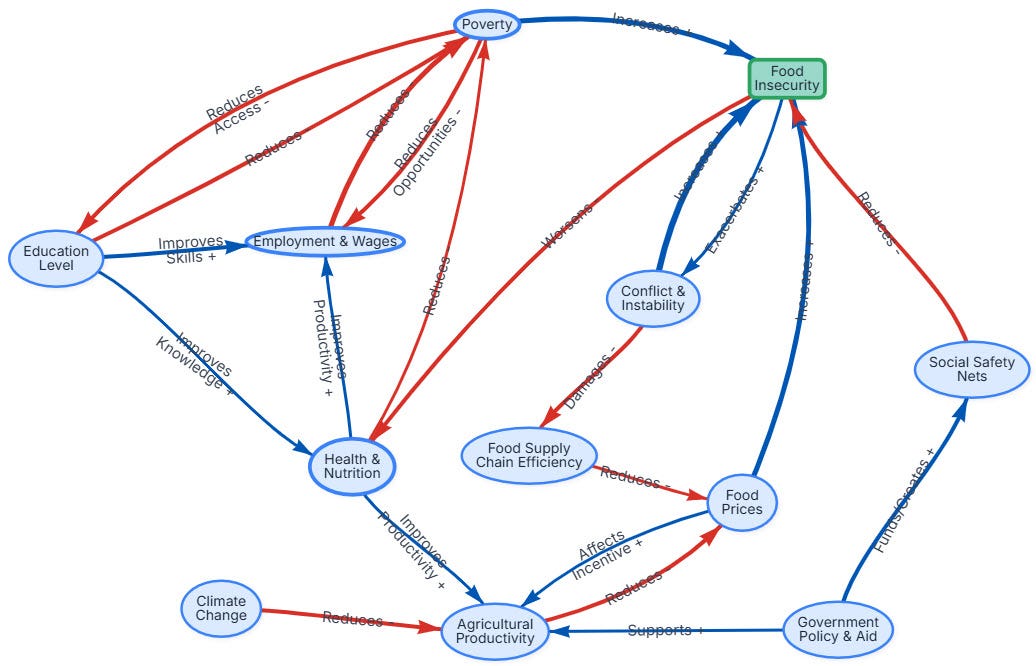
Source
The model is driven by several key sub-systems:
The Economic System: This includes variables like Poverty, Employment & Wages, and Food Prices. It demonstrates how economic hardship is both a cause and a consequence of food insecurity.
The Agricultural System: Centered around Agricultural Productivity, this sub-system is influenced by environmental factors like Climate Change and human factors like Health & Nutrition of the farming workforce.
The Social & Political System: This includes factors like Education Level, Conflict & Instability, Social Safety Nets, and Government Policy & Aid, highlighting how social structures and governance can either create resilience or exacerbate vulnerability.
These sub-systems are not separate; they are deeply intertwined. For instance, a political decision (Government Policy) can fund an agricultural program (Agricultural Productivity), which affects market economics (Food Prices), household welfare (Poverty), and ultimately public health (Health & Nutrition).
Future Implications of the Relationships:
The future trajectory of a community caught in this system depends entirely on which feedback loops are allowed to dominate.
A Future of Vicious Cycles (Negative Implications): If left unaddressed, the reinforcing loops (R-loops) create a downward spiral. A future dominated by these loops would see:
Entrenched Generational Poverty: The Poverty-Education (R4) and Poverty-Employment (R3) traps would become more rigid. Lack of education and job opportunities would solidify poverty, ensuring that children are less healthy and less educated than their parents, with even dimmer economic prospects.
Increased Fragility and Conflict: The Conflict-Insecurity Spiral (R1) suggests that worsening food insecurity could lead to greater social unrest and resource competition, creating fragile states that are vulnerable to collapse. This would completely destroy agricultural and economic systems, leading to catastrophic humanitarian crises.
Accelerated Environmental and Health Crises: Climate change will continue to degrade agricultural productivity, while poor health from malnutrition will reduce the workforce's capacity to adapt, creating a future where communities are less and less able to feed themselves.
A Future of Virtuous Cycles (Positive Implications): If strategic interventions are made, the same reinforcing loops can be flipped to work in a positive direction, creating a "rags to riches" scenario for the entire community. A future guided by these interventions would see:
Emergence of a Resilient Middle Class: Breaking the poverty traps through education and health initiatives would create a virtuous cycle. Better education leads to better jobs (Education-Employment Cycle, R6), which reduces poverty. This allows families to invest more in their children's health and education, creating a foundation for long-term prosperity.
Sustainable Food Systems: Investments in health and agriculture would kickstart the Health-Productivity Cycle (R7). A healthier population would lead to more robust food production, stabilizing food prices and improving nutrition for everyone, making the community resilient to external shocks like climate change.
Increased Stability and Social Cohesion: A well-fed, healthy, and economically secure population is far less prone to conflict. By resolving the root causes of desperation, the system would naturally move towards greater political and social stability.
2. Primary Insights of the Model
Food Insecurity is a Symptom, Not the Core Problem: The most significant insight is that hunger is the visible outcome of deeper systemic failures in education, healthcare, economic opportunity, and governance. Treating only the symptom with food aid (Social Safety Nets) is a temporary fix; the system will always trend back toward crisis unless the underlying feedback loops are addressed.
Poverty is a Powerful Trap: The model vividly illustrates that poverty is not simply a lack of money; it is a system that actively prevents escape. The reinforcing loops R3, R4, R5, and R8 show how poverty, poor health, lack of education, and unemployment all mutually reinforce each other, creating a powerful trap that can span generations.
Health and Education are Economic Inputs: The model clarifies that health and education are not just social welfare goals; they are fundamental economic inputs. A healthy, educated population is more productive, more innovative, and better able to find employment, forming the basis of a stable economy and a secure food system.
3. Primary Archetypes Driving the Model
Systems archetypes are common patterns of behavior that help us understand complex systems. This model is driven by several powerful archetypes:
Vicious Cycles (or Virtuous Cycles): This is the most dominant archetype in the model. It's a reinforcing loop where one action leads to a result that encourages more of the same action, causing exponential growth or decline.
Example: The Poverty-Education Trap (R4) is a classic vicious cycle. Poverty leads to less education, which leads to more poverty.
Implication: These loops are responsible for the system's tendency to get "stuck" in a state of deep poverty and hunger. However, they also offer the potential for dramatic positive change. A small, sustained push in the right direction can flip the cycle from vicious to virtuous, leading to exponential improvement.
Balancing Loop: This archetype represents a system seeking stability or a goal. It resists change and tries to keep a variable within a specific range.
Example: The Agricultural Price Stabilization (B2) loop is a balancing process. High productivity leads to low prices, which then discourages productivity, which in turn raises prices.
Implication: Understanding this loop is key to policy. Trying to artificially hold prices too low can destroy farmer incentives, while holding them too high can harm consumers. The goal of an intervention should be to make this balancing process more stable and less volatile, not to eliminate it.
4. Leverage Points in Accordance with Donella Meadows
Donella Meadows' "Leverage Points: Places to Intervene in a System" describes a hierarchy of interventions, from least to most effective. This model provides clear examples at several levels.
Level 9: Constants, Parameters, Numbers (Weak Leverage):
Example: Increasing the amount of food aid distributed through Social Safety Nets.
Analysis: This is a crucial short-term intervention to save lives, but it's a weak leverage point because it doesn't change the underlying structure of the system. Once the aid stops, the system reverts to its previous state of hunger because the vicious cycles are still active.
Level 6: Structure of Information Flows (Moderate Leverage):
Example: Providing farmers with better information about market prices or climate-resilient farming techniques. This relates to Education Level and Agricultural Productivity.
Analysis: This is a more powerful intervention because it allows the actors within the system to make better decisions. A farmer with knowledge of crop rotation or water conservation can directly improve productivity without massive external investment.
Level 5: The Rules of the System (Strong Leverage):
Example: Implementing policies (Government Policy & Aid) that guarantee access to primary education for all children, or land tenure reforms that give farmers secure ownership of their land.
Analysis: Changing the rules fundamentally alters how the system operates. Guaranteeing education directly attacks the Poverty-Education Trap (R4). Secure land tenure encourages farmers to invest in their land, directly boosting the Health-Productivity Cycle (R7).
Level 4: The Power to Add, Change, Evolve, or Self-Organize System Structure (Very Strong Leverage):
Example: Fostering the creation of farmers' cooperatives and local governance structures.
Analysis: This is a very high-leverage point because it empowers the community to manage its own resources and adapt to challenges. A cooperative can collectively bargain for better prices, manage shared resources like water, and disseminate knowledge, strengthening multiple positive loops simultaneously.
Level 2: The Goal of the System (Highest Leverage):
Example: Shifting the national goal from simple GDP growth to one of community well-being, resilience, and equity.
Analysis: This is the most powerful leverage point. If a government's primary goal is simply resource extraction or aggregate economic growth, it may tolerate high levels of poverty and food insecurity. If the goal shifts to ensuring that all citizens are healthy, educated, and secure, then policies will naturally be designed to break the vicious cycles and strengthen the virtuous cycles.
“food insecurity” and “poverty” can have many different meanings and definitions, what is the precise definition you are using here?
And what specific geographical region or country is this diagram?