
Fascism v2: A Deeper Dive

The Model: A System of Reinforcing Feedback Loops
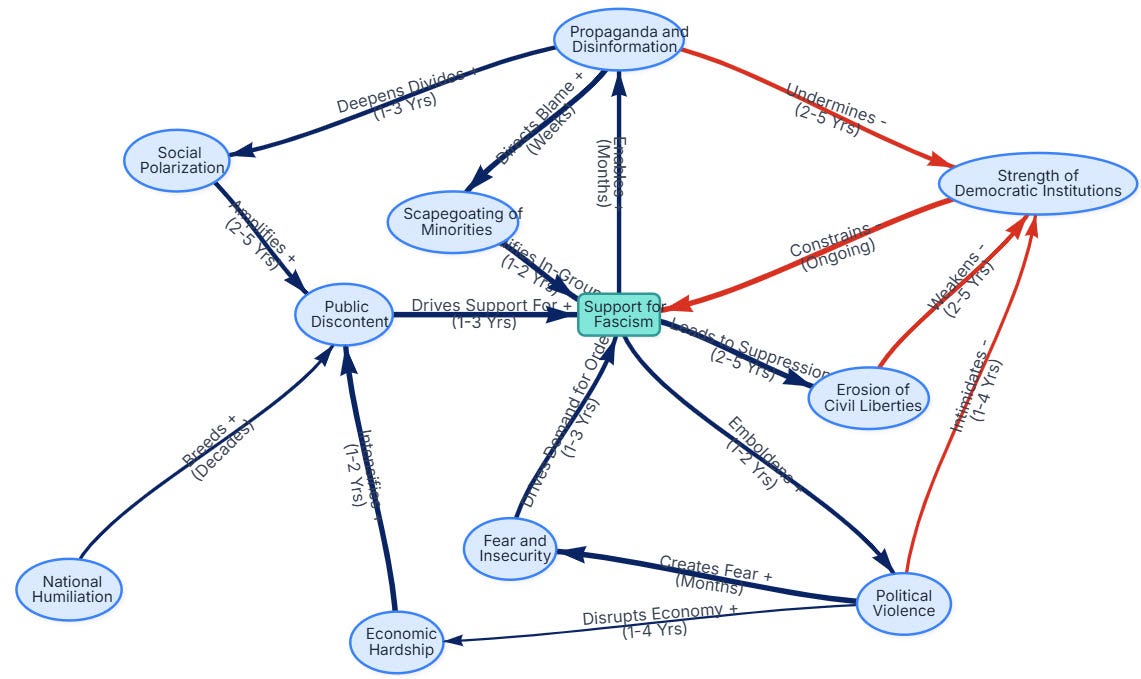
This Causal Loop Diagram (CLD) illustrates the rise of fascism as a dynamic system driven by a series of interconnected, reinforcing feedback loops. It moves beyond a simple linear cause-and-effect explanation to show how various social, economic, and political factors can interact to create a self-perpetuating cycle that strengthens a fascist movement and erodes democratic structures. The core of the model is the "Support for Fascism" stock, which is influenced by inflows from public discontent and outflows from strong democratic institutions.
Source: Fascism v2
Future Implications of the Relationships
The future implications of the relationships in this model are stark. If the reinforcing loops are left unchecked, they will continue to accelerate, leading to:
Complete Democratic Collapse: The continued erosion of democratic institutions will eventually lead to their total failure, resulting in the establishment of a single-party authoritarian state.
Increased Violence and Persecution: The "Scapegoating" and "Fear Engine" loops will intensify, leading to increased persecution of minority groups and the violent suppression of all political opposition.
Chronic Instability: While fascism promises order, the model suggests it can create chronic instability. The "Instability Breeds Hardship" loop (R5) shows how the movement's own tactics can worsen the very conditions it claims to be solving, requiring ever-greater levels of repression to maintain control.
Conversely, the model also implies that interventions that focus on the high-leverage points—strengthening democratic institutions and changing the societal paradigm—can reverse these trends. By fostering economic security, social cohesion, and a robust democratic culture, a society can build resilience against the dynamics illustrated in this powerful Causal Loop Diagram.
Primary Insights of the Model
The primary insights from this model are:
Fascism Feeds on Discontent: The model clearly shows that economic hardship, social polarization, and national humiliation are not direct causes of fascism but rather drivers of "Public Discontent." This discontent is the fertile ground upon which fascism grows, as it makes the population more receptive to radical, authoritarian solutions.
The Power of Reinforcing Loops: The model identifies several powerful reinforcing loops (R1-R5) that, once initiated, can accelerate the rise of fascism. For example, "The Fear Engine" (R1) shows how political violence creates fear, which in turn increases demand for an authoritarian leader who promises order, leading to more support for the movement and, consequently, more violence.
Erosion of Democratic Institutions is Key: A central theme is the systemic weakening of democratic institutions. Propaganda, political violence, and the erosion of civil liberties all work to undermine the structures (free press, independent judiciary) that would normally constrain an authoritarian movement. This creates a "Shifting the Burden" dynamic where the mechanisms for democratic self-correction are dismantled.
Scapegoating as a Unifying Force: The "Scapegoating Reinforcement" loop (R2) highlights the critical role of creating an "out-group." By directing public anger towards a minority, the fascist movement solidifies its own "in-group" identity, strengthening its base of support.
Primary Archetypes Driving the Model
The model is driven by several classic systems archetypes:
Reinforcing Feedback: The entire model is built around reinforcing loops (R1-R5), where an action produces a result that influences more of the same action, leading to exponential growth or decline. This explains the often rapid and seemingly unstoppable rise of fascist movements.
Shifting the Burden: This archetype is evident in the relationship between "Support for Fascism" and "Strength of Democratic Institutions." Instead of addressing the root causes of discontent (the "fundamental solution"), the system shifts the burden to a symptomatic solution (supporting a strongman leader). This symptomatic solution not only fails to solve the underlying problems but also actively weakens the fundamental solution (democratic institutions) by eroding trust and civil liberties.
Fixes that Fail: This archetype is closely related to "Shifting the Burden." The "fix" of supporting a fascist movement to address economic hardship or social instability ultimately fails and makes the problem worse. The model shows how political violence, a tool of the movement, can further disrupt the economy and increase hardship (R5).
Leverage Points According to Donella Meadows
Applying Donella Meadows' "Leverage Points: Places to Intervene in a System," we can identify several key intervention points in this model:
12. Parameters (Weakest Leverage)
This involves changing the numbers and quantities within the system without altering its underlying structure.
In this model: Providing economic aid or subsidies to lessen "Economic Hardship" is an example. While helpful, it's a weak intervention because the powerful reinforcing loops (like the "Polarization Spiral" or "The Fear Engine") can easily counteract the benefits if the system's structure remains unchanged.
8. The Strength of Negative (Balancing) Feedback Loops
This involves strengthening the loops that provide stability and correction.
In this model: The primary balancing loop is the ability of "Strength of Democratic Institutions" to constrain "Support for Fascism." Strengthening this loop, for example by increasing funding for judicial oversight or election security, makes it more effective at counteracting the rise of authoritarianism.
7. The Gain Around Driving Positive (Reinforcing) Feedback Loops
This focuses on weakening the reinforcing loops that cause exponential growth.
In this model: This means slowing down the vicious cycles identified as R1-R5. For instance, initiatives that promote community resilience and rapid, trusted communication can reduce the amount of "Fear and Insecurity" generated by "Political Violence," thus weakening "The Fear Engine" (R1).
6. The Structure of Information Flows
This involves changing who has access to information and ensuring that information is accurate and timely.
In this model: This is a critical leverage point. Interventions like funding independent media, promoting media literacy, and aggressively countering disinformation directly disrupt the "Propaganda and Disinformation" node, which is essential for fueling scapegoating and eroding institutional trust.
5. The Rules of the System
This refers to the fundamental rules, laws, and incentives that shape behavior.
In this model: This means reinforcing the foundational rules of a democratic society. Strengthening constitutional protections for civil liberties, passing robust anti-corruption laws, and ensuring the legally mandated independence of the judiciary are high-leverage actions that change the constraints on the entire system.
4. The Power to Evolve or Self-Organize System Structure
This is the ability of the system to alter, adapt, and evolve its own structure.
In this model: This refers to a society's capacity for civic engagement and democratic innovation. A culture that encourages grassroots movements, protects the right to protest, and allows for the creation of new institutions (like citizen oversight committees) has the power to change its own structure to become more resilient to authoritarian pressures.
3. The Goal of the System
This involves changing the fundamental purpose or goal of the system.
In this model: Fascism orients the system toward a goal of nationalistic dominance, ethnic purity, and authoritarian order. A powerful intervention is to shift this goal. Championing a new, widely-held societal goal of pluralistic democracy, social equity, and inclusive well-being changes the direction of every component in the system.
2. The Mindset or Paradigm Out of Which the System Arises
This is the shared social paradigm—the deeply held beliefs and values—from which the system's goals and rules emerge.
In this model: The underlying paradigm that allows fascism to take root is one of fear, scarcity, and a zero-sum "us vs. them" worldview. This mindset gives rise to the goal of national dominance.
1. The Power to Transcend Paradigms (Highest Leverage)
The most effective leverage point is to realize that no single paradigm is absolute truth.
In this model: This involves fostering a societal mindset that rejects simplistic, fear-based narratives and embraces complexity, empathy, and the understanding that multiple perspectives can coexist peacefully. It is the conscious cultivation of a culture that is immune to the appeal of scapegoating and authoritarian certainty because it understands that no single group holds all the answers.