
Enabling Change: From Control to Trust
The Aha! Paradox of Control

Paid subscribers have access to all the elements used to create this post, and they can be found in the “Enabling Change” folder. Collaborators also have access to all the tools used to develop components of this podcast.
The Unclenched Hand
Why “The Unclenched Hand”?
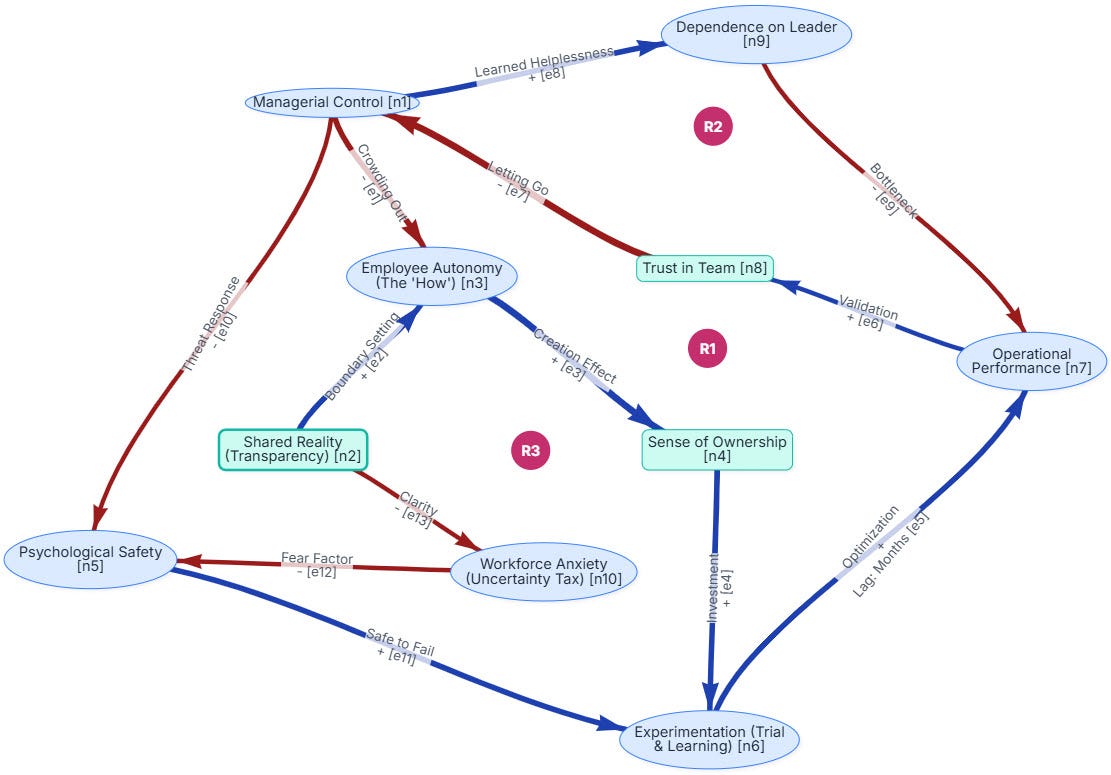
The title refers to the central physical and psychological act of the story. The “Fist” represents the Control Refuge—tight, protective, and strong, but incapable of holding anything new. You cannot receive (Trust) with a closed fist. You must open the hand (Let Go) to allow the Flywheel to spin, even though it feels like you are losing your grip.
Archetype: Rebirth
Systemic Theme: The psychological transition from R2 (Control Refuge) to R1 (The Architecture of Freedom).
The Shadow (The Status Quo)
Elena was not a bad manager. In fact, she was the best “fixer” the company had. Her office was the emergency room of the Operations department, and she was the chief surgeon.
Every morning began with the same ritual: the triage of the inbox. 150 emails. 40 approvals. Can we ship this? Is this copy safe? Can I override the budget by $200?
She felt essential. This was the Control Refuge (R2). The dopamine hit of solving problems hid the darker truth: she was drowning. Her team wasn’t moving; they were waiting. They were huddled in the doorway, watching her work, their agency slowly atrophying into Learned Helplessness (n9).
She told herself she was protecting them. She was the umbrella keeping the rain off their heads. She didn’t realize she was blocking the sun.
The Threat (The Crisis)
The collapse didn’t happen with a bang; it happened with a silence.
It was a Tuesday. Elena was in an all-day strategy offsite, completely unreachable. In the warehouse, a critical packaging machine threw a sensor error. It was a known glitch; the fix was a $400 replacement part that could be overnighted.
But the rule was clear: All non-standard procurement requires Director approval.
Marcus, the shift lead, knew what to do. He knew the part number. But he also knew the last time he acted without approval, he was reprimanded for “process violation.” The Fear Factor (e12) outweighed the Sense of Ownership (n4).
So, Marcus waited. The machine sat idle for 9 hours. By the time Elena stepped out of her meeting and approved the request (a 10-second action), the shipment window had closed. The delay cascaded. They missed the logistical cutoff for their largest client.
The cost of the part was $400. The cost of the delay was $45,000.
The Awakening (The Realization)
Elena stood on the warehouse floor the next morning, furious. “Why didn’t you just order it?” she snapped at Marcus.
Marcus looked at his boots, then looked her in the eye—a rare moment of Psychological Safety (n5) born of exhaustion. “Because you told us not to,” he said quietly. “You told us you wanted to see everything. So we showed you everything. And we waited.”
The realization hit Elena like a physical blow. She wasn’t the victim of the bottleneck; she was the bottleneck. Her need for Managerial Control (n1) hadn’t ensured safety; it had guaranteed failure. She had treated them like children, so they had become children.
The Redemption (The Action)
The next Monday, Elena called a meeting. The team filed in, notebooks ready, expecting a lecture on “urgency” or new protocols for approval.
Elena stood at the whiteboard. She didn’t write a new rule. She wrote a set of numbers:
Our Monthly Budget Limit
The Client Delivery Deadline
The Quality Standard (0.5% defect rate)
“This is the Shared Reality (n2),” she said, her voice shaking slightly. “This is what I know. Now you know it too.”
She turned to the team. “Effective immediately, I am dissolving the approval chain for anything under $1,000. Do not ask me for permission. If it fits inside these numbers, the answer is yes. Just tell me what you did.”
The room was silent. It wasn’t relief; it was terror. She had removed the safety net of her authority. She was forcing them to trade Dependence (n9) for Anxiety (n10).
“I am trusting you,” she lied. She didn’t trust them yet. She was terrified. But she knew it was the only way to build the Trust (n8) she needed.
The Spring (The Future)
The first week was chaos. Mistakes were made. Elena had to sit on her hands to keep from intervening, fighting the urge to reactivate the Control Loop.
But then, the Flywheel (R1) caught.
Marcus ordered a part before it broke, predicting the failure based on vibration data.
The shipping team reorganized the loading dock without asking, cutting load times by 15%.
The emails stopped coming. The silence in her office wasn’t the silence of waiting anymore; it was the silence of a humming engine.
Elena looked out her window. She wasn’t steering the ship anymore. She was just watching the water. And for the first time in ten years, she breathed.
Tailoring the Narrative
For the Senior Executive (The Sponsor)
The Modification: Shift the focus from “Elena’s relief” to “Systemic Speed.”
The Hook: The story isn’t about being nice to employees; it’s about the $45,000 loss caused by latency.
The Lesson: “Control is an invisible tax on every transaction. We paid $45,000 for a $400 decision because our governance model is too slow for our market.”
For the Middle Manager (The Protagonist)
The Modification: Focus on the identity crisis.
The Hook: Acknowledge the fear that “If I don’t approve things, do I still have a job?”
The Lesson: “You are currently a highly paid gatekeeper. We need you to become an Architect. You don’t build the car anymore; you design the road.”
For the Frontline Employee (The Team)
The Modification: Focus on the “Terror of Ownership.”
The Hook: Validate that autonomy feels heavy at first. It’s safer to be told what to do.
The Lesson: “Freedom is uncomfortable because it comes with the weight of the result. But it is the only way to stop being a ‘Renter’ of your job and become an ‘Owner’ of your craft.”
The Aha! Paradox of Control
Based on our model (The Logic of Enabling) and the specific “Phase Transition” dynamics we uncovered, here is the Aha! Paradox applied to the problem of organizational control.
1. The Anchor (The Delusion)
The Illusion of the Central Processor.
The foundational lie holding the status quo together is the belief that Accuracy requires Intervention. We operate on the assumption that if the leader doesn’t “check” the work, the quality will inevitably decline. We view the manager as the “Quality Control Filter” that catches errors before they leave the building.
2. The Default (The Status Quo)
The Compliance Spiral (R2).
Because we believe accuracy requires intervention, when errors happen, we add more checkpoints. We institute “sign-offs,” “review meetings,” and “approval chains.”
Systemic Effect: This feeds the Dependency Loop (R2). By catching the errors for the team, the leader trains the team to stop looking for errors. The team outsources “worrying” to the manager, which increases the error rate, which justifies more control.
3. The Bottleneck (The Constraint)
The Silence of the Boss.
You are forbidden from answering questions.
The Rule: If a team member asks, “What should I do?” or “Is this good enough?”, you are not allowed to give an opinion or a decision. You may only answer with Data (Context/Shared Reality) or a Question regarding the goal.
The Insight: This removes the “Control Valve” (n1) from the system. It forces the system to find a new mechanism for processing uncertainty (shifting from n1 to n2).
4. The Collision (The Isomorph)
Topic Collision: Traffic Engineering (Signalized Intersections vs. Roundabouts).
The Intersection (Control Regime): A traffic light is “Managerial Control.” It requires a central computer to dictate flow. It is “efficient” in theory but fragile in practice. If the computer fails (or the leader is overwhelmed), traffic stops (Bottleneck). It assumes drivers are stupid and need explicit instructions (Red/Green).
The Roundabout (Trust Regime): A roundabout has no signals. It relies on Shared Reality (visibility of other cars) and Simple Rules (yield to those in the circle).
The Synthesis: Roundabouts statistically have higher throughput and 90% fewer fatal accidents than traffic lights. Why? Because drivers are forced to be Hyper-Alert (n4: Ownership) rather than Passive Compliers (n9: Dependence). The “danger” of the roundabout is exactly what makes it safe.
5. The Reversal (The Truth)
Friction is a Feature, not a Bug.
We usually think the leader’s job is to “remove obstacles.” The truth is the opposite: The leader’s job is to create the right obstacles.
In the Control Regime, the obstacle is “The Manager’s Approval.”
In the Trust Regime, the obstacle is “The Strategic Constraint” (Shared Reality).
The Shift: You stop managing the decisions and start managing the constraints. If the constraints (n2) are clear, the decisions (n3) manage themselves.
6. The Kinetic Result (The Action)
The Aha! Insight:
Control is Latency.
Every time you require permission, you are not adding “quality”; you are adding “lag.” In a complex system, the speed of the correction (Loop R1) matters more than the precision of the instruction. The “safe” choice (waiting for approval) is actually the “risky” choice (being too slow to react).
The First Domino:
“The Intention Protocol.”
Institute a new rule for your direct reports starting tomorrow:
“I will no longer approve requests. Instead, you will send me a statement of ‘I Intend To...’“
If they say “I intend to do X,” and you do nothing, they do it.
This shifts the psychological burden. They are no longer asking for permission (Passive); they are informing you of a future reality (Active). You retain the right to veto (Emergency Brake), but you are no longer the Steering Wheel.