
Empowerment: A Deeper Dive

Comprehensive Analysis of the Empowerment Causal Loop Diagram
This document provides a detailed analysis of the “Empowerment” model, breaking down its structure, dynamics, and implications into key sections as requested.
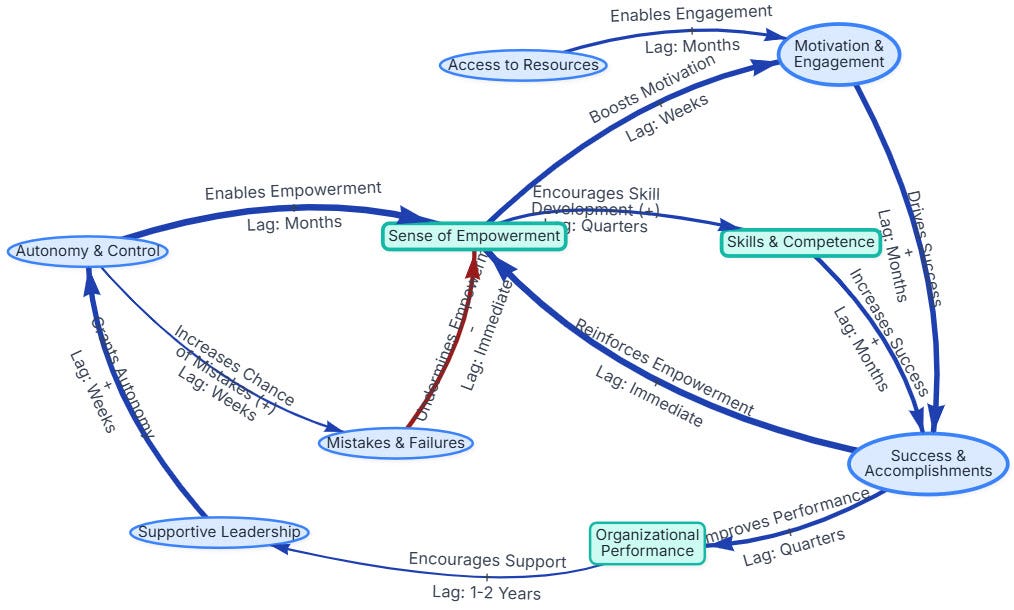
1. Model Explanation
The model portrays “Empowerment” not as a personal trait but as an emergent property of a dynamic system. It illustrates that an individual’s “Sense of Empowerment” is a central stock that grows or declines based on its interactions with other key factors.
Reinforcing Dynamics: The model is driven by several reinforcing feedback loops. The core engine shows that empowerment boosts motivation, which leads to success, which in turn builds a greater sense of empowerment (R1: Empowerment Engine). Similarly, empowerment encourages skill development, which also leads to success and reinforces empowerment (R2: Competence Builds Confidence).
External Enablers: These engines are catalyzed by external factors, primarily “Supportive Leadership,” which grants “Autonomy & Control” and provides “Access to Resources”—both essential for the reinforcing loops to function effectively.
Balancing Dynamics: The system is kept in check by a crucial balancing loop (B1: Fear of Failure). While autonomy is necessary for empowerment, it also increases the chance of mistakes. If these mistakes are punished, they directly undermine the sense of empowerment, creating a culture of fear that stifles the very risk-taking the system needs to thrive.
In essence, the diagram shows that empowerment is a delicate flywheel that, once spinning, can generate immense positive momentum for both the individual and the organization. However, its motion can be quickly halted by leadership behaviors that punish failure.
Source: Empowerment (Archetypes Experimental)
2. Wisdom
The core wisdom of this model is that empowerment is not given, it is grown. It is a self-reinforcing capability that emerges from a system where trust is the catalyst, competence is the fuel, and success is the accelerant. The role of leadership is not to bestow empowerment but to cultivate the conditions—autonomy, resources, and psychological safety—where it can flourish on its own.
3. Donella Meadows’ Leverage Points
Analyzing the model through the lens of Donella Meadows’ 12 leverage points reveals where interventions can be most effective, ordered from least to most powerful.
Constants, parameters, numbers:
Leverage: Very Low.
In the Model: This corresponds to adjusting quantitative inputs like the amount of training budget (
Access to Resources) or setting specific KPIs (Success & Accomplishments). While necessary, simply throwing more resources into the system without changing its structure yields minimal results.
The sizes of buffers and other stabilizing stocks:
Leverage: Low.
In the Model: The key stocks are
Sense of Empowerment,Skills & Competence, andOrganizational Performance. A person with a high stock of empowerment or competence can withstand an occasional failure (B1) without losing momentum. Building these stocks takes time, but they provide resilience.
The structure of material stocks and flows:
Leverage: Low-Medium.
In the Model: This relates to the physical and logical structure of the organization. For example, redesigning workflows to require fewer approvals directly increases
Autonomy & Control.
The lengths of delays, relative to the rate of system change:
Leverage: Medium.
In the Model: The model explicitly shows delays. A key leverage point is shortening the delay between
Success & Accomplishmentsand the reinforcement ofSense of Empowerment. Quick recognition, praise, and celebration of wins accelerate the R1 and R2 loops significantly. Conversely, long delays between an action and its outcome can weaken the loops.
The strength of negative feedback loops:
Leverage: Medium-High.
In the Model: The primary balancing loop is B1: Fear of Failure. The strength of this loop is a powerful leverage point. Organizations that punish mistakes strengthen this loop, which chokes off autonomy and stifles the reinforcing engines. The leverage point is to weaken this loop by creating psychological safety and reframing mistakes as learning opportunities, thus turning a balancing loop into another reinforcing loop for
Skills & Competence.
The gain around driving positive feedback loops:
Leverage: High.
In the Model: The model has three powerful reinforcing loops (R1, R2, R3). The leverage point is to increase the “gain” of these loops. This can be done by making success more visible (strengthening the e3 link), providing better coaching (
Supportive Leadership), or offering more opportunities for skill application (strengthening the e7 link). Small pushes in these loops can generate escalating positive returns.
The structure of information flows:
Leverage: High.
In the Model: This is about transparency. Does an individual have the information needed to exercise their autonomy effectively (
Access to Resources)? IsOrganizational Performance(n9) shared widely, so people see the impact of their work and leaders feel encouraged to be more supportive? Making information more accessible strengthens multiple links in the system.
The rules of the system (incentives, punishments, constraints):
Leverage: Very High.
In the Model: This is one of the most powerful leverage points. The “rules” dictate how the system operates. Examples include:
Performance Management: Do you only reward success, or do you also reward intelligent risk-taking?
Promotion Criteria: Are leaders promoted based on their team’s output alone, or on their ability to develop and empower their people (
Supportive Leadership)?Decision Rights: Formally defining and pushing down decision-making authority (
Autonomy & Control). Changing these rules fundamentally alters the behavior of everyone in the system.
The power to add, change, evolve, or self-organize system structure:
Leverage: Very High.
In the Model: This involves giving teams the power to design their own workflows, roles, and levels of autonomy. It is the ultimate expression of
Autonomy & Controlat a group level and can lead to the emergence of more effective structures.
The goal of the system:
Leverage: Very High.
In the Model: What is the ultimate goal? Is it simply to maximize
Organizational Performancein the short term? Or is the goal to build a resilient, adaptive organization by maximizing theSense of EmpowermentandSkills & Competenceof its people, with the understanding that performance will follow? Shifting the stated and implicit goal of management toward fostering empowerment changes every decision and action within the system.
The mindset or paradigm out of which the system arises:
Leverage: Highest.
In the Model: The paradigm is the collection of shared beliefs about how work should be done. The highest leverage point is shifting the organizational paradigm from “Command and Control” to “Trust and Empower.” A command-and-control mindset sees employees as resources to be managed, strengthening the “Fear of Failure” loop. A trust-based paradigm sees employees as capable agents to be unleashed, strengthening all the reinforcing loops.
The power to transcend paradigms:
Leverage: Highest.
This involves recognizing that no single paradigm is a universal truth and being able to choose the appropriate mindset for a given situation. This level of thinking is outside the model itself but represents the ultimate form of organizational wisdom.
4. Knowledge
The model contains the following core pieces of knowledge:
A sense of empowerment drives motivation.
High motivation and engagement lead to greater success.
Success and accomplishments are the most direct reinforcers of empowerment.
Autonomy is a necessary precondition for empowerment.
Supportive leadership is the primary source of autonomy.
Competence increases the likelihood of success.
Empowerment itself drives the desire to build more competence.
Mistakes, if punished, are the fastest way to destroy empowerment.
Widespread individual success aggregates into strong organizational performance.
Strong organizational performance validates and encourages the continuation of supportive leadership.
5. Systems Archetypes
The primary archetype visible in this model is Success to the Successful.
Explanation: The structure is centered on two reinforcing loops (R1 and R2) that create a “rich get richer” dynamic. An individual with a high initial
Sense of EmpowermentandSkills & Competenceis more likely to enter these virtuous cycles. Their motivation leads to success, which builds more competence and reinforces their empowerment. This success makes them more visible and trusted, leadingSupportive Leadershipto grant them even moreAutonomy & ControlandAccess to Resources.Implication: Conversely, an individual with low initial empowerment or competence may struggle to get the “flywheel” spinning. Their lack of success may lead to them being perceived as less capable, resulting in less autonomy and fewer resources, starving them of the very ingredients needed to build empowerment and success. This widens the gap between high and low performers over time.
6. Primary Principles
Empowerment is an Output, Not an Input: You cannot “give” empowerment; you can only create the conditions for it to emerge.
Trust Precedes Control: The system is initiated by leadership’s willingness to grant autonomy, an act of trust. Control is an outcome of an empowered system, not the input to it.
Learning Requires Safety: The “Fear of Failure” balancing loop (B1) demonstrates that without psychological safety, the system defaults to risk aversion, and the reinforcing engines of empowerment stall.
Success is the Feedback: The system’s reinforcing nature is critically dependent on the feedback from
Success & Accomplishments. If success is not visible, recognized, or meaningful, the loops break.
7. Key Insights
Focus on Leadership Behavior: The most effective starting point is not on the individual but on cultivating
Supportive Leadership. This is the catalyst for the entire system.Make Success Visible and Frequent: To accelerate the reinforcing loops, break down large projects into smaller milestones. Celebrating small, frequent successes provides the rapid feedback needed to build momentum.
Decouple Mistakes from Punishment: The single most destructive action is punishing well-intentioned failure. The highest priority for a leader wanting to empower their team is to create an environment where mistakes are treated as learning moments, thus weakening the B1 loop.
Invest in Both Autonomy and Competence: Granting autonomy without ensuring access to resources and opportunities for skill-building can lead to failure, which then triggers the B1 loop and destroys empowerment. The two must go hand-in-hand.
8. Future Implications
If Reinforcing Loops Dominate: The organization enters a virtuous cycle. High empowerment leads to high engagement, innovation, and strong performance. This success makes it easier to attract and retain top talent and validates the empowering culture, ensuring its continuation. The organization becomes resilient, adaptive, and a market leader.
If the Balancing Loop Dominates: If leadership is risk-averse or punitive, the “Fear of Failure” loop becomes dominant. Autonomy is curtailed, motivation plummets, and employees focus only on “safe” tasks. This leads to stagnation, low engagement, and declining organizational performance. The organization becomes brittle, unable to adapt, and will likely lose its most creative and driven employees.
Synthesis: Core Wisdom & Highest Leverage Point
Core Wisdom: Empowerment is a self-fueling engine of success that thrives on trust and learning.
Highest Leverage Point: The single highest point of leverage within this model is to change the paradigm of leadership from control to cultivation. This is achieved by changing the Rules of the System: specifically, by altering how leaders are evaluated and rewarded. When leaders are incentivized not just for their team’s output but for their demonstrated ability to foster psychological safety (weakening B1) and develop their team’s competence and autonomy (strengthening R3), the entire system shifts toward a virtuous state of high performance and engagement.