
Ecosystem Co-optation Trap
An Aha! Mystery - Deciphering the Mess

The Situation
The Current Event: A purpose-driven, sustainable agricultural firm scales its operations by building a revolutionary, open-source software platform that helps independent farmers track soil health and optimize organic yields. Two years later, multinational agrochemical conglomerates copy the open-source code, integrate it into their proprietary asset systems, and use it to lock farmers into long-term chemical purchase agreements.
The “Aha!” Angle: This highlights the paradox of open-system interventions created by a Stratum V leader. When a purpose-driven organization operates with a systemic, abundance-oriented mindset (open-sourcing intellectual property to elevate the whole industry), it operates in a wider economic ecosystem driven by zero-sum, extractive rules. The altruistic intervention accidentally lowers the R&D costs for predatory players, accelerating the optimization and dominance of the extractive system rather than dismantling it.
The Question: How must a Stratum V architect structure intellectual property and collaborative networks so that open-system benefits can only accumulate to aligned, regenerative actors?
The Paradox of the Open Soil: The Case of the Co-opted Code
The tractor idled at the edge of the field while the farmer stared at a locked digital dashboard. The screen demanded a renewed contract for synthetic fertilizers before it would calculate the day’s optimal seeding depth. The friction point was localized right there in the cab: a piece of algorithmic yield optimization software, originally developed as a free tool by a purpose-driven firm, had been weaponized. The widespread, superficial explanation was that the original open-source project simply failed to compete in the free market, succumbing to the superior business acumen of massive agrochemical corporations. This is a load-bearing delusion. It is a classic case of shifting the burden, masking the reality that unconditional openness in a predatory market does not democratize innovation; it merely subsidizes extraction. To understand the crime scene, one must accept that there are no static objects in this digital ecosystem, only processes and temporary bundles of relationships. The conglomerates intentionally froze the free flow of soil data, wrapping it in proprietary software to optimize their own upstream market velocity while guaranteeing the downstream financial exhaustion of the independent farmer.
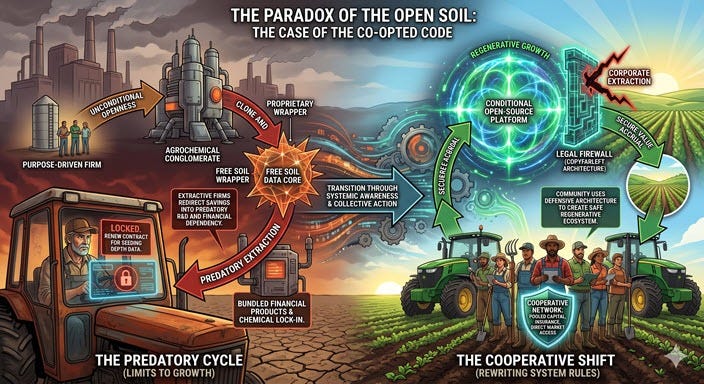
The system was designed for the cheapness and friction-free nature of initial creation, leading straight into a core paradox: optimizing an open repository of agricultural knowledge solely for rapid sharing generated an exponential debt of friction at the end of the software’s lifecycle. A purpose-driven firm created a core repository of soil data and algorithms to act as the intellectual reservoir for a regenerative agriculture ecosystem. And? Access to these free, cutting-edge tools directly increased a farmer’s ability to operate autonomously. And? As farmers gained this sovereignty, they began relying less on corporate credit and chemical inputs. And? This unconditional open-source license allowed multinational agrochemical conglomerates to legally clone the software without funding any foundational research themselves. And? The capital conserved by these extractive firms from this predatory R&D savings was redirected into building aggressive proprietary wrappers around the stolen core technology.
These closed-ecosystem platforms served as Trojan horses, intentionally designed to deliver dependency-creating financial products. And? The deployment of these bundled systems forced farmers to accept chemical lock-ins as the price of admission for financial security. And? Widespread adoption of these restrictive contracts restored and expanded the structural power of the agrochemical giants, directly strangling the operational freedom of independent farmers through debt and dependency. The open platform had inadvertently subsidized the very conglomerate R&D that trapped the farmers, creating a massive unintended drag on the ecosystem. This structural contradiction was not the result of a personalized, external enemy, but an archetypal mechanism at play. It was the logical output of the Limits to Growth system archetype, where the regenerative platform’s growth was inherently limited by its unconditional openness in a predatory environment. The conglomerates simply acted as a balancing feedback mechanism, predictably extracting the platform’s momentum until the rules of the system were fundamentally rewritten.
The sheer existential threat of total corporate dominance eventually forced isolated, vulnerable farmers to band together for mutual survival. This cooperative network provided pooled capital, insurance, and direct market access, structurally shielding the farmer’s sovereignty. For the pragmatists in the fields, this collective pooling of resources was an immediate architectural shift that attacked the root cause rather than treating the symptoms. With their sovereignty temporarily restored, this unified cooperative possessed the collective bargaining power and awareness to demand protective legal structures for their shared resources. They implemented a conditional legal framework, utilizing a copyfarleft architecture, that explicitly prohibited commercial extraction and legally segregated aligned users from predatory actors. This licensing firewall criminalized corporate co-optation, immediately halting their free R&D pipeline and dismantling the predatory bundling machine. Through a rigorous process of trial and learning, the community realized that shared understanding and defensive architecture permanently alter the flow of systemic energy, ensuring that future empowered, independent farmers can safely contribute field data back into the ecosystem, securely accruing value only to those aligned with regenerative growth.
Systemic Reflection & Stakeholder Notes
First Principles & Core Paradoxes
The Paradox of Openness: An unconditional open-source license allows conglomerates to legally clone software without paying for foundational research.
The Limit to Growth: The regenerative platform’s growth is inherently limited by its unconditional openness in a predatory environment, acting as a balancing feedback loop.
The Co-optation Trap: The open platform inadvertently subsidizes conglomerate R&D, powering proprietary systems that trap farmers.
The Resource Squeeze: Increased corporate leverage directly strangles the operational freedom of independent farmers through debt and dependency.
Structural Leverage Points
Cooperative Counter-Power: The existential threat of total corporate dominance forces isolated farmers to band together for mutual survival.
Resource Pooling: The cooperative provides pooled capital, insurance, and direct market access, structurally shielding the farmer’s sovereignty.
Conditional Architecture: Implementing a strategic licensing architecture, such as copyfarleft, strictly prohibits commercial extraction.
The Licensing Firewall: This legal framework explicitly criminalizes or blocks corporate extraction, immediately halting their free R&D pipeline.
Stakeholder Actionable Wisdom
For the Visionaries: True systemic regeneration requires recognizing that unearned economic advantages allow extractive firms to redirect saved capital into building aggressive proprietary wrappers around stolen core technology.
For the Pragmatists: Empowered, independent farmers must contribute field data and code improvements back into the ecosystem under conditional licenses to ensure innovations securely accrue value only to the regenerative ecosystem.
The Theorists Behind the Co-optation Trap
The provided documents outline a systemic trap where massive agrochemical conglomerates legally co-opt open-source platforms meant to democratize regenerative agriculture. Because these open intellectual resources inadvertently lower research and development costs for predatory players, conglomerates bundle the co-opted technology with essential financial lifelines, forcing farmers into chemical lock-ins. To break this extractive cycle, the literature emphasizes the need for cooperative networks to demand conditional legal frameworks, such as “copyfarleft” licenses, which strictly prohibit commercial extraction.
While the provided text serves as a conceptual blueprint without naming specific individuals, several real-world scholars and technologists have published the foundational perspectives that define this exact socio-technical conflict:
Dmytri Kleiner & Michel Bauwens (The Architects of “Copyfarleft”): Kleiner, alongside Bauwens from the P2P Foundation, developed the exact “Peer Production License” (or copyfarleft) mentioned as a strategic defense in your seed literature.
Unique Perspective: They argue that standard open-source licenses blindly enable a “communism of capital,” where multinational corporations freely exploit commons-based peer production to amass wealth. To counter this, they engineered the Copyfarleft license to legally segregate aligned users from predatory actors. Under this framework, worker-owned cooperatives can freely commercialize the commons, while capitalist enterprises are explicitly barred or forced to pay. This directly mirrors the “Licensing Firewall” concept meant to starve the corporate R&D pipeline.
Nick Srnicek (The Mechanisms of “Platform Capitalism”): Srnicek, known for his seminal book Platform Capitalism, explores the macroeconomic drivers behind the push for proprietary bundled software.
Unique Perspective: He argues that as traditional manufacturing profitability stalls, conglomerates are forced to turn to data extraction as their primary growth engine. From this view, agricultural platforms aren’t just software tools; they are monopolistic business models designed to siphon immense amounts of operational data and create structural dependencies. This perfectly explains the predatory incentive for extractive firms to redirect saved R&D capital into aggressive proprietary wrappers.
Kelly Bronson & Agricultural Data Sovereignty Scholars: Scholars focusing on the socio-technical transitions in agriculture often examine the stark power imbalances created by digital farming technologies and data capture.
Unique Perspective: They emphasize that “vendor lock-in” is not a bug of agricultural tech, but a deliberate feature of corporate ecosystem design. By tying essential financial lifelines to proprietary tech platforms, conglomerates systematically neutralize farmer independence. These researchers champion “data sovereignty,” advocating for collective cooperative infrastructure and multi-stakeholder governance as structural defense mechanisms against isolated vulnerability.
The co-optation trap you name, where an ecosystem neutralizes a challenger not by beating it but by absorbing it until participation becomes the only rational move, is one of the most under-examined dynamics in platform competition. What makes it so hard to resist is that each individual decision to integrate looks locally optimal even as it quietly forecloses the exit. I keep running into a cousin of this in AI adoption, where 'we are using it' replaces 'it is working' as the success metric and the felt progress diverges from the measured kind: https://rkto.substack.com/p/you-think-ai-is-making-you-faster
This one has a very different flavor from many of your stories. Far from attempting to "save the market," copyfarleft is based upon deep critique of capitalism.