
Crypto Future: A Deeper Dive

Analysis of the Crypto Future Causal Loop Diagram
This document provides a detailed analysis of the “Crypto Future” model, examining its structure, dynamics, and implications through the lens of systems thinking.
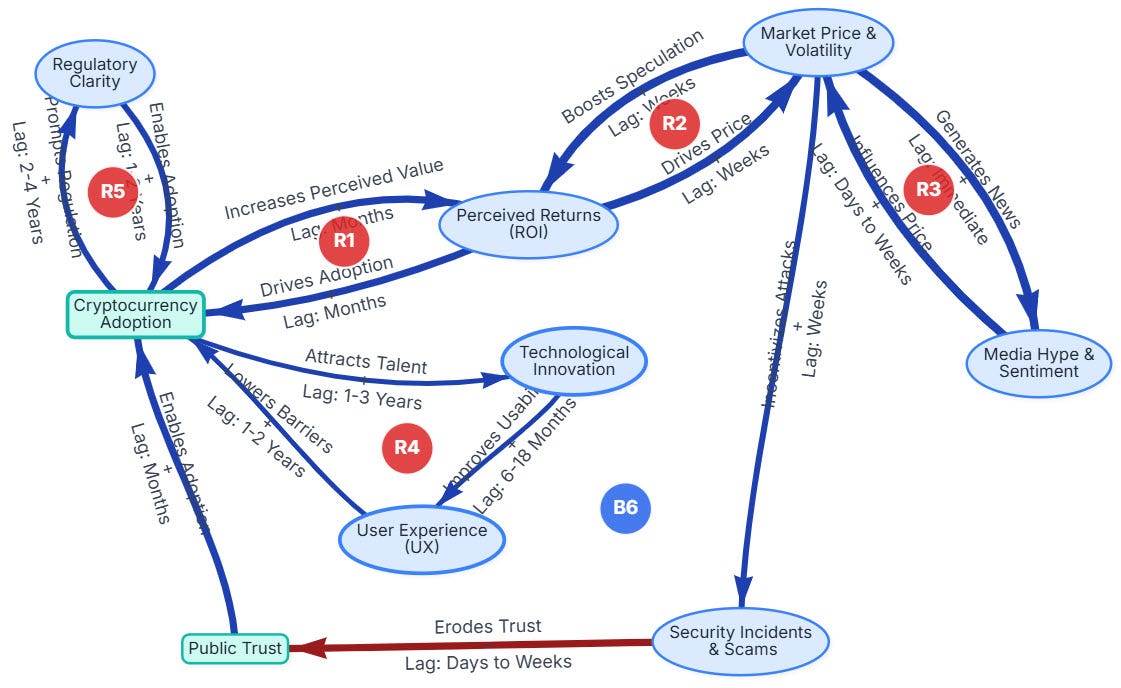
Model Explanation
The “Crypto Future” causal loop diagram illustrates the complex web of interconnected factors driving the adoption, valuation, and long-term viability of cryptocurrencies. It models the system as a set of feedback loops where variables like public trust, technological innovation, market price, and regulatory clarity influence each other. The model highlights the reinforcing “engines of growth” (like speculation and innovation) and the balancing “brakes” (like security risks and regulatory responses) that together shape the future trajectory of the crypto ecosystem.
Source: Crypto Future
Wisdom
The core wisdom of this model is that the future of cryptocurrency is not a technological inevitability but a battle between speculative hype and earned trust. While hype-driven reinforcing loops (R2, R3) can create exponential price growth, they simultaneously strengthen the system’s balancing loops (B5), which trigger scams, erode trust, and invite regulation. Sustainable, long-term adoption (R1, R4, R6) can only be achieved if the system’s ability to build and maintain trust outpaces its tendency to self-destruct through unchecked speculation.
Donella Meadows’ Leverage Points
Applying Donella Meadows’ framework helps identify the most effective places to intervene in the crypto system, ranked from lowest to highest leverage.
9. Parameters (Lowest Leverage): Intervening here involves changing numerical values, such as the lag times between events (e.g., shortening the time for regulation to be implemented) or the strength of relationships (e.g., reducing the impact of a security incident on public trust). While these changes can tune the system’s behavior, they do not change its fundamental structure. For example, a faster regulatory response might dampen a bubble more quickly, but it won’t prevent the bubble from forming in the first place.
7. Strength of Negative Feedback Loops (Medium Leverage): A more powerful intervention is to strengthen the system’s balancing loops. In this model, this means strengthening the “Trust Brake” (B5). This could be achieved by increasing the transparency of security incidents, promoting consumer education to quickly identify scams, and establishing rapid-response mechanisms to hacks. A stronger B5 would make the system more resilient by ensuring that trust-eroding events have a swift and significant cooling effect on speculative fever, preventing bubbles from growing to catastrophic sizes.
4. The Power to Change the System’s Structure (High Leverage): This involves adding new variables or links that fundamentally alter the system’s dynamics. A powerful intervention would be to create a strong, new link from “Technological Innovation” and “User Experience” directly to “Public Trust.” If innovations focused explicitly on security, ease of use, and fraud prevention, they could build a foundation of trust that is independent of market price. This would weaken the dominance of the speculative loops and strengthen the “Innovation Flywheel” (R4) as the primary driver of adoption.
2. The Goal of the System (Very High Leverage): The current implicit goal of much of the crypto system is the maximization of financial returns (”Perceived ROI”). This goal naturally prioritizes the reinforcing loops of speculation (R2, R3). A higher leverage point would be to shift the system’s goal from speculative gain to utility and problem-solving. If the primary goal became creating decentralized applications that are genuinely useful, secure, and easy to use, the entire system would self-organize around strengthening the “Innovation Flywheel” (R4) and building “Public Trust” (B5), rather than just pumping the “Market Price.”
1. The Power to Transcend Paradigms (Highest Leverage): The highest leverage point is changing the underlying mindset from which the system emerges. The dominant paradigm is that crypto is primarily a speculative asset class for generating wealth. Transcending this paradigm means shifting the collective belief to see cryptocurrency as a foundational technology for building a more transparent, equitable, and decentralized digital infrastructure. This isn’t just about changing the goal; it’s about changing the worldview. If developers, users, and regulators operated from this paradigm, a focus on long-term value, security, and real-world utility would become the natural default, making the system inherently more stable and sustainable.
Knowledge
Systems Archetypes
The model exhibits two classic systems archetypes that explain its volatile behavior:
Limits to Growth (Primary Archetype): This archetype is central to the entire model.
Engine of Growth: The reinforcing “Adoption Loop” (R1), “Hype Cycle” (R2), and “Speculation Cycle” (R3) all work together to create rapid, exponential growth in price and adoption.
Limiting Factor: This growth eventually confronts limits. The primary limits are the balancing loops: the “Trust Brake” (B5), where growth in price leads to scams that erode trust and slow adoption, and the “Regulatory Response” (R6, acting as a potential brake), where growth attracts government intervention.
Growth and Underinvestment: This archetype highlights a potential failure mode for the system.
Growth Engine: The system relies heavily on the “Hype Cycle” (R2) and “Speculation Cycle” (R3) for its growth.
Underinvestment: If this growth is not matched by sufficient investment in the “Innovation Flywheel” (R4)—specifically in the areas of “User Experience” and security—the system becomes fragile. Performance degrades, usability remains poor, and security vulnerabilities persist. This underinvestment in fundamentals makes the system highly susceptible to the “Trust Brake” (B5), where even minor incidents can cause a major collapse in confidence because the underlying utility is weak.
Primary Principles
Hype is a Double-Edged Sword: The same feedback loops (R2, R3) that create euphoric bull markets also sow the seeds of their own destruction by incentivizing scams and attracting regulatory scrutiny.
Trust is a Lagging Indicator but a Critical Stock: Public Trust (n2) builds slowly but can be destroyed quickly. While the market can ignore a decline in trust for a while, its depletion eventually acts as a powerful brake on adoption and price.
Utility is the Only Sustainable Foundation: The “Innovation Flywheel” (R4) is the only reinforcing loop in the model that creates value independent of price speculation. Long-term viability depends on strengthening this loop.
Regulation is an Inevitable Consequence of Success: As adoption grows, the system will inevitably trigger a regulatory response. The nature of this response—whether it enables or stifles growth—is a key uncertainty.
Key Insights
The system is inherently prone to boom-and-bust cycles because the speculative loops (R2, R3) operate much faster than the trust-building and innovation loops (R4, B5, R6).
Focusing solely on price as a measure of success is dangerous, as it directly strengthens the “Trust Brake” (B5) by incentivizing bad actors.
Improving “User Experience” (n8) is a critical, high-leverage intervention because it strengthens the sustainable “Innovation Flywheel” (R4) and makes adoption less dependent on speculative hype.
The relationship between regulation and adoption is a crucial uncertainty. Proactive engagement with regulators to create “Regulatory Clarity” could be a powerful strategy to stabilize the system.
Future Implications
The model suggests several possible futures for cryptocurrency, depending on which loops come to dominate:
Endless Boom-Bust Cycles: If the speculative loops (R2, R3) remain dominant, the future will be a series of increasingly intense bubbles and crashes as the system’s growth repeatedly slams into the limits of trust and regulation.
Mainstream Integration: If the “Innovation Flywheel” (R4) and “Regulatory Response” (R6) can be strengthened to the point where they overtake the speculative loops, crypto could transition into a stable, integrated part of the technological and financial landscape, with value driven by utility rather than hype.
Stagnation and Niche Status: If a major security incident or a harsh regulatory crackdown permanently damages “Public Trust,” the reinforcing loops could be broken, leading to a long period of stagnation where cryptocurrency remains a niche technology for a small group of enthusiasts.
Synthesis: Core Wisdom & Highest Leverage Point
The ultimate wisdom of the model is that sustainable growth requires shifting the system’s reliance from the fast, fragile loops of speculation to the slower, more robust loops of innovation and trust.
Therefore, the highest leverage point is to transcend the paradigm of crypto-as-a-speculative-asset and collectively adopt the paradigm of crypto-as-a-foundational-technology. This mental model shift would naturally reorient the system’s goals toward utility, security, and usability, strengthening the feedback loops that lead to long-term health and weakening those that cause its inherent instability.