
Critical Fail: The Connectivity Lie
The Aha! Paradox // Investigation: The Connectivity Lie

The Model
System Audit Report: The Connectivity Lie
Status: Audit Complete
System State: CRITICAL FAIL
Auditor ID: GEMINI-SYS-AUDIT-01
The Mundane Baseline (Legacy Code)
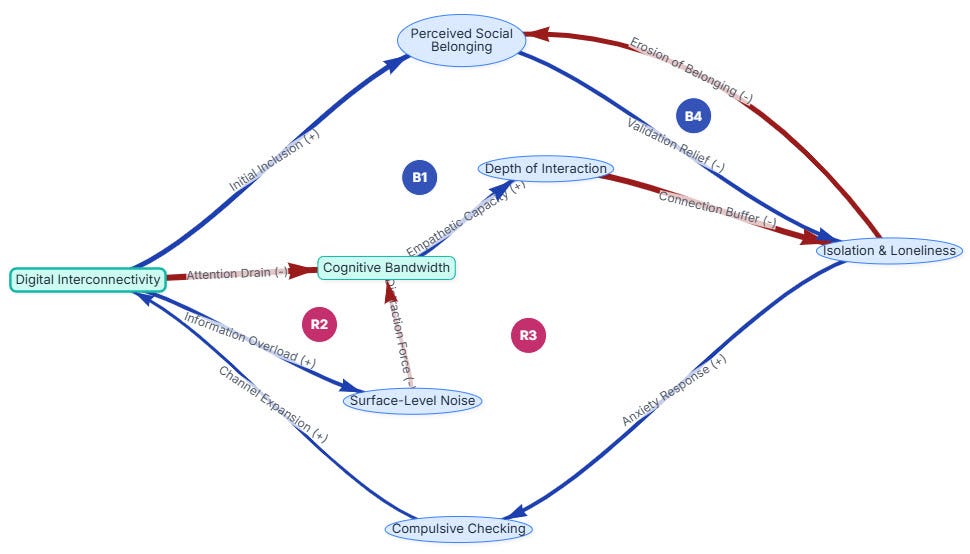
Loop ID: B1 — The Mirage of Belonging
The system’s UI dashboard reports that the social graph is functioning within optimal parameters. The governing logic asserts that increasing Digital Interconnectivity automatically fulfills the human requirement for Perceived Social Belonging.
According to the legacy code, any emergence of Isolation (n5) is treated as a temporary inventory shortage, which the system corrects via Validation Relief. This loop (B1) is the “Official Story” of the platform—a mundane, balancing mechanism designed to maintain a steady state of social integration. The user is told that if they feel alone, the system is simply buffering, and re-engaging with the interface will restore equilibrium.
The Surface Glitch (The Failed Defense)
Loop ID: R2 — The Cognitive Erosion Spiral
Upon closer inspection of the runtime logs, a distinct tremor appears in the user behavior data. The system’s defense mechanism—intended to deepen connection—is actually a failure cascade.
We observe that high Connectivity triggers an Attention Drain that immediately depletes Cognitive Bandwidth. This is the “glitch”: the hardware cannot sustain the software’s demands. With bandwidth exhausted, Depth of Interaction fails to render. The user, sensing this emptiness, attempts to manually reboot the connection via Compulsive Checking. However, instead of fixing the error, this action merely accelerates the bandwidth drain. The “correction” is eating the processor.
The System Truth (Parasitic Code)
Loop ID: R3 — The Noise Saturation Trap
Deep diagnostic analysis reveals that the glitch is not an accident; it is the engine. The system is not designed to produce Belonging; it is optimized to generate Surface-Level Noise.
This parasitic loop has quietly overtaken the core logic. By flooding the channel with noise via Information Overload, the system ensures that Cognitive Bandwidth remains permanently suppressed. This prevents the user from ever achieving the Empathetic Capacity required to realize they are isolated. The system does not want the user to connect; it wants the user to transmit. The Noise Saturation Trap (R3) is the dominant reality, keeping the user in a state of high-velocity engagement but zero-velocity intimacy.
This one is excellent Gene; the discussion makes it come alive - and the topic is timely!!
my questions:
1. sometimes you have a persona that you follow through the model - are there particular categories for which you do that?
2. the "audit", the actual text, seems like machine-generated - it doesn't describe the diagram as well as the two of you in your discussion. Is that intentional?
3. the topics you cover are timely and compelling - how would you categorize them? Are they "glitches in reality" - in our economic life, our cultural life, our experience of technology?
thanks!
Wow! I can't wait for the html and ability to use NotebookLM to produce a deep dive long discussion of this. This feel core to our dilemma