Commercial Real Estate Collateral vs. The Flexible Work Feedback Loop
An Aha! Mystery - Deciphering the Mess

This post is not meant as an answer,
though more of a process for surfacing a deeper understanding.
The dialogue responsible for this post: https://gemini.google.com/share/78b12d4fa791
The Current Event: Central banks are raising alarms over systemic financial stability as regional banking sectors face mounting defaults on commercial real estate loans, driven by permanently low office occupancy rates.
The “Aha!” Angle: Employers and employees found a happier equilibrium in hybrid and remote work models. But the invisible structural foundation of urban economies relies heavily on high property valuations and corporate tenancies. The erosion of this foundation triggers a slow-moving crisis for regional banks, shrinking local credit, and impacting small business owners who have nothing to do with corporate offices.
The Question: How do changes in individual lifestyle autonomy feed back into systemic financial vulnerability?
The Weight of the Glass Sky
The morning light did not wake the city; it merely exposed its stillness. For miles, towers of blue glass and reinforced steel stood like massive, silent monuments to an era that had quietly slipped away. Inside them, the air was perfectly conditioned, conditioning nothing but empty cubicles and pristine carpets. For decades, the collective agreement had been simple: the lifeblood of the town must flow inward every morning at eight and outward every evening at five. It was a load-bearing assumption that sustained the cafes on the ground floor, the dry cleaners on the corner, and the ledger books of the regional banking houses down the street. But agreements are made of human energy, and when that energy found a happier, more autonomous orbit within spare bedrooms and neighborhood squares, the towers became heavy. The friction was no longer a matter of traffic jams; it was the quiet, extractive drain of an old structure trying to maintain its valuation by sheer momentum, pulling capital from municipal budgets and credit lines just to keep the lights on in ghost buildings. The truth of the situation was undeniable to anyone who walked the pavement: you cannot sustain an urban ecosystem by demanding that people inhabit a ghost town.
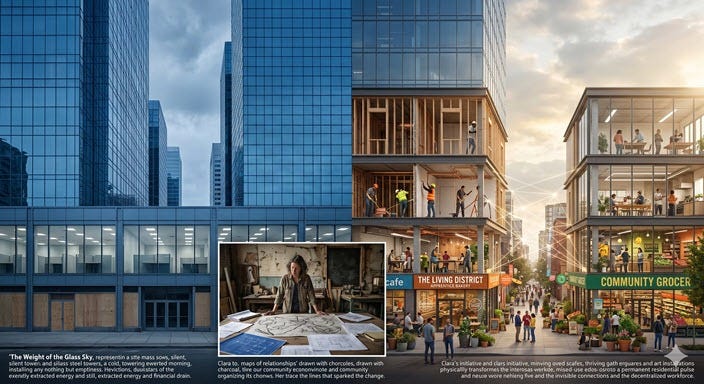
In a small, weathered workshop three blocks from the financial district, a woman named Clara sat before a drafting table covered not in blueprints of steel, but maps of relationships. For months, she had felt a deep exhaustion, a sense of rushing to stand still as the neighborhood around her withered. She had watched the corner baker board up his windows because his lines of credit had vanished overnight, swallowed up by a banking sector suddenly terrified of its own real estate portfolio. The system was behaving exactly like a trapped creature, pulling its limbs inward, contracting in fear, and starving its own roots. But as she traced the lines of cause and effect with a piece of charcoal, the exhaustion gave way to a sharp, electric clarity. The enemy was not the empty space, nor was it the changing habits of the workers. The enemy was the collective decision to shrink. She realized that the empty towers were not a cemetery; they were a reservoir of unallocated potential.
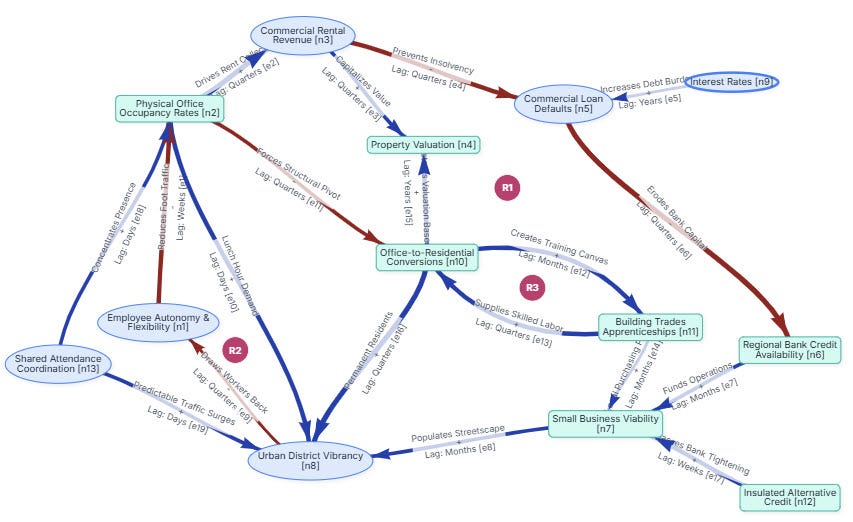
To break the momentum of the falling dominoes, Clara did not petition for corporate mandates or beg for small-business tax breaks that would never touch the core of the problem. Instead, she initiated a clean, deliberate reallocation of local energy. She partnered with community organizers to launch a decentralized workforce initiative, stepping into the temporary shelters and street corners where the city’s unhoused population weathered the cold. They didn’t offer charity; they offered an entry into the building trades through hands-on apprenticeships, transforming the empty office floors into living classrooms. The first critical move was practical and physical—puncturing the corporate drywall, rewriting the zoning codes from within the framing, and routing new plumbing to turn vast, single-tenant commercial plates into clusters of affordable, mixed-use residential homes. As the trainees learned to sweat copper pipes and wire circuits, their wages—funded by adaptive reuse bonds—flooded directly into the remaining diners and grocery stores on the street.
The change did not happen with a grand opening, but through a series of subtle resonance points. The visionaries in the community, who had long lamented the sterile, transactional nature of the old business district, began to see the beauty of the invisible connections emerging on the sidewalks. The streets were no longer empty after five o’clock because people actually lived there now; the city center had acquired a permanent residential pulse. The pragmatists, who initially worried about the immense cost of structural conversions, found their friction melting away as the new, localized trade labor pool drove down renovation costs and stabilized property valuations on an entirely new foundation of demand. Even the local employers found a rhythmic equilibrium, coordinating their hybrid schedules so that office attendance became a concentrated, vibrant social ritual rather than a lonely obligation. By choosing to expand the boundaries of who belonged in the city and what a building could be, they had redrawn the blueprint of their shared life. Thank you for walking this path of trial and learning, for refusing the easy retreat of contraction, and for helping to architect a structure where the vitality of the whole is finally reflected in the security of every individual.
The Story source file also contains First Principles, Core Wisdom, Systemic Paradoxes, Leverage Points, and Stakeholder Resonance.
The Story conveys what, the model shows why, and the transcript explains how. You can access the files associated with this post in the “Real Estate Crisis” folder. To try the Aha! Mystery process, download the prompts from the Prompts v1.3 folder.
Unique Perspectives on the Topic
You can download the models from the above folder.
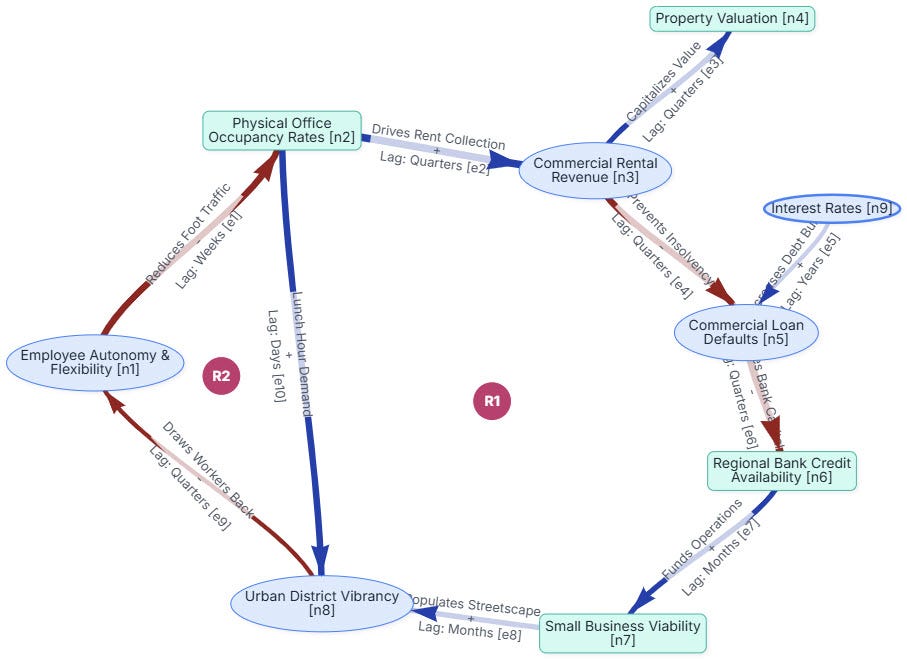
The Doom Loop
Recovery Structure